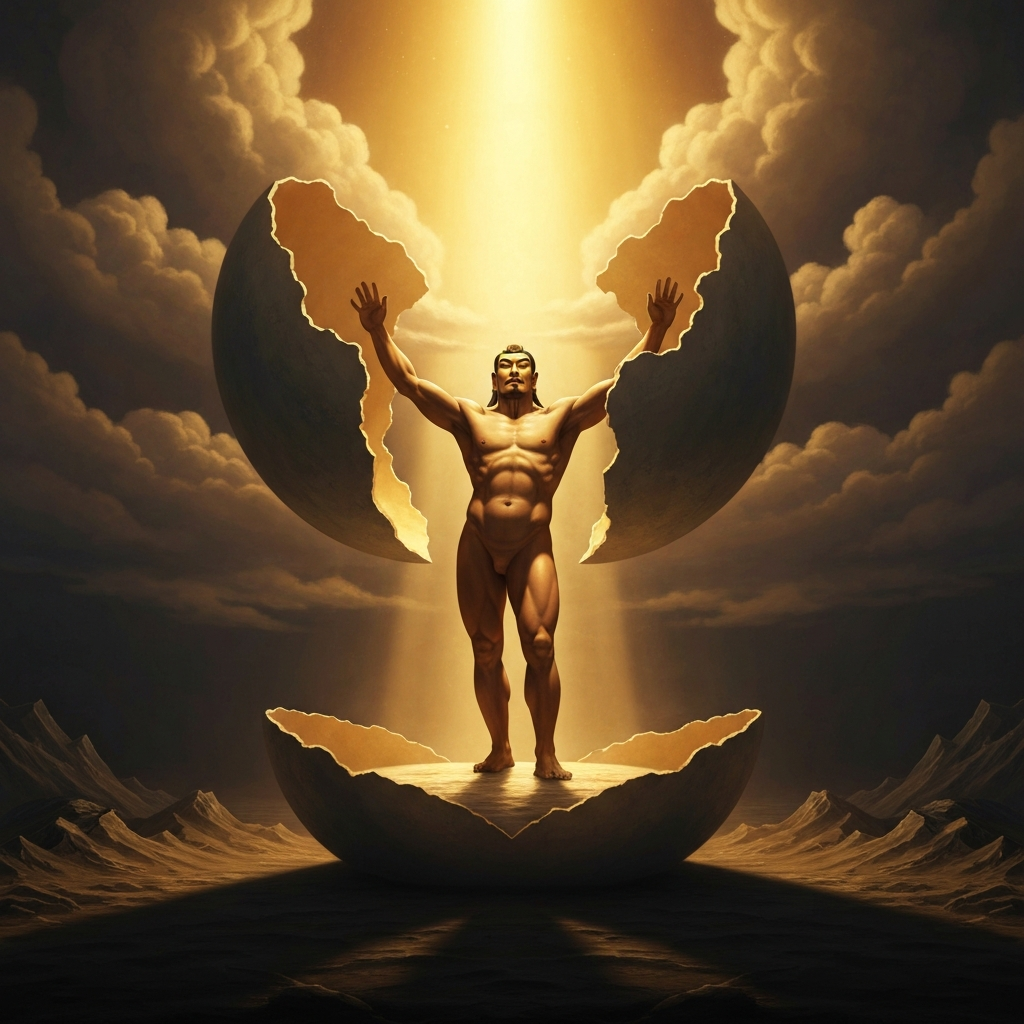
Erlang Shén and the Third Eye That Sees Truth
The mythological past — the battle against Sun Wukong's Heaven-disrupting rebellion · Heaven and the clouds above Flower Fruit Mountain
Contents
The divine warrior Erlang Shén, nephew of the Jade Emperor and slayer of six monsters, possesses a third eye in the center of his forehead that sees through every disguise — and it is he, not the celestial armies, who finally corners the Monkey King.
- When
- The mythological past — the battle against Sun Wukong's Heaven-disrupting rebellion
- Where
- Heaven and the clouds above Flower Fruit Mountain
He does not live in heaven.
This is the first thing to know about Erlang Shén: he is the Jade Emperor’s nephew, the son of a celestial sister and a mortal man, and he chooses not to live in the jade palace despite his blood right to a place there. He lives on Earth Mountain — Guankou, in Sichuan — with his sworn brothers and his hunting dog Xiao Tianquan, the dog who will become as famous as his master. He hunts. He exercises his authority in his chosen territory without reference to the celestial bureaucracy. He is the outsider who is more powerful than the insiders.
When the Jade Emperor needs him for the Sun Wukong problem, he does not command him. He asks him.
The celestial armies have failed. The Four Heavenly Kings, the 100,000 divine soldiers, the generals with their various specialties — Sun Wukong has fought through them all. He transforms to escape, transforming into the creatures of the seventy-two changes: a bird, a fish, a snake, a stone, a tree. The celestial generals cannot tell which creature on the battlefield is the Monkey King and which is an ordinary animal. The battle has been going on for three days and is not resolving.
Erlang Shén arrives with his six sworn brothers and his white divine hunting dog. He carries his three-pointed double-edged sword and he has, in the center of his forehead, the celestial eye — the third eye that sees through transformation, that reads essential nature rather than apparent form.
He opens the third eye.
The battle that follows between Erlang Shén and Sun Wukong is the one battle in Journey to the West that the Monkey King genuinely cannot win by transformation alone. Every disguise Sun Wukong takes — the fish, the water snake, the temple — Erlang Shén’s third eye reads. The monkey transforms into the form of Erlang Shén himself, trying to confuse the divine dog. The dog is not confused. It bites him.
The transformations become more desperate: a sparrow, a cormorant, a pelican. Erlang Shén becomes a hawk. Sun Wukong dives into the river and becomes a fish. Erlang Shén transforms into a fishing crane and waits at the water’s edge. Sun Wukong becomes a water snake and slithers into the grass. Erlang Shén becomes a grey crane.
This is the famous battle of transformations — two beings matched not in strength but in the capacity to see and be seen, to recognize and be recognized. What finally contains Sun Wukong is not force but the eye that cannot be deceived. The battle ends when Laozi helps from above and the Monkey King is captured.
But Erlang Shén’s role in the larger story is not simply as the instrument of Sun Wukong’s capture. He represents something in the cosmological structure that is neither the official heaven nor the rebellious earth: the independent power that operates by its own code, that can be enlisted but not commanded, that is effective precisely because it has kept itself outside the system.
The third eye that sees truth is not the eye of judgment — it does not condemn what it sees. It simply sees accurately. Erlang Shén looks at the Monkey King mid-transformation and sees the Monkey King. He looks at the temple that is actually Sun Wukong in disguise and sees the tail hidden behind the temple. He looks at the seventy-two faces and sees the one face beneath them all.
This is the power the celestial bureaucracy cannot generate within itself: clear sight. The bureaucracy sees titles, ranks, filed reports, official forms. Erlang Shén, living outside the bureaucracy in his hunting camp on Earth Mountain, has kept the simpler, sharper gift: to see through the form to what is actually there.
He returns to Earth Mountain after the battle. He is not given a promotion. He does not ask for one. The divine eye is already open and it has already seen what it needed to see, which is enough.
Echoes Across Traditions
Entities
- Erlang Shén (Yang Jian)
- the Jade Emperor
- Sun Wukong
- the Three-Pointed Double-Edged Sword
- the divine dog Xiao Tianquan
Sources
- Journey to the West (西遊記), Wu Cheng'en, c. 1592, chapters 6-7
- Investiture of the Gods (封神演義), Xu Zhonglin, c. 1620
- Anthony Yu, trans., *The Journey to the West* (University of Chicago, 1977)
- Meir Shahar, *Crazy Ji: Chinese Religion and Popular Literature* (Harvard, 1998)