Contents
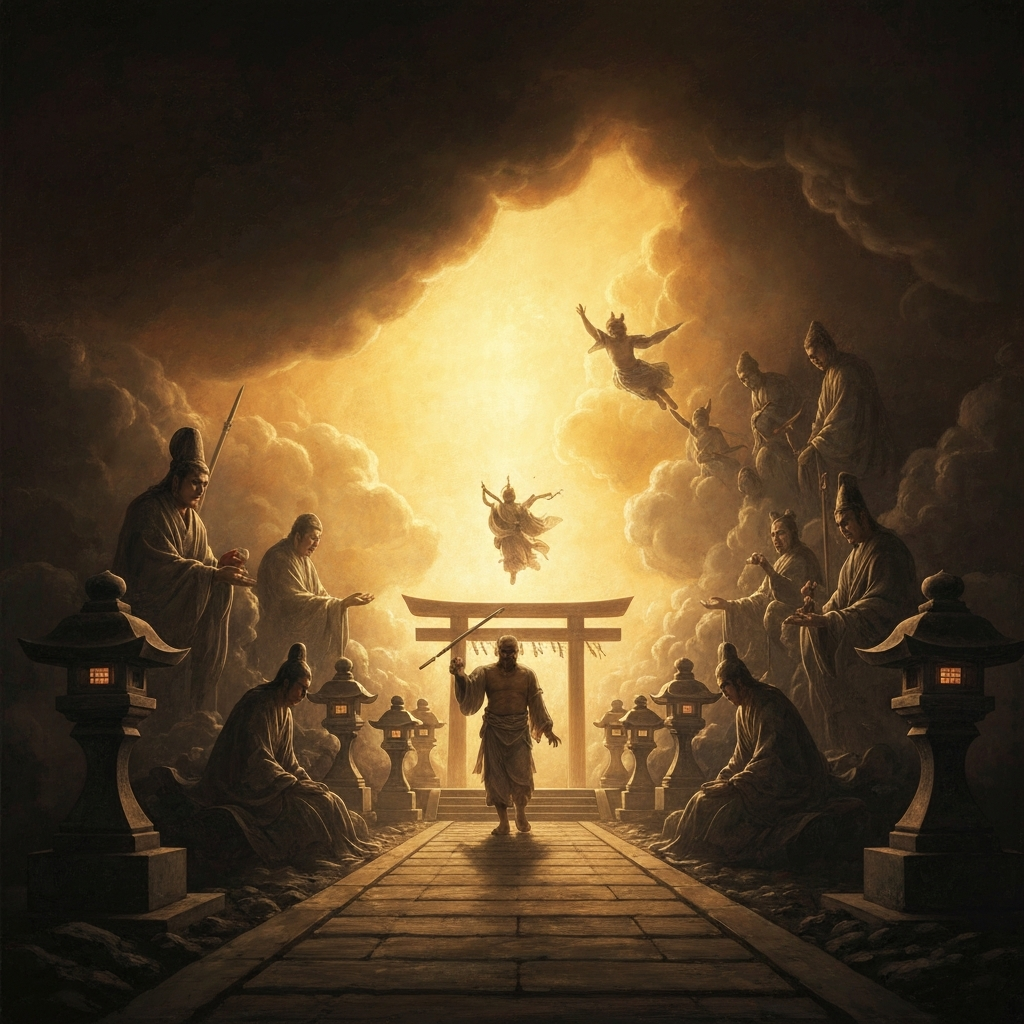
The most widely worshipped deity in Japan stands at the intersection of the sacred and the practical — Inari Ōkami ensures the rice harvest, the sake brewing, the metalwork and swordsmanship and foxfire, watched over by white fox messengers who move between the human world and the divine.
- When
- Nara period — first Inari shrine established 711 CE; tradition older
- Where
- Mount Inari in Fushimi, Kyoto — and the approximately 32,000 Inari shrines throughout Japan
The foxes are not the god.
This is the first clarification that any study of Inari requires. The white foxes — the kitsune — are the messengers, the attendants, the visible embodiments of Inari’s presence in the human world. They carry the divine energy of the rice deity out into the fields and the sake breweries and the sword-forges and the merchant counting-houses. They are the interface between the deity and the practical world.
The deity itself is more fundamental and harder to define.
Inari Ōkami is one of three names, sometimes the name of three kami simultaneously: Ukanomitama, who is food and especially rice; Ōmiyame, who is a divine woman associated with the first Inari shrine at Fushimi; and Tanaka Daimyōjin, the manifestation most associated with commercial and agricultural blessing. In Buddhist overlay — which arrived at Inari worship early and has been intertwined with it for over a thousand years — Inari is also associated with Dakiniten, a Tantric goddess of white foxes.
This multiplicity is not a contradiction. It is Inari’s nature: the deity that is present in everything the rice civilization needs to sustain itself.
The Fushimi Inari shrine on the south side of Kyoto is the most important of the approximately thirty-two thousand Inari shrines across Japan. You walk up the mountain through the famous tunnel of torii gates — thousands of them, donated by companies and individuals over centuries, the orange-red gates so densely spaced that the path becomes a corridor of sacred boundary — and the mountain itself becomes increasingly Inari’s body as you ascend. At the summit, the view over Kyoto looks out at the city that is fed by the rice Inari protects.
The white fox offerings at Inari shrines are distinctive: two ceramic foxes flank every major shrine entrance, each holding something in its mouth. One holds a key — to the rice granary, or to the store of divine wisdom. One holds a jewel. One holds a sheaf of rice. One holds a scroll. The variation is deliberate: Inari is the keeper of many things, and the fox holds whichever of them the particular shrine emphasizes.
Prayers to Inari are the most pragmatic in Shinto: they are explicitly for things. Rice harvest prayers. Sake quality prayers. Safe delivery for mothers. Business success. Swordsmanship. The smelting of iron. The protection of the company. The Inari shrine does not ask for spiritual elevation; it asks for material blessing, understood as the flow of divine abundance through the correct channels into the correct vessels.
This directness is not irreverence. It is the Shinto understanding that the sacred is not separate from the practical. The rice in the paddy is sacred because Inari attends to it. The sake in the barrel is sacred because the fox messenger has been by. The sword is sacred because the heat of the forge is also Inari’s heat.
The foxes move through the dusk at the edges of fields.
The gates stand in their thousands on the mountain.
The rice grows.
Echoes Across Traditions
Entities
- Inari Ōkami
- the white fox (kitsune) messengers
- Ukanomitama no Kami
- Fushimi Inari
Sources
- Smyers, Karen, *The Fox and the Jewel: Shared and Private Meanings in Contemporary Japanese Inari Worship* (University of Hawaii Press, 1999)
- Fushimi Inari Taisha shrine records and histories
- Breen, John and Mark Teeuwen, *A New History of Shinto* (Wiley-Blackwell, 2010)
- Blacker, Carmen, *The Catalpa Bow* (Allen & Unwin, 1975)