Contents
A prince cheated of his throne is sent on an impossible quest: sail to the end of the world, plow a field with fire-breathing bulls, sow a dragon's teeth, defeat the army that grows from them, and steal the golden fleece from a sleepless serpent. He cannot do any of it. A foreign princess can. She does.
- When
- c. 1300 BCE (mythic time)
- Where
- Iolcus in Thessaly, the open sea, the kingdom of Colchis at the eastern edge of the Black Sea
A boy is hidden in the mountains.
His uncle Pelias has stolen the throne of Iolcus from his father. The boy — Jason — is sent for safety to the cave of Chiron, the centaur who teaches heroes. He grows up there. He learns medicine, music, archery, the names of plants. He does not learn to plow. He does not learn to be cautious.
When he is twenty he comes down from the mountain. He fords a river on the way and loses a sandal in the mud. He arrives in Iolcus wearing one shoe.
Pelias, on his throne, looks up and sees a young man with one bare foot. An oracle has told him to beware a man with one sandal. The king’s blood goes cold. But he is a politician, and he smiles, and he embraces his nephew, and he asks what brings him home.
Jason says he has come for his throne.
Pelias, smiling still, agrees in principle. But — he says — there is a small matter of religious obligation. The ghost of a kinsman, Phrixus, lies unburied at the eastern edge of the world. Phrixus once flew to Colchis on the back of a flying ram with golden fleece; the ram was sacrificed there, and the fleece hung in a sacred grove, guarded by a serpent that does not sleep. Bring the fleece home, says Pelias, and the throne is yours.
The errand is designed to be fatal. Jason accepts.
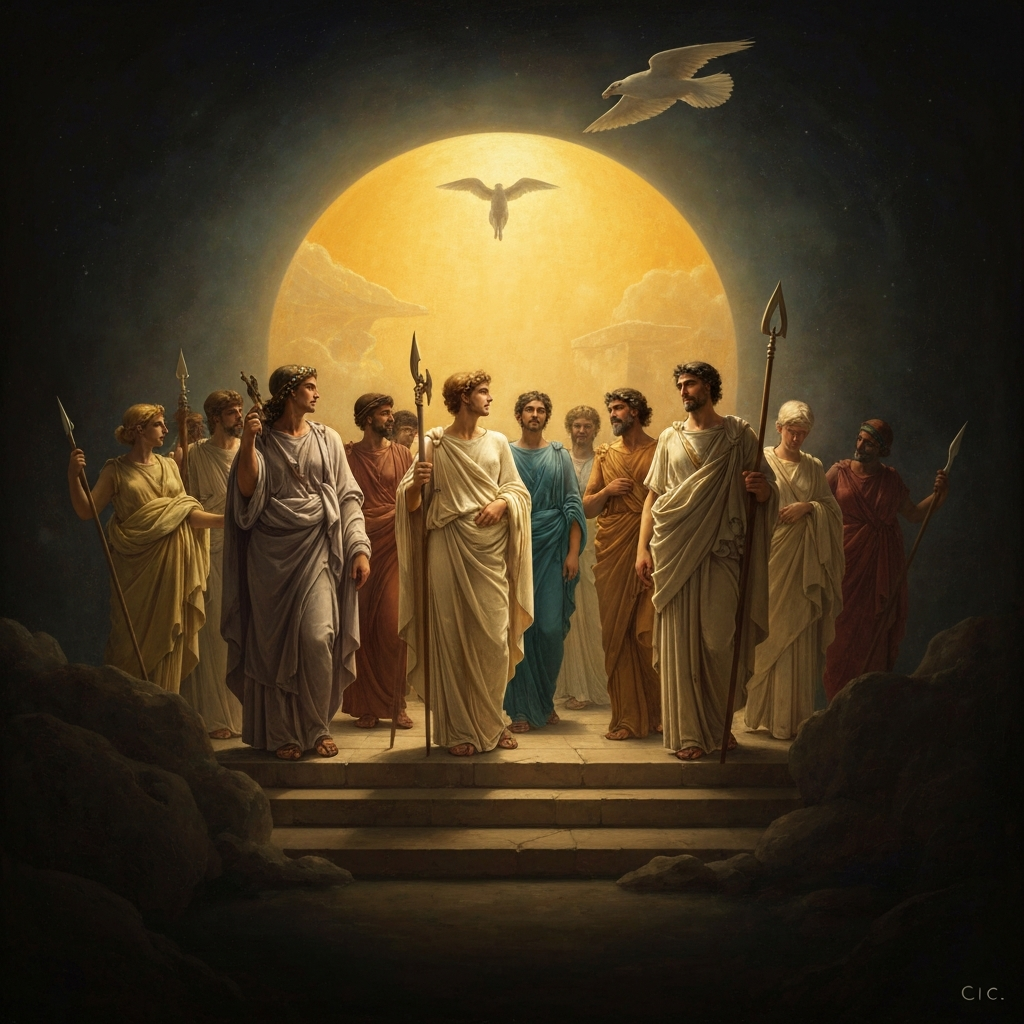
He commissions a ship. The shipwright Argus, with Athena’s help, builds the Argo — fifty oars, a prow speaking with a beam from Dodona’s oak. Jason sends heralds across Greece for crew. The greatest heroes of the age come: Heracles, Orpheus the singer whose voice can charm waves, Castor and Pollux, the keen-eyed Lynceus, the sharp-eared Periclymenus, the winged sons of the North Wind, Atalanta the runner, Peleus father of the unborn Achilles. Fifty heroes board. The Argo is launched.
The voyage is long. They lose Heracles in Mysia when his beloved Hylas is dragged underwater by nymphs and the hero, mad with grief, tears apart the forest searching. They survive the harpies tormenting the blind seer Phineus, in exchange for which Phineus tells them how to pass the Clashing Rocks — release a dove first, row hard behind it, the rocks will smash and rebound and let you through. The dove loses its tail-feathers. The Argo loses its sternpost. They are through.
They arrive at Colchis.
King Aeëtes receives them coldly. He has been warned by his own oracle. He cannot openly refuse a guest, so he agrees to give Jason the fleece — on conditions. Jason must yoke the king’s two bronze-hoofed, fire-breathing bulls. He must plow with them a four-acre field. He must sow the field with the teeth of a dragon. He must defeat, alone, the army of warriors that springs up from the teeth.
It is a death sentence delivered as a courtesy.
Jason returns to the Argo. He has no plan. He has no skill that can answer this. He sits in the prow and stares at the water.
In the palace above, Medea is watching him.
She is the king’s daughter. She is a priestess of Hecate, schooled in herbs and in the magic of the dark moon. She is not yet twenty. Hera and Aphrodite — for reasons of their own, intricate and divine — have made her fall in love with Jason at first sight, and the love that has been fitted to her chest is the kind that overrides every other duty.
She comes to him in secret. She brings a salve made from a flower that grew where Prometheus’s blood fell. Smear this on your body and your weapons, she tells him, and for one day fire cannot harm you and no blade can cut you. When the dragon’s-teeth warriors rise from the field, do not fight them — throw a stone among them, and they will turn on each other, and you can finish the survivors. Afterwards I will bring you to the grove where the fleece hangs, and I will put the serpent to sleep.
In return, take me with you. Take me back to Greece. Marry me.
Jason agrees. He does not hesitate.
The next morning he yokes the bulls. The flame jets from their nostrils and rolls over him and does not burn. He plows the four acres. He sows the teeth. The earth heaves; armed men rise from the furrows. He throws a stone among them. They turn on each other. He finishes the survivors with his sword. The crowd watching in the king’s stand falls silent. Aeëtes knows he has been betrayed by someone in his own house.
That night Medea takes Jason to the grove. The fleece hangs from an oak, and beneath the oak the serpent — vast, scaled, eyes that never close — uncoils. Medea steps forward. She sings. She scatters herbs. The eyes that do not close, close. The huge head sinks. Jason climbs the oak and lifts the fleece, heavy as wet wool, blazing in the dark like a captive sun.
They run for the Argo. The crew is already at the oars.
Aeëtes is in pursuit by morning. He has many ships. He is faster. Medea, on the deck of the Argo, takes from her satchel her younger brother — Apsyrtus, whom she has brought with her, whom she now kills — and she dismembers him and throws the pieces into the sea, one by one. Aeëtes, behind them, must stop to gather the pieces of his son for burial. The Argo escapes.
This is the moment the audience must hold. This is the gift Medea has given Jason. He has the fleece. He has the princess. He has, in the bow of the ship behind him, the floating pieces of a child she murdered for him. He has incurred a debt that no throne, no marriage, no sacrifice will ever balance.
He sails home to Iolcus. He gives the fleece to Pelias. Pelias does not give him the throne. (Medea will arrange Pelias’s death too, by trickery, persuading his daughters to dismember and boil him.)
Jason and Medea go to Corinth. They have two sons. They live for ten years. Then Jason, restless, ambitious, tired of the foreign witch with the dangerous reputation, decides to marry the king of Corinth’s daughter and discard Medea as politically inconvenient.
What happens next is its own story. But the audience knew, watching the Argo sail home triumphant, that it was already happening. Jason had taken everything Medea had, including the things she should never have given. The bill, in Greek tragedy, always comes.
Scenes
On the beach at Iolcus, the Argo is being launched
Jason, naked to the waist, yokes the bronze-hoofed bulls of King Aeëtes
The fleece blazes on its oak in the sacred grove
Echoes Across Traditions
Entities
- Jason
- Medea
- Pelias
- King Aeëtes
- The Argonauts
- Hera
- Aphrodite
Sources
- Apollonius of Rhodes, Argonautica
- Pindar, Pythian 4
- Apollodorus, Library 1.9.16-28
- Hesiod, Theogony 992-1002