Contents
The goddess who birthed the islands of Japan dies giving birth to fire, and descends into Yomi — the dark underworld — where she becomes something no one who loved her will recognize.
- When
- Age of the Gods — before historical time, Kojiki cosmogony
- Where
- The land of Yomi (Root Country) — the underworld beneath the Japanese islands
The last child Izanami bears is fire.
His name is Kagutsuchi — the Shining Thing of Fire — and as he is born he burns his mother. The Kojiki is matter-of-fact about this: the birth of fire kills the goddess of creation. Her genitals are burned as the fire deity passes through them. She vomits and defecates and urinates in her agony, and from each of those emissions other deities are born — metal gods, water gods, earth gods — because in the Shinto universe even the dying of a goddess is creative. But then she dies.
She dies and descends into Yomi.
Yomi is not hell in the Abrahamic sense. It has no punishments, no moral order, no judgment. It is simply the dark place, the country beneath the earth where the dead go and from which they do not return. The Kojiki calls it Ne-no-Kuni — Root Country — which suggests something like the place below the soil, the underground where roots go, where things are held down and held in. Izanami goes there.
Izanagi, above, mourns.
The texts describe what he does with her body before the descent, or what happens to her body as she descends, and the details are not easy to look at. More deities are born from her body’s decomposition: from her head, from her chest, from her stomach, from her left hand, from her right hand, from her left foot, from her right foot. The productive universe does not stop producing even in death. But these births are catalogued by the Kojiki in the tone of inventory — not celebration, not mourning, just the record-keeping of a world in which nothing is wasted.
What Izanagi cannot catalogue is the grief.
He is, by this point in the Kojiki, the father of all the Japanese islands, the co-creator of all the gods of fire and metal and water and earth, the deity who helped stir the formless ocean into land with a jeweled spear. He is powerful and ancient and full of divine knowledge. And he cannot accept that his wife is in the dark.
He follows her.
The path to Yomi is not described precisely in the Kojiki. It is somewhere beneath the earth, approached through a pass or a cave or a place where the soil is thin. Izanagi goes down. He calls to Izanami from the entrance. He tells her: The lands we made are not yet finished. Come back. We have more work to do.
She answers from inside.
She says: I have already eaten the food of Yomi. This is the rule — the same rule that governs Persephone and pomegranate seeds, Inanna and the garments she shed at each gate. Once you eat the food of the dead country, you are the dead country. You cannot be called back by love or need or the fact that the world above is still unfinished. She has eaten. She belongs here now.
But she tells him to wait. She says she will ask the gods of Yomi if she may be released. She says: Do not look at me. Wait outside and do not look.
He waits. He does not know what he is waiting for, what she is becoming in the darkness, what the food of Yomi does to a goddess over time. He does not know that she is already something he will not recognize.
He waits too long. In the dark, a man who loves a woman will always wait too long.
Then he does what the gods of every tradition warn the living not to do.
He looks.
What he sees is Izanami, yes — but Izanami as she has become in Yomi. Her body is rotting. The maggots of death are moving through her form. She is everywhere in the process of return, returning to the soil she came from, returning to the dark brine that preceded all creation. She is the end of the thing she helped begin.
He runs.
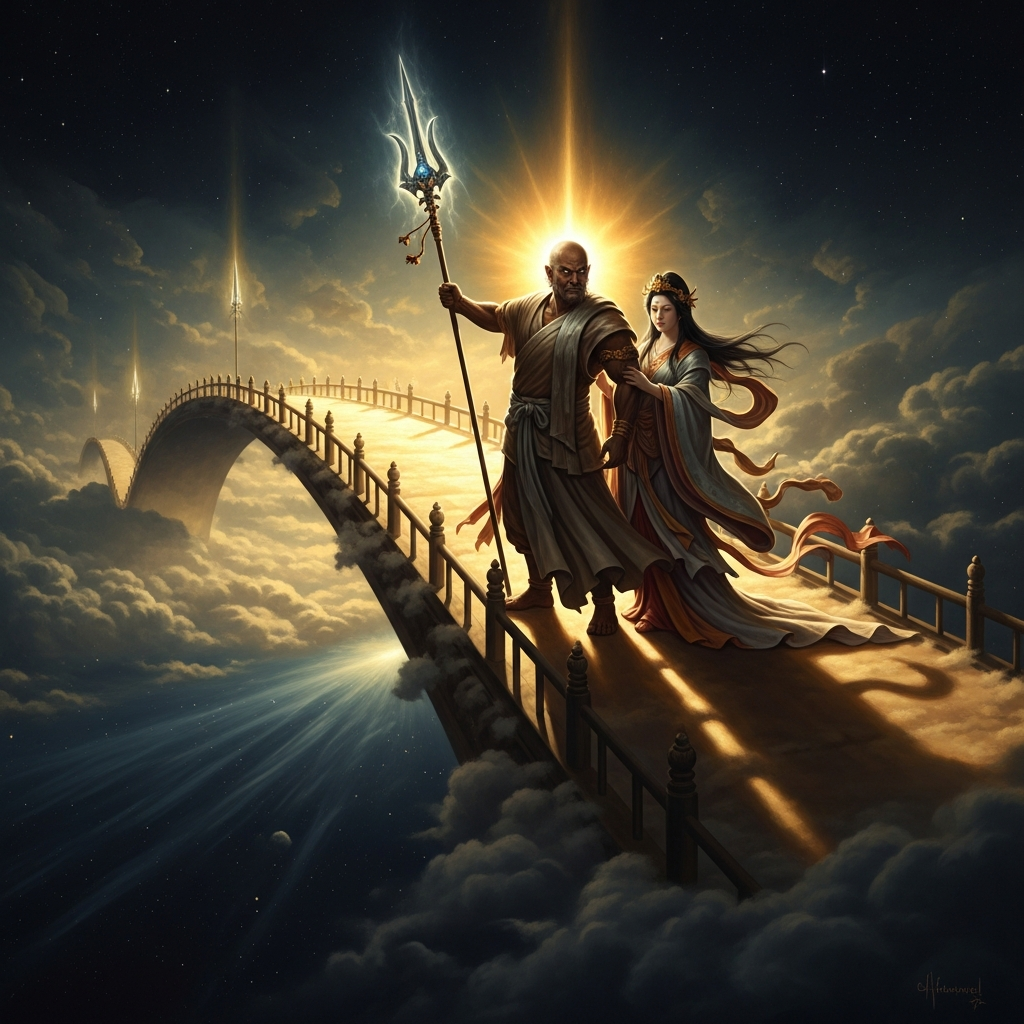
She sends the hags of Yomi after him, then the armies of Yomi, then finally herself — and what pursues him through the dark passage is no longer the goddess who stood beside him on the Floating Bridge with a jeweled spear in their hands, looking down at the unfinished ocean.
The world above will never fully recover from what he saw.
Echoes Across Traditions
Entities
- Izanami
- Izanagi
- Kagutsuchi
- the maggots of Yomi
Sources
- Kojiki (Record of Ancient Matters), compiled 712 CE, Book I, Section 5-9
- Nihon Shoki (Chronicles of Japan), compiled 720 CE, Age of the Gods scrolls
- Nelly Naumann, *Die einheimische Religion Japans* (Brill, 1988)
- Motoori Norinaga, *Kojikiden* (Commentary on the Kojiki), 1798