Contents
Izanagi emerges from Yomi polluted by death and wades into a river to purify himself — and from the washing of his face are born the three most important deities in all of Shinto.
- When
- Age of the Gods — before historical time, Kojiki cosmogony
- Where
- The river Tachibana in Ahaji (Awaji) — a purification stream at the boundary of worlds
He comes out of Yomi carrying death on his skin.
The Kojiki uses the word kegare — pollution, defilement — and in the Shinto universe this is not a metaphor. The contamination of death is real and physical. It clings to the person who has been in contact with it the way smoke clings to cloth, the way the cold of deep water lingers in the body long after you have surfaced. Izanagi has walked through a country of maggots and rotting divine flesh. He has been pursued by the armies of the dead. He has touched the darkness.
He needs to wash.
He goes to the river at Ahaji — the Tachibana river, some texts say, or a different stream in a place called the sea of Tachibana — and he undresses at the water’s edge and begins to remove the objects on his body. Each object he removes becomes a deity. His staff becomes a god. His sash becomes a god. His robe becomes a god. His trousers, his shoes, his belt — all deities, born from the disrobing of a god who needs to get clean. The Kojiki is attentive to this surplus of creation; nothing Izanagi touches or removes fails to become something.
But the most important births come from the water itself.
He wades in. He begins to wash.
The Kojiki describes which parts of his body he washes and in what order, and each washing produces more deities — gods of the deep water and gods of the shallow water, gods of the river mouth and gods of the current. There is something almost liturgical about the accumulation: the body of a god being cleaned, and each portion of the cleaning producing a new divine being, as if purification is itself a creative act. As if you cannot wash away pollution without turning it into something.
Then he washes his left eye.
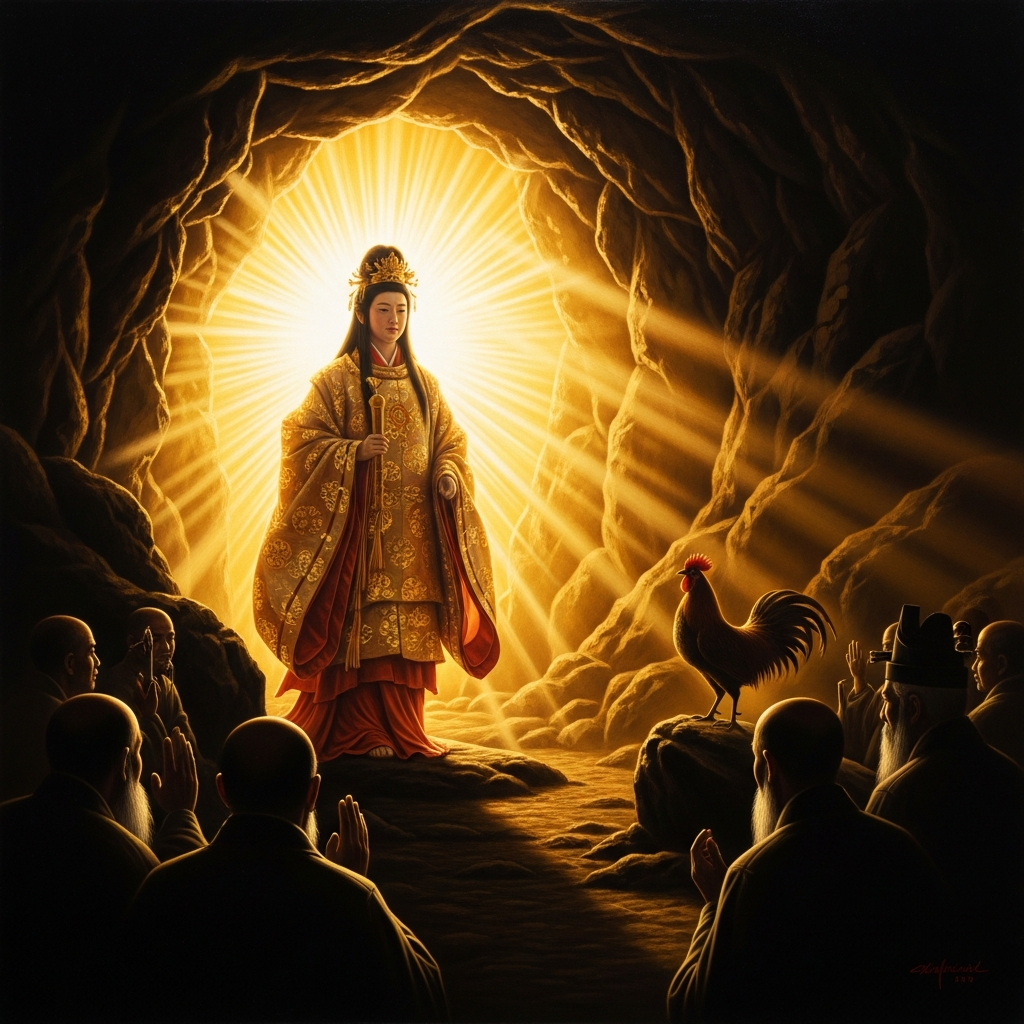
Amaterasu is born.
She is the Great Divinity Illuminating Heaven — Amaterasu-Ōmikami — and the moment she emerges the Kojiki changes its register. Up to this point the text has been moving at the pace of inventory, listing deities with their names and epithets. Now it slows. Now the narrative lingers. Izanagi looks at what has been born from the washing of his left eye and feels something the Kojiki calls ura-gasashi — joy, wonder, a satisfaction so deep it transforms into praise. He says: I have been begetting child after child, and now at the last I have gotten three illustrious children.
He washes his right eye.
Tsukuyomi is born — the Moon-Reader, the Counter of Months, the deity who governs the passage of time by tracking the moon’s face. Less is written about Tsukuyomi in the Kojiki than about the other two; the moon-god will cause a scandal soon that removes him permanently from Amaterasu’s presence, which is why the sun and moon do not travel together across the sky.
He washes his nose.
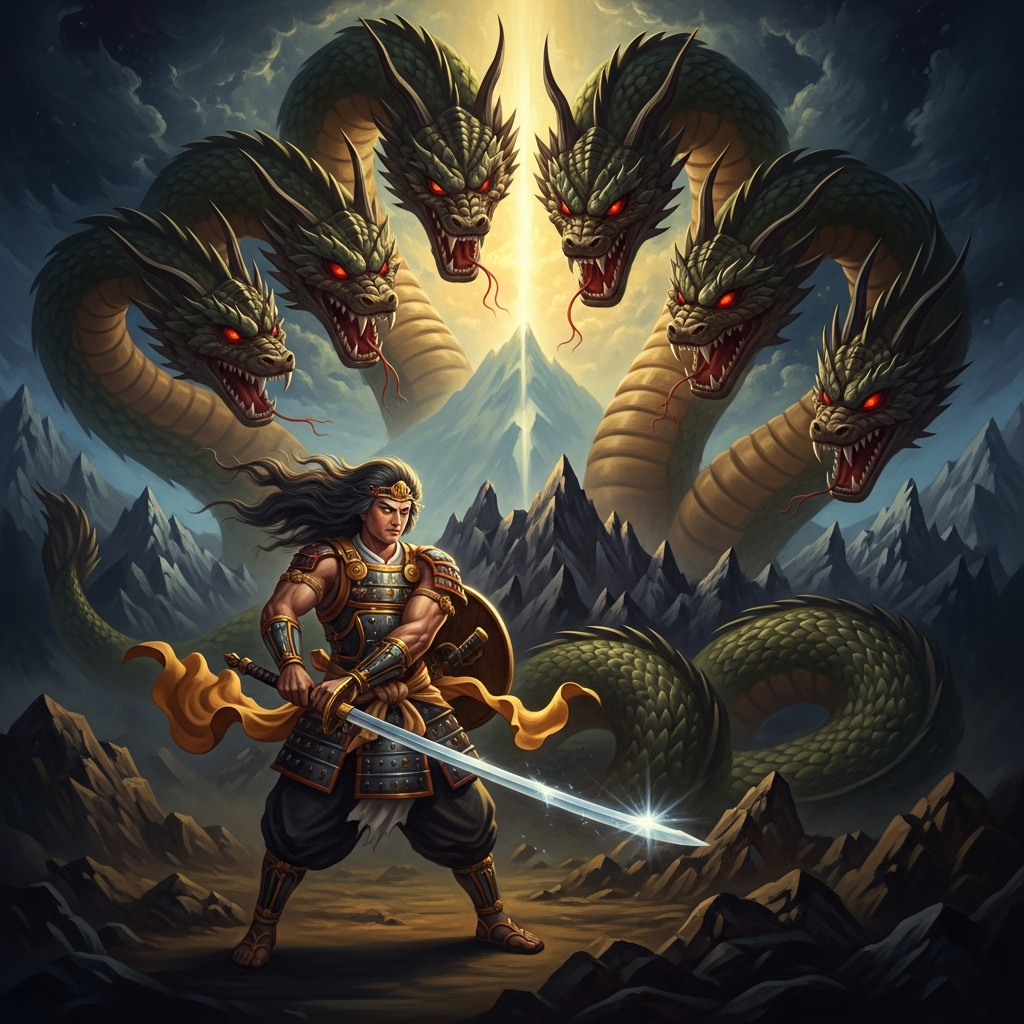
Susanoo is born — the Impetuous Male, the Storm Lord, the weeping god who will be expelled from heaven and who will kill a dragon and who will write the first poem.
Three children from three washings. Heaven, Moon, Storm — the sky, the count of time, the weather. The three most powerful realms of the visible world born from a father cleaning the death of the underworld off his face.
Izanagi is delighted in a way the Kojiki almost never describes other divine actions. He takes off his necklace — the divine necklace he wears, heavy with curved jewels — and he gives it to Amaterasu. He says: Rule the Plain of High Heaven. He tells Tsukuyomi: Rule the realms of night. He tells Susanoo: Rule the ocean. And with those three commands the cosmos is organized. The world that Izanagi and Izanami stirred into being from the formless ocean is now governed — light above, time measured, sea bounded.
The purification rite he performs here at the river will be practiced in Japan in every generation after his. It will be called misogi — the purification by water — and it will be performed by priests and pilgrims and the devout on cold mornings at rivers and ocean shores, standing in moving water, washing away what has accumulated, watching the current carry the pollution downstream, into the sea, into dissolution.
The theological implication is precise: pollution is not permanent. The dead country’s contamination can be removed. The way to make something sacred is not to protect it forever from all contact with death, but to return repeatedly to the running water, to wash again, to allow the birth of something new from the act of cleaning.
Three deities born from washing.
The cosmos organized by a father’s joy at his own face in the river.
Echoes Across Traditions
Entities


Sources
- Kojiki (Record of Ancient Matters), compiled 712 CE, Book I, Section 10
- Nihon Shoki (Chronicles of Japan), compiled 720 CE
- Sokyo Ono, *Shinto: The Kami Way* (Tuttle, 1962)
- Stuart Picken, *Shinto: Japan's Spiritual Roots* (Kodansha, 1980)