Contents
The Sassanid prince Khusrow falls in love with Shīrīn of Armenia through a portrait, pursues her across deserts and kingdoms, loses her through his own weakness, and finds her again only after his pride has been ground down by years of longing and loss.
- When
- Late 6th–early 7th century CE — the reign of Khusrow II Parviz (591–628 CE)
- Where
- The Sassanid capital Ctesiphon, Armenia, and the court of the Sassanid empire
The portrait arrives before she does.
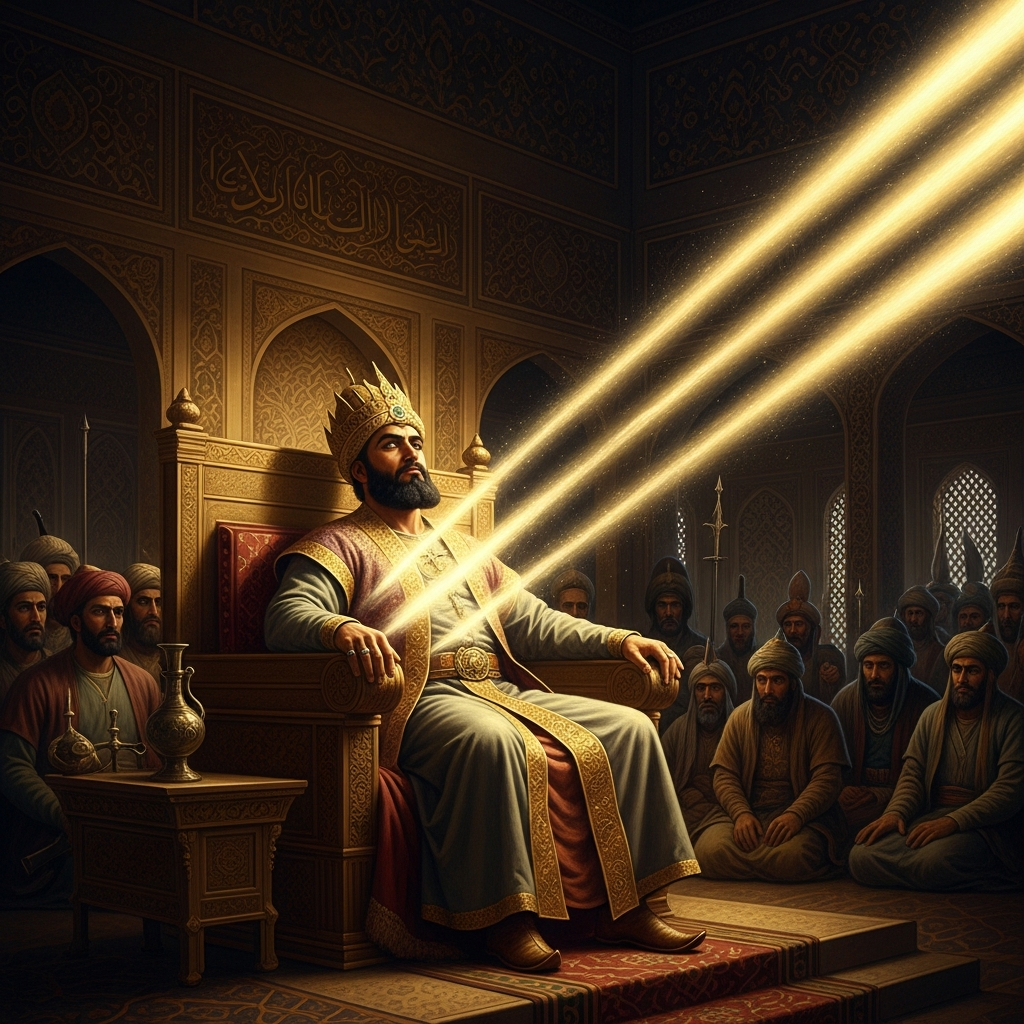
Khusrow’s friend Shāpur — painter, diplomat, man of considerable social intelligence — has traveled to Armenia and spent time at the court of the Armenian queen Shīrīn, who is young and beautiful and entirely uninterested in any suitor her court has produced. He has painted her portrait and brought it back to the Sassanid capital. When Khusrow sees it, the coup of the image is immediate: he is in love with a woman he has never met, from a portrait.
Shāpur returns to Armenia and begins his campaign of indirect preparation.
He places copies of Khusrow’s portrait in the places where Shīrīn rides — on the trees along her favorite paths, on the rocks near the springs where she waters her horse. He lets the portraits accumulate until Shīrīn, encountering them repeatedly, becomes curious. Then he tells her about the Sassanid prince. She, who has refused every suitor, becomes curious enough to act.
She takes her famous horse Shabdiz — the horse that will become as iconic in Persian literature as Rakhsh is in the Shahnameh — and rides south toward the Sassanid lands.
Khusrow, riding north to find her, passes her on the road.
They see each other. Neither knows who the other is. Khusrow sees a beautiful woman on a magnificent black horse and calls out a flirtatious remark — a prince’s remark, confident of his own attraction and accustomed to having it met with eagerness. Shīrīn sees an attractive young man with a presumptuous manner and rides on without answering.
He does not know that was her. She does not know that was him.
Years of complication follow.
Khusrow’s political situation — the throne he must fight for, the Byzantine princess Maryam he must marry for diplomatic reasons, the rebellions he must suppress — keeps interrupting his pursuit of Shīrīn. Each time he is close to reaching her, something pulls him back to Ctesiphon, to the throne, to the obligations of kingship. She, in the meantime, has gone to live in the mountains of the Caucasus, where she had a palace built and where she tends her horses and maintains a court of her own.
There is Farhad.
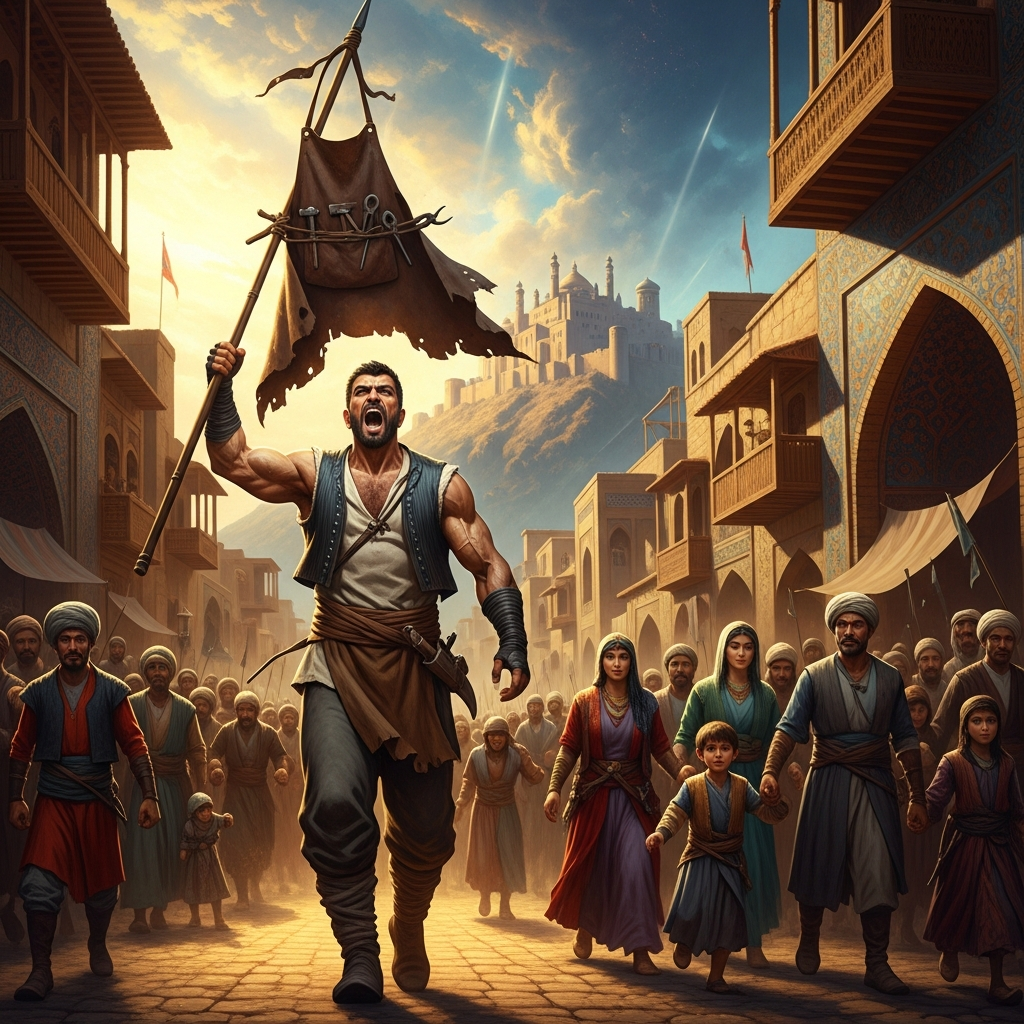
Farhad is the stone-cutter who loves Shīrīn with the purity that Khusrow cannot manage — a love with nothing in it of self-interest, no throne, no political calculation, no competing marriages. He comes to the mountain where she lives and carves things for her: channels in the stone through which he brings milk from the lowlands to her palace, because she mentioned, once, that she liked milk. He carves an entire infrastructure of devotion.
Khusrow, hearing of Farhad, arranges a challenge: Carve a road through Mount Bisotun and Shīrīn is yours. Farhad begins to carve. He carves for months, making visible progress on the impossible task. Khusrow, genuinely alarmed, arranges for a messenger to reach Farhad on the mountain with the news that Shīrīn has died.
Farhad drops his tools.
He throws himself from the mountain or strikes himself with his tools, depending on which version — the end is the same. He dies at the moment he believes she is gone, because a love that is not interested in any other object has no motivation to continue once the object is believed destroyed.
Shīrīn, learning what was done to Farhad, grieves for him with a grief she does not grieve for any political setback Khusrow has caused her.
The love story continues between Khusrow and Shīrīn — they find each other, lose each other, find each other again. Eventually they marry, but the marriage is not the end of the story. The end comes when Khusrow is murdered by his own son, and Shīrīn chooses to be buried with him rather than become the son’s trophy, entering his tomb and dying there with the dignity that the love story always implied was its true register.
Nizami presents the whole arc as the story of love becoming spiritual discipline: Khusrow, at the beginning, loves with the confidence of a man who has never been refused. By the end, he has been refused and returned to and lost and found again so many times that the love has become something different from the feeling he started with.
Something more like what Farhad had from the beginning.
He arrived at it too late, which is the story’s point.
Farhad carved it into the mountain while it was still there to use.
Echoes Across Traditions
Entities
- Khusrow II (Khusrow Parviz)
- Shīrīn
- Shāpur (the painter-friend)
- Farhad
- Maryam
Sources
- Nizami Ganjavi, *Khusrow and Shīrīn*, translated by W. Heinz (Wiesbaden, 1983)
- Ehsan Yarshater, 'Khosrow II,' *Encyclopædia Iranica* (2010)
- Annemarie Schimmel, *A Two-Colored Brocade: The Imagery of Persian Poetry* (UNC, 1992)
- Jerome Clinton, 'Nizami's Iskandarnameh,' *Studies in Medieval Iranian Culture* (1977)