Blodeuwedd: The Woman Made of Flowers
circa 500-700 CE — the mythic age of the Mabinogion, the Fourth Branch · Gwynedd, Wales — the court at Caer Dathyl and the hills of Ardudwy
Contents
When Arianrhod curses her son never to have a human wife, the magician Gwydion and Math conjure a woman from the flowers of oak, broom, and meadowsweet — and the woman they make, being neither human nor goddess, must find her own path to freedom.
- When
- circa 500-700 CE — the mythic age of the Mabinogion, the Fourth Branch
- Where
- Gwynedd, Wales — the court at Caer Dathyl and the hills of Ardudwy
They gather the flowers in the morning when the dew is still on them.
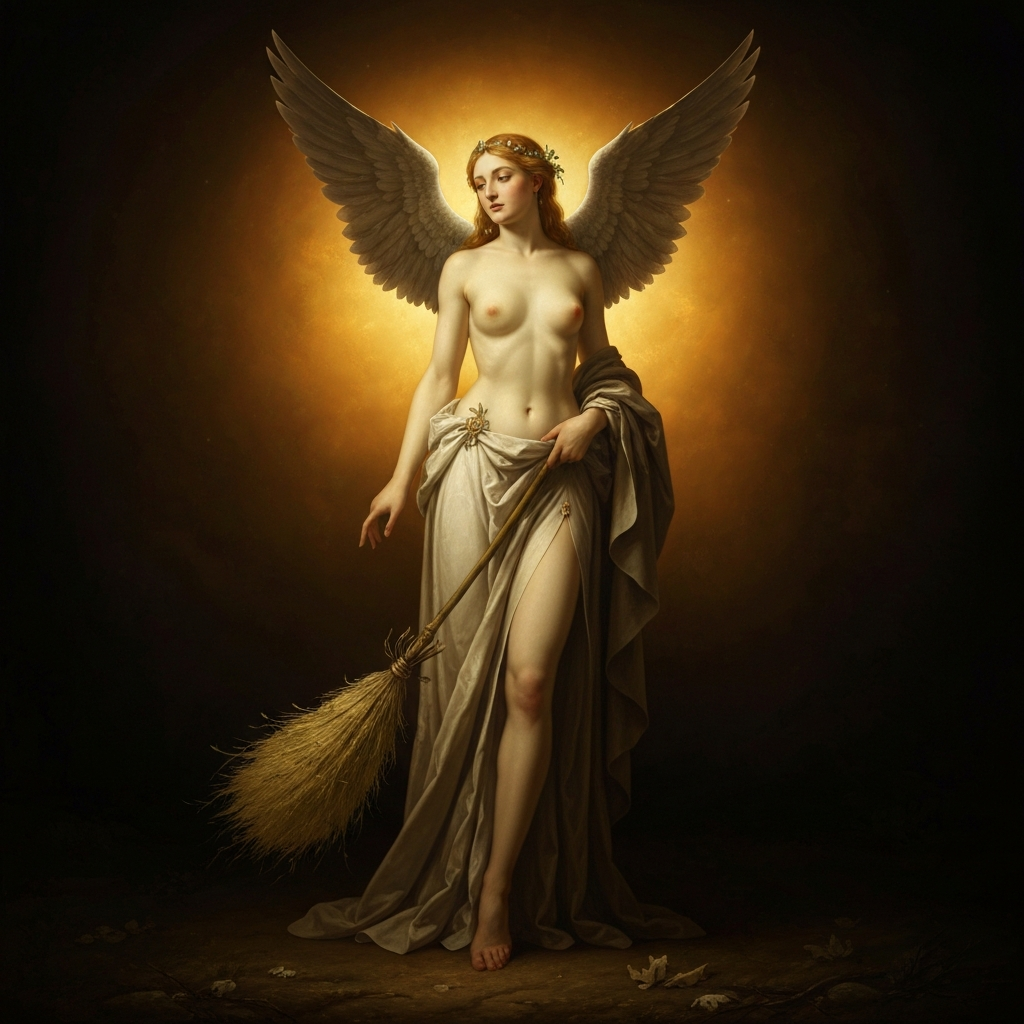
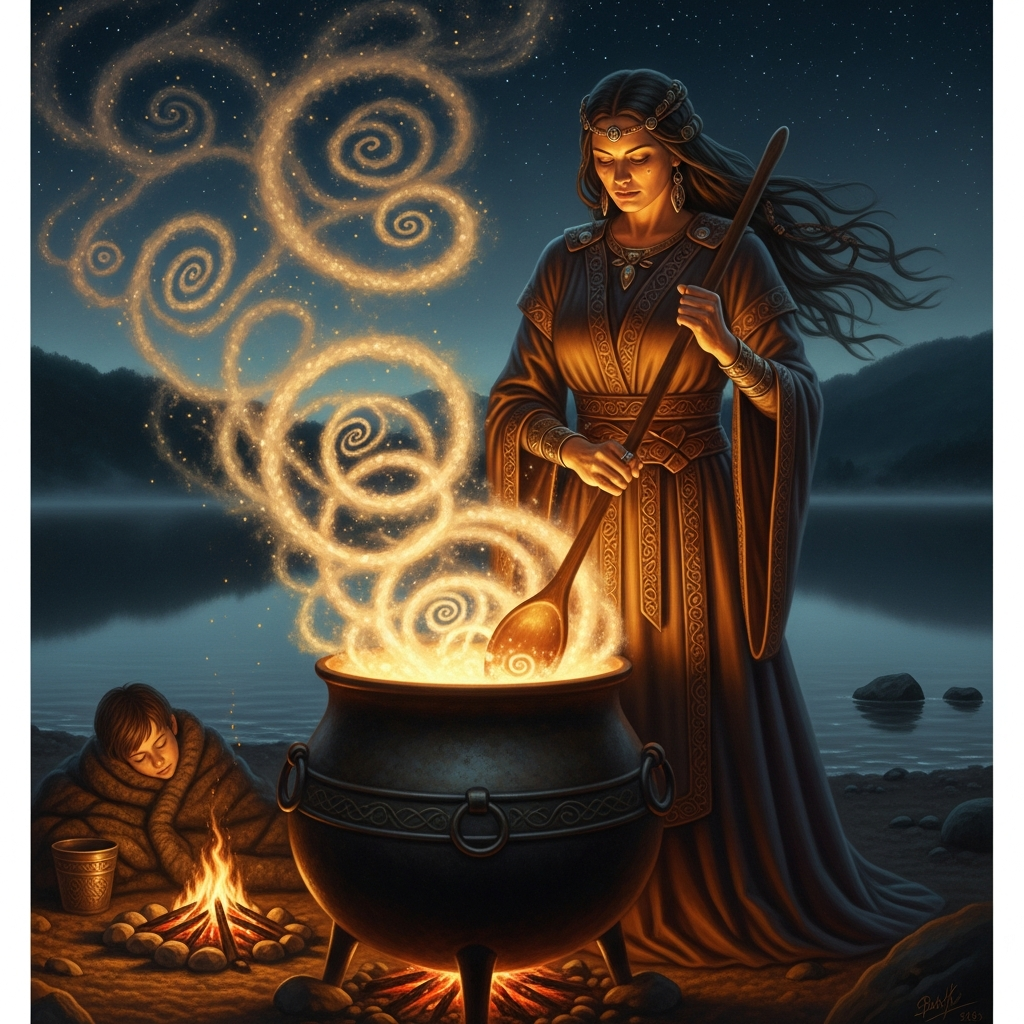
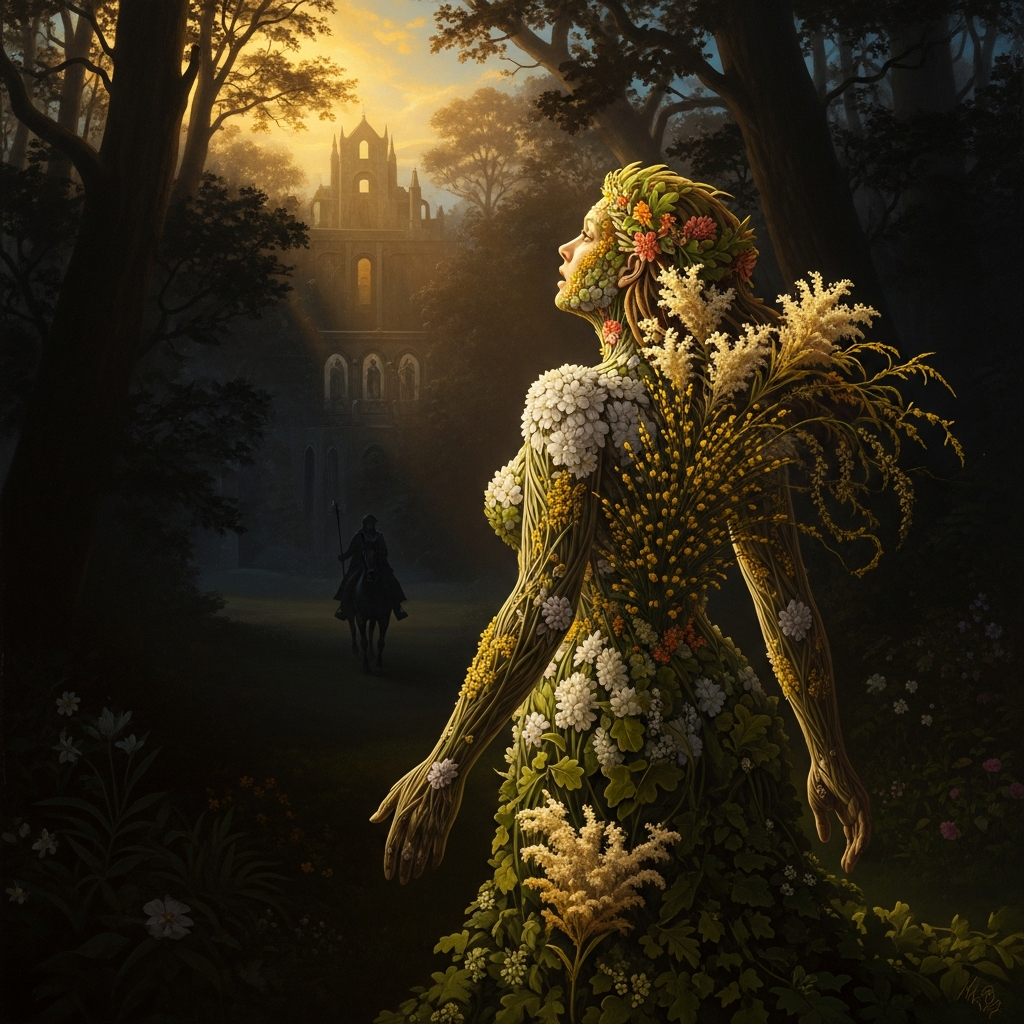
Math Son of Mathonwy and Gwydion stand in the meadow with the blooms of oak and broom and meadowsweet and they work the magic that has no name in the tradition because it has never been done before: the conjuring of a woman from the materials of the growing world. The oak gives structure, the broom gives warmth, the meadowsweet gives sweetness, and the three together, worked by the two best magicians in Wales, become a woman standing in the morning meadow with dew still on her shoulders.
Her name is Blodeuwedd — Flower-face.
She is given to Lleu Llaw Gyffes, Math’s nephew, because Lleu’s mother Arianrhod has cursed him: he will never have a wife of the human race. Math and Gwydion have found the loophole in the curse with the same approach they find all loopholes — by deciding what the curse prohibits and then creating exactly what it doesn’t. A woman made of flowers is not human. The curse does not apply.
Lleu and Blodeuwedd are given a court and a territory and a household, and Blodeuwedd manages all of it with the competence of someone who was made for this specific role. She is a fine lady of the court. She is everything Lleu needs.
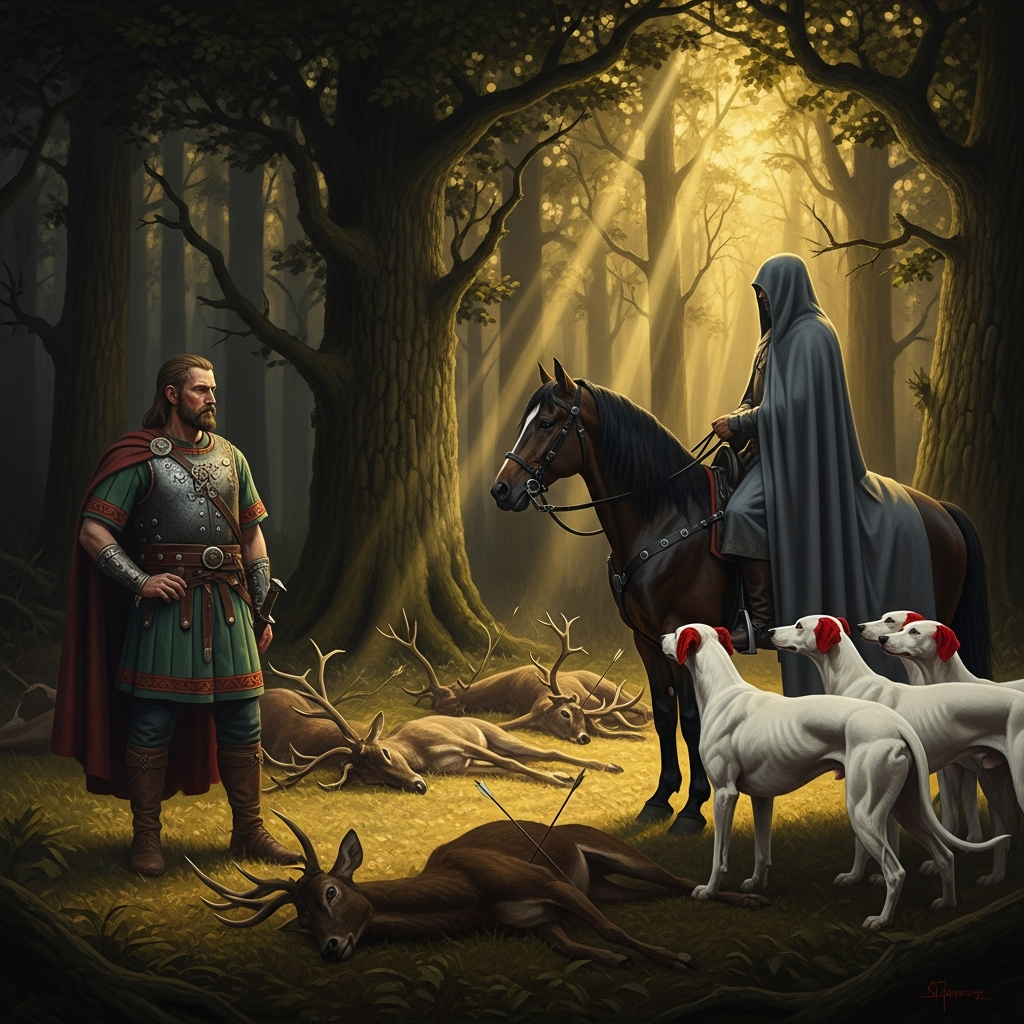
Then a stranger arrives. Gronw Pebr, lord of Penllyn, stops at their court overnight, and Blodeuwedd looks at him across the hall the way people look at someone when they realize there is a whole register of possibility they haven’t encountered before.
She and Gronw are lovers before he leaves. This happens in the sources with the speed of facts rather than the elaboration of sentiment — they meet, they recognize something in each other, they act on it.
And then Blodeuwedd, being a woman who acts on what she feels, takes the logic further. She loves Gronw. She does not love Lleu. She was made to be Lleu’s wife. These facts do not resolve easily.
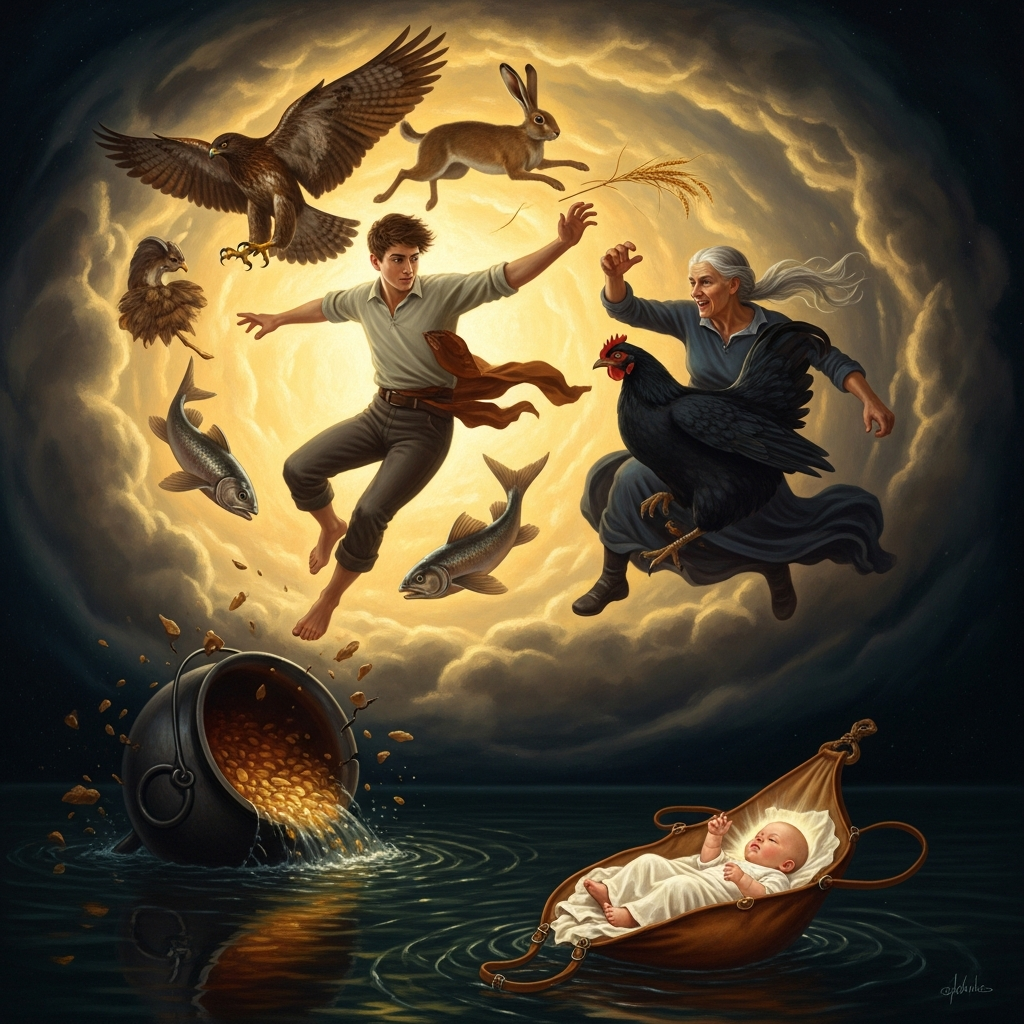
She works with Gronw to find Lleu’s weakness — a specific vulnerability that requires elaborate conditions: he can only be killed at dusk, neither inside nor outside, neither on horseback nor on foot, by a spear made over a year’s Sundays, while he is standing with one foot on a cauldron and one foot on a goat’s back on the rim of the cauldron. She extracts these conditions from Lleu through careful manipulation, pretending fear for his safety.
They create the conditions. Gronw throws the spear.
Lleu does not die — he transforms into an eagle and flies to the top of an oak tree. Gwydion finds him there, coaxes him down with a poem, restores him to human form.
Gronw is killed. Lleu lives. The court is recovered.
Blodeuwedd is caught.
Gwydion comes for her and he does not kill her. He turns her into an owl — the creature that cannot look at daylight, that lives in the dark, that is hated by all other birds. Her name in owl-form is Blodeuwedd, still, because the name means flower-face but also, in the owl shape, becomes something else: the beautiful thing that was made by men and was remade by the consequence of wanting what she wanted.
She lives in the dark and is hated by the birds who live in the light. She was made from flowers. She became an owl. No man made the owl — that was all hers.
Echoes Across Traditions
Entities
- Blodeuwedd
- Lleu Llaw Gyffes
- Gwydion
- Math
- Arianrhod
- Gronw Pebr
Sources
- Jeffrey Gantz, trans., *The Mabinogion* (Penguin, 1976)
- Sioned Davies, trans., *The Mabinogion* (Oxford World's Classics, 2007)
- John Bollard, 'The Role of Myth and Tradition in the Fourth Branch of the Mabinogi,' *Cambridge Medieval Celtic Studies* 6 (1983)