The Maize God Rising from the Turtle's Back
Classic Maya period, c. 300-900 CE — primary iconographic period · Throughout the Classic Maya world; depicted on ceramics, murals, and stone sculpture
Contents
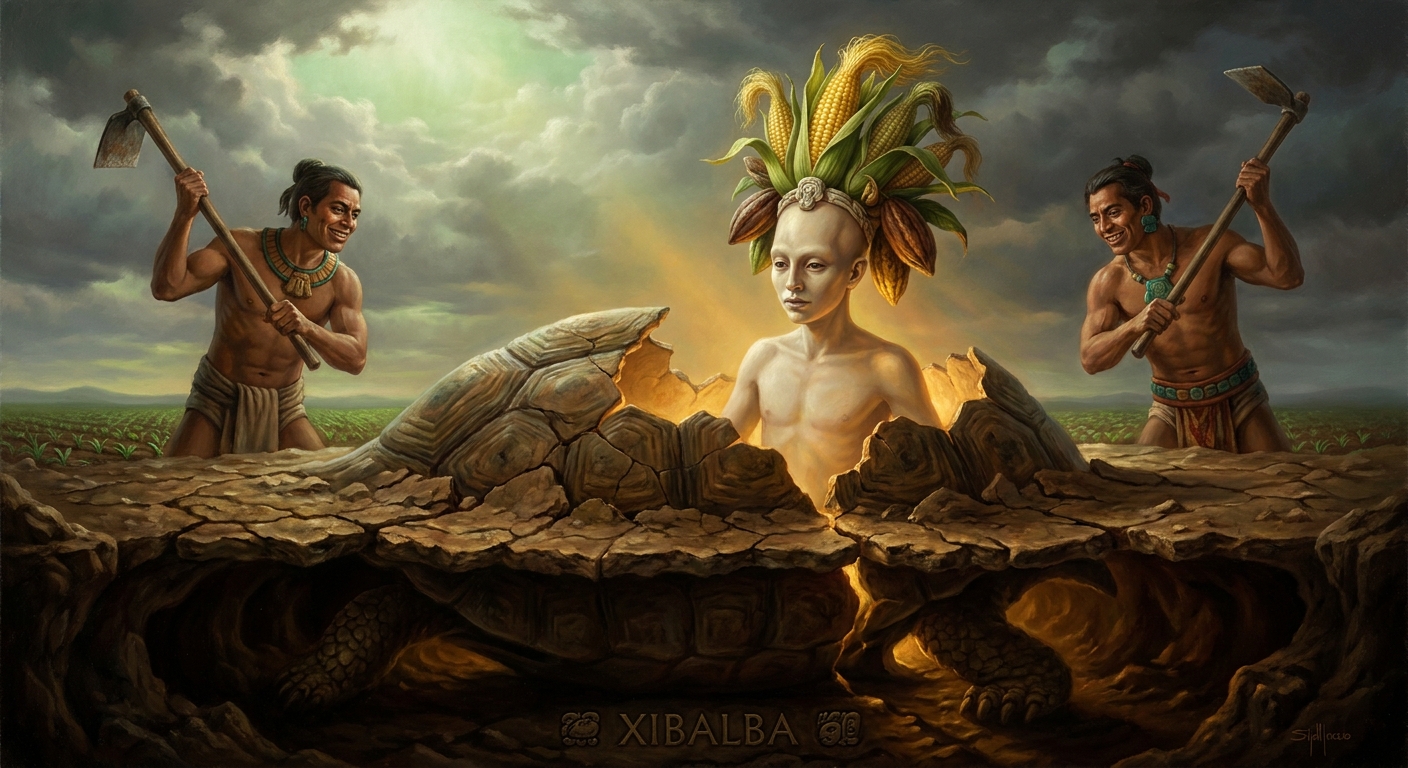
In Classic Maya art, the resurrection of the Maize God is depicted as his emergence through a crack in the back of a great turtle — the turtle representing the earth's surface, the maize plant breaking through the soil after planting.
- When
- Classic Maya period, c. 300-900 CE — primary iconographic period
- Where
- Throughout the Classic Maya world; depicted on ceramics, murals, and stone sculpture
The earth is a turtle.
Not metaphorically, not poetically — in the Maya understanding of the physical world, the surface of the earth on which human beings live is the back of a great turtle floating in the primordial water that underlies everything. The turtle’s back is the ground. The cracks in the turtle’s shell are the fields and the roads and the boundaries between things. The turtle floats in the same water that fills the cenotes, the same water that flows through the underground rivers of the Yucatán, the water that is both the underworld and the source of the rain.
In the Classic Maya night sky, the turtle was Orion.
The three stars that form Orion’s belt — the three hearthstones of the cosmic hearth — were the shell markings on the cosmic turtle’s back. The Orion nebula, below the belt, was the crack in the turtle’s shell. The Pleiades, rising above Orion before planting season, were the signal.
When the Pleiades appeared at the right point in the night sky, it was time to plant.
And when the seed was planted in the crack in the turtle’s back — in the hole made with the digging stick in the earth’s surface, the puncture through the soil into the darkness below — what happened next was what the Maya depicted on hundreds of ceramic vessels, on stone panels, on the walls of painted rooms: the Maize God rising.
The scene is one of the most frequently painted in Classic Maya art.
The Maize God — tall, young, with the elongated and slightly tilted skull that signifies both beauty and corn’s tassel, his body spotted with the markings of the turtle shell — emerges through the crack in the turtle’s back. He rises from below. His arms may be raised, his body in the posture of someone pushing upward through a narrow opening. Sometimes the Hero Twins are there, flanking him, helping him up through the crack in the way a midwife helps a child through the birth canal.
He is being born. He is being reborn. The distinction is not relevant.
He went down as a kernel.
He comes up as a plant.
The cracking turtle shell is the cracking of the earth above the germinating seed — the sound, if you listen closely in a field in the first days after planting, of the soil separating as the first shoot pushes upward. This sound is the Maize God clearing his throat. This slow green eruption is the resurrection.
The turtle as earth appears in Maya cosmology in multiple contexts beyond the Maize God scene.
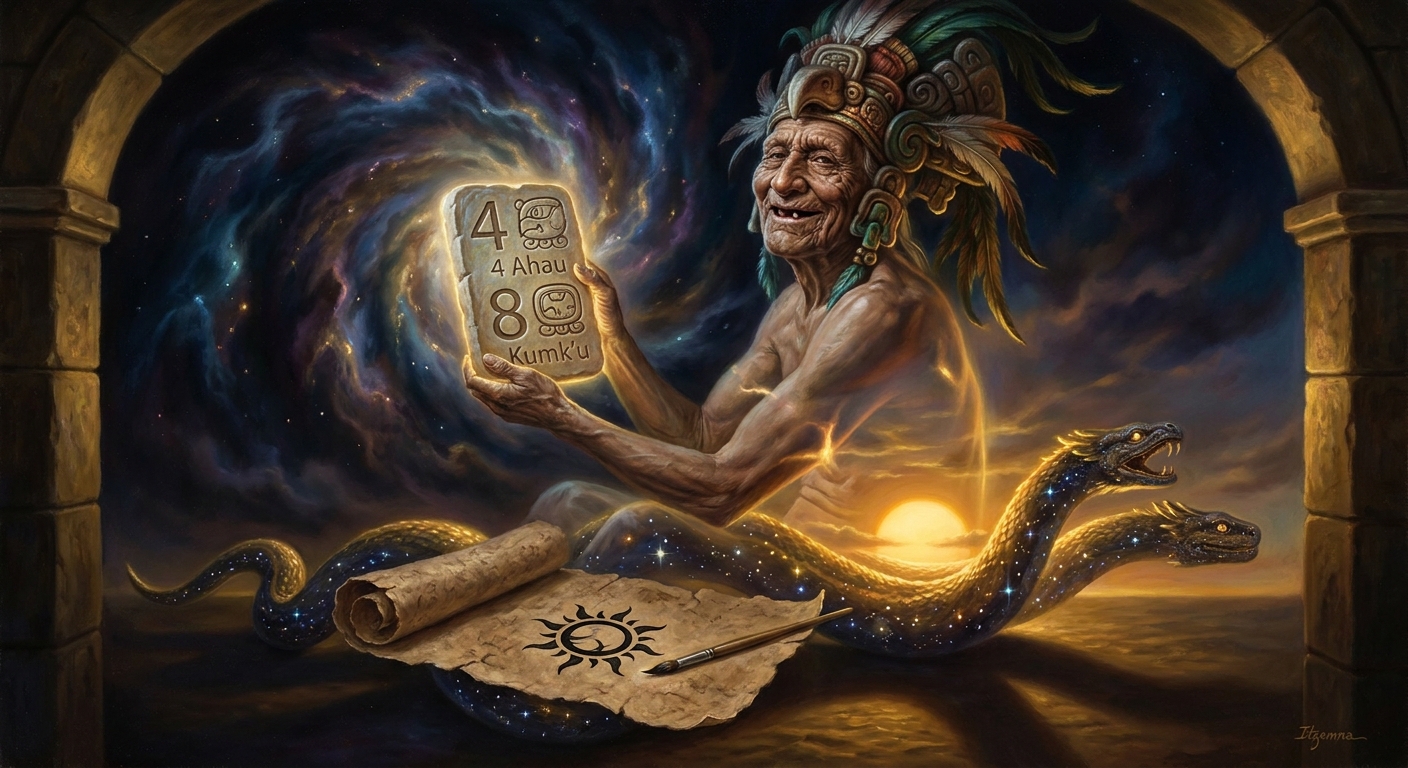
The Long Count date at the beginning of the current creation — August 11, 3114 BCE — is described in some inscriptions as the moment when the three hearthstones of creation were set, with Orion’s belt marking that cosmic hearth. The cosmic turtle floats in the creation water. The three stars are the cooking stones that every Maya household placed around its fire. The universe began with the lighting of a cooking fire on a turtle’s back.
The domestic is the cosmic. The cooking fire is the creation. The crack in the turtle shell where the corn emerges is the opening in every milpa through which next year’s food is arriving.
In the lowland forests of the Petén, where the Classic Maya civilization reached its greatest elaboration, the mornings in planting season have a particular quality: the forest holds the moisture from the previous night’s rain, the air is thick with it, the light is filtered green through the canopy, and in the cleared fields at the forest edge the soil is freshly turned and the first green things are just beginning to push up from the dark.
The Maize God is there, in every field.
Rising through the turtle.
Rising into the light that his sons carry across the sky each day, the same light that was him all along, returning to the place he was planted in, returning as more than he went in with, which is what corn does, what the Maize God does, what the Maya dead were expected to do in the model their cosmology provided.
The turtle holds.
The corn rises.
Echoes Across Traditions
Entities
- Hun Hunahpú
- the Maize God
- the Hero Twins
- the turtle of the earth

Sources
- Karl Taube, *The Major Gods of Ancient Yucatan* (Dumbarton Oaks, 1992)
- Linda Schele and David Freidel, *A Forest of Kings* (William Morrow, 1990)
- David Freidel, Linda Schele, and Joy Parker, *Maya Cosmos* (William Morrow, 1993)