The First Scribe Learns to Trap Time in Glyphs
c. 300 BCE — earliest proto-Maya writing; c. 250 CE — full Maya script in use · The lowland Maya region; Naj Tunich cave, Guatemala; San Bartolo, Guatemala — early writing sites
Contents
The invention of Maya writing — the only fully developed writing system in pre-Columbian America — was simultaneously a political act, a theological act, and an act of war: the ability to record a ruler's name and deeds in permanent, unambiguous form was the most powerful technology of Classic Maya civilization.
- When
- c. 300 BCE — earliest proto-Maya writing; c. 250 CE — full Maya script in use
- Where
- The lowland Maya region; Naj Tunich cave, Guatemala; San Bartolo, Guatemala — early writing sites
The first scribe learned to trap speech.
This is what writing does that no other technology does: it holds the spoken word in a form that outlasts the voice. A spoken sentence dissolves the moment it is finished. A carved sentence lasts as long as the stone lasts. The Maya invented a writing system that could record any sentence in their language — any sentence, in any order, in any tense — and they carved those sentences on stone monuments that have been standing for two thousand years.
The system is called a logosyllabary: a combination of logographs (signs that represent words) and syllabic signs (signs that represent CV syllables, a consonant-vowel pair). The combination allows the writer to express anything that can be said aloud — because any word can be spelled phonetically with syllabic signs if no logograph exists for it. The system is not limited by vocabulary. It grows with the language.
The decipherment of Maya writing is one of the great intellectual adventures of the twentieth century.
By the late nineteenth century, Bishop Landa’s alphabet — a sixteenth-century attempt to transcribe Maya speech sounds into Spanish letters — had been recovered in manuscript, but for decades scholars misread it as a phonetic alphabet when it was actually a syllabary that Landa had misunderstood. The breakthrough came from a Soviet linguist named Yuri Knorosov, who in 1952 demonstrated that the signs were syllabic, and from the work of subsequent American and British scholars who built on Knorosov’s insight.
By the 1990s, most Classic Maya inscriptions could be read.
What they said surprised everyone.
The inscriptions are political documents. The majority of Classic Maya writing on stone monuments records specific historical events: the dates of kings’ births, accessions, deaths; the dates and results of wars; the names of the captured enemies who were sacrificed; the dates of bloodletting ceremonies; the names of the children who would succeed.
This is not the mythology scholars expected.
The inscriptions are not the Popol Vuh. They are the newspaper — the record of what happened, to whom, on which date in the Long Count calendar, in which city-state. Maya writing exists primarily to record the king’s deeds in permanent, unambiguous form: I was born on this date, I took the throne on this date, I captured this enemy on this date, I performed bloodletting on this date. The stone is the witness that does not forget.
The theological claim embedded in this political function is immense.
To record an event in the Long Count calendar is to situate it within cosmic time — to claim that this event, on this date, has cosmic significance, that the universe noticed it, that it will be relevant when the calendar cycles come around again. The king who records his accession in the Long Count is claiming that the universe began counting toward this moment and will count from it.
The scribes who wrote were among the most powerful people in Maya society.
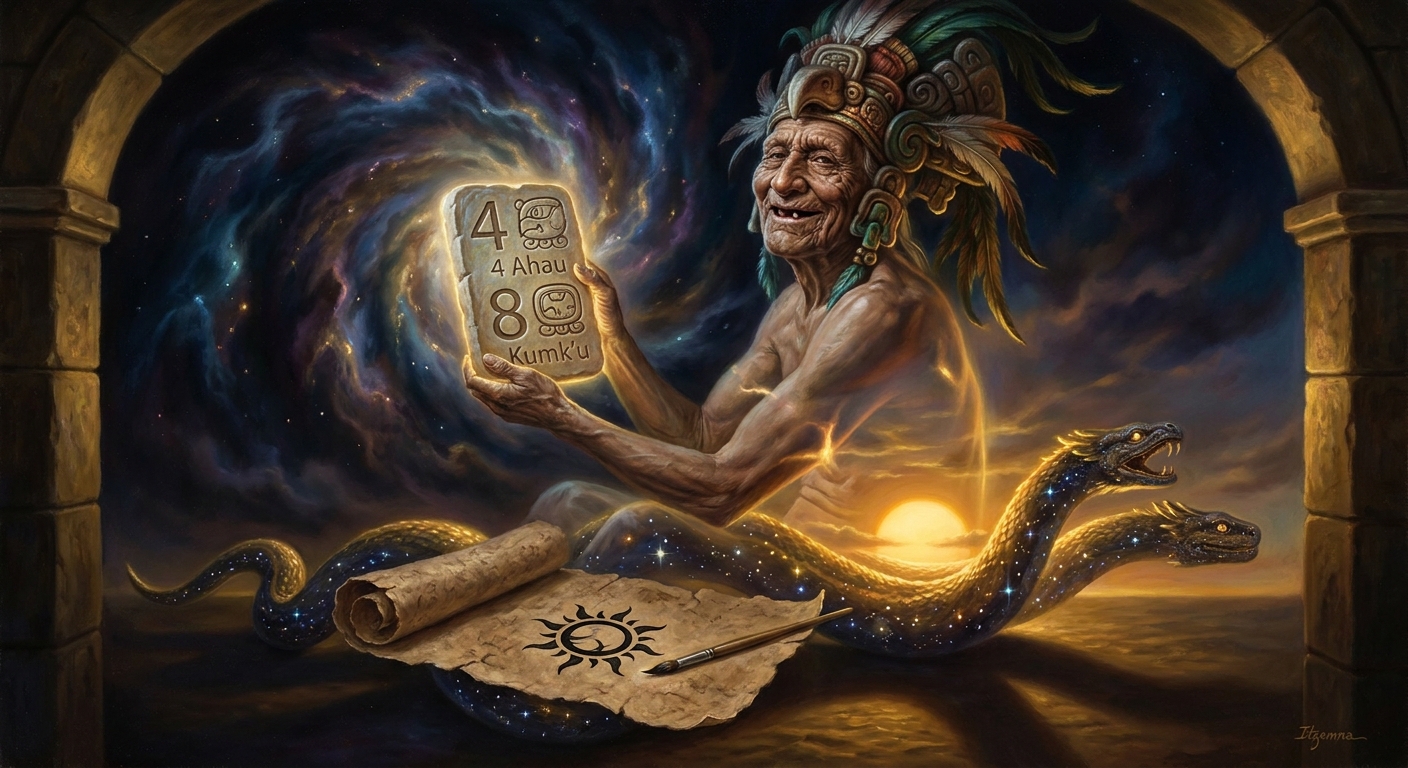
The ah ts’ib — the writers, the painter-scribes — were trained from childhood in the craft, in the households of noble families. Writing was not a craft that everyone could learn; it was a restricted technology, a form of power held by the literate few and exercised on behalf of the ruling class. The scribes painted the codices — the bark-paper books — and incised the stone monuments and painted the ceramic vessels and decorated the buildings.
In the Popol Vuh, Hunbatz and Hunchouén — the elder half-brothers of the Hero Twins — are musicians and scribes, identified with the monkey, with artistic skill. The Hero Twins transform them into monkeys as a punishment for their pride. The scribes end up as the howler monkeys in the canopy, chattering in the trees.
This is the Popol Vuh’s commentary on scribal culture: the scribes who have the power of writing and use it for pride rather than service end up with the form of writing — the gesture, the articulation — but not the content. They chatter. They do not communicate.
The glyphs that remain on the stone do.
They have been communicating for two thousand years, waiting for someone to learn the language again — which Knorosov did, which the epigraphers did — so that the speech the stone trapped can finally be spoken aloud again, in the light, by living voices.
Echoes Across Traditions
Entities
- Itzamna
- the first scribes
- the monkey scribes of the Popol Vuh
- the ah ts'ib

Sources
- Michael D. Coe, *Breaking the Maya Code* (Thames & Hudson, 1992)
- David Stuart, *Fifteen Glyphs* (Dumbarton Oaks, 2005)
- Houston, Robertson, and Stuart, *The Language of Classic Maya Inscriptions* (Current Anthropology, 2000)