Contents
A king is granted his deepest wish: that everything he touches turn to gold. The wish works. He turns his garden, his food, his wine, and finally his daughter into yellow metal.
- When
- c. 700 BCE (mythic time)
- Where
- Phrygia in central Asia Minor, the king's palace and rose garden, the river Pactolus
A drunk old man wandered into the king’s rose garden one morning.
He was bald, fat, garlanded with ivy, and he had been carried part of the way by satyrs who had given up and put him down. He was Silenus, the foster-father and constant companion of the wine-god Dionysus, and he was lost — separated, the night before, from the god’s wandering retinue.
The peasants who found him snoring in the rose-bushes did not know who he was. They tied him with garlands of flowers — they were Phrygian, they did not bind a guest with rope — and brought him to the king of Phrygia, Midas.
Midas knew.
Midas had seen Dionysus’s processions before. He recognized Silenus. He immediately untied the garlands, called for wine, called for couches, called for music. He treated the old satyr like a returning prince. For ten days he kept Silenus in the palace, feeding him and listening to him talk — Silenus talked, when drunk, about the geography of the world beyond the seas, about lost continents, about ages of the world before the gods — and at the end of the tenth day Midas himself escorted Silenus back into the wandering company of Dionysus.
Dionysus was so pleased to have his foster-father returned that he offered Midas any gift the king could name.
Midas had been thinking about the answer for ten days. He had practiced.
He said: Grant that whatever I touch turn to gold.
Dionysus winced. He looked at the king for a long moment. He saw, behind the request, what every god sees behind such requests: an entire story. He sighed. He said, quietly: Granted.
The god went on his way. Midas walked back into his palace, alone, with the new gift in his hands — not yet quite believing.
He tested it.
He plucked an oak twig from a low branch as he passed. The twig, between his fingers, stiffened, brightened, became gold. He nearly laughed. He picked up a stone from the path. It became gold. He went into the courtyard and touched the marble fountain. The fountain turned to gold. He went into the palace, where his servants stood at attention, and walked along the wall trailing his fingers — the wall became gold behind him.
He hurried into the throne room. He touched the throne. The throne became gold.
He sat on it. The throne was hard and cold. Gold, he discovered, did not warm to the body the way wood did. He stood up and went to the great hall, where the table had been set for his return.
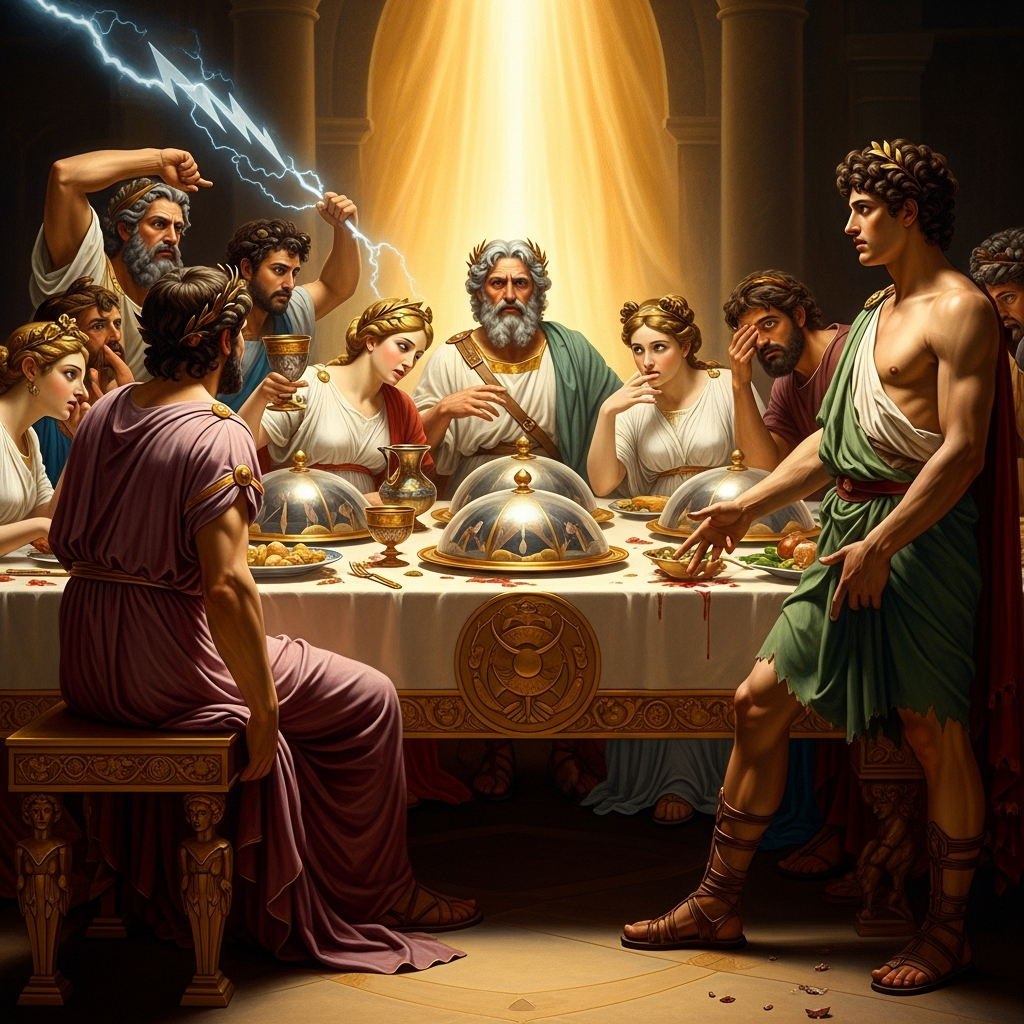
The servants had laid out his favorite breakfast.
He reached for a piece of bread. The bread, the moment his fingers closed on it, hardened into a brick of gold. He brought it to his mouth anyway and tried to bite it. He nearly cracked his teeth.
He reached for a cluster of grapes. The grapes turned, in his fingers, to a bunch of pretty golden beads, smooth and lifeless on a golden stem. He tried to push one between his lips. It was a stone.
He picked up his wine cup. The wine in it had been red. The moment his lips touched the cup’s rim — perhaps a little of the wine came up his lower lip — both wine and cup became molten and then, an instant later, solid gold. The wine on his lip cooled. He felt it harden.
He could not eat. He could not drink.
This had not been part of his calculations.
He sat at the table for a long time. He tried bread again. He tried fruit. He tried a piece of meat, dipping his head down to bite at it without using his hands. The moment any of it touched his mouth — his lips, his teeth — it transformed. He could swallow only what was already inside him. He drank from a fountain by lying on his side and lapping carefully like a dog, but as soon as the water was on his tongue it solidified, and he had to spit out a small gold ingot. He could not drink water either.
He realized, sitting at his beautiful useless table, that he was going to die of starvation surrounded by every wealth in the world.
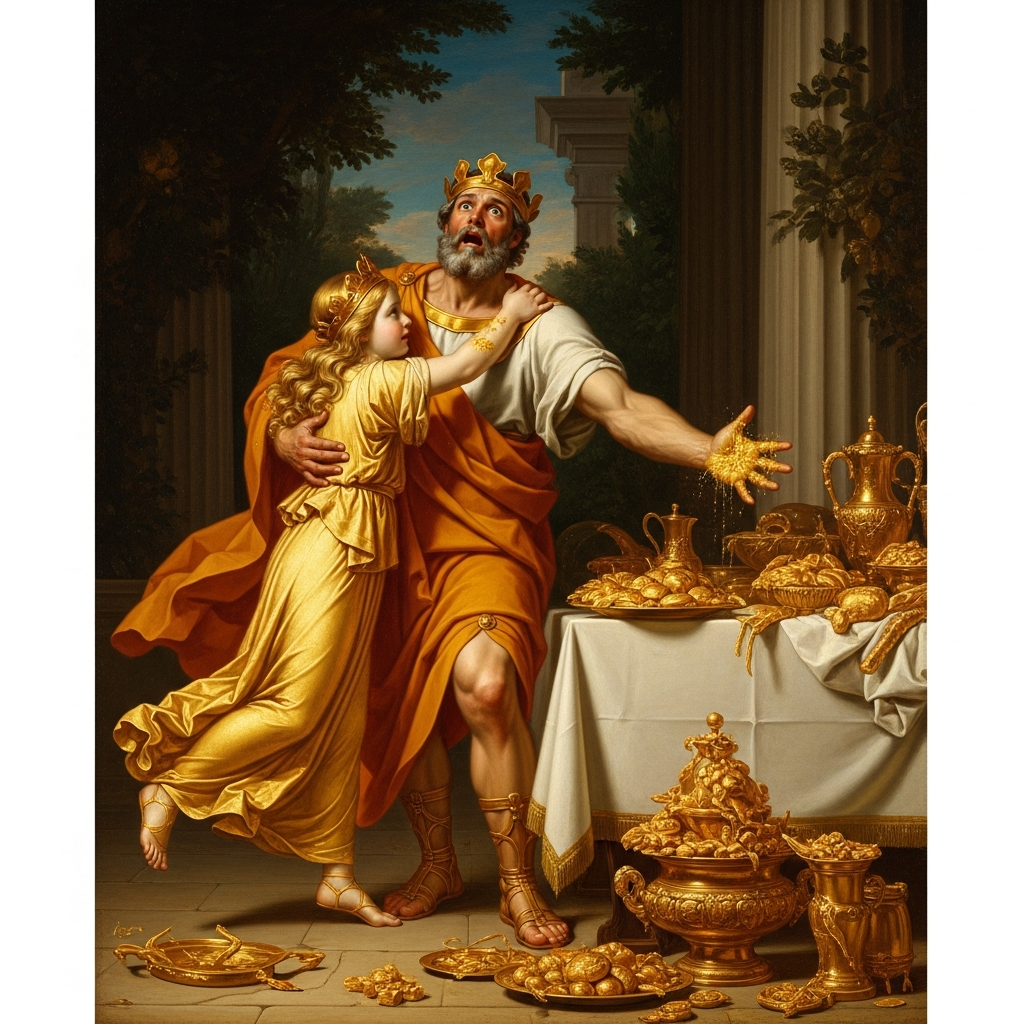
His daughter found him there. She had heard, in the gardens, that her father had been given a gift by the god, and she had come — laughing, running — to embrace him. She came around the table, and put her arms around his neck.
He turned to push her away. His hand brushed her cheek.
The gold went up her face like frost across a window. Her smile froze. Her eyes went hard and dull. Her warm body, in the half-second of contact, became cold and heavy and golden under her hair, the hem of her dress stiffening down her legs to the floor. She stood there, in the dining hall, a perfectly rendered statue of his daughter in mid-laugh, her arms around his neck.
He could not even hold her. He could not even take her in his arms again. The act of holding would only deepen the gold, would only make her more permanent, more unliftable.
Midas screamed.
He went out of the palace. He went out into the country. He walked all night. He left no servant behind him untransformed who had touched him, because any servant who had touched him was already a statue. He walked until he came to the source of the river Pactolus, in the hills, and he stood by the running water and prayed.
He prayed to Dionysus. He prayed in plain words. Take this back. Take it back. I do not want it. I will accept any punishment for my greed. I will give you anything. Take it back.
Dionysus, far away, heard. The god was not without mercy.
A voice came to him. Wash in the river. The river will take the gift from you. Then go home, find your daughter, and undo what you have done by reversing the same touch in the same water.
Midas plunged his hands into the cold mountain stream. He washed his arms to the elbows. He washed his face. He saw, in the water around him, the gold leach out of his skin and drift downstream as glittering particles. The water carried it away. From that day, Greek and Roman writers said, the river Pactolus ran with grains of gold in its sand — a fact actual geographers, two thousand years later, would confirm. Lydian goldwork was made from Pactolus sand. The geological deposit and the myth pointed to the same place.
He went home. He took her by the arm — gently, terrified — and he led her, statue and all, by main force back to the river. He brought a basin of the cleansed water. He poured it over her hair, her face, her hands, her dress. The gold ran off her in glittering droplets. She came back. She blinked. She looked at her father, confused. She did not know what had happened.
He did not tell her. He held her for a very long time. He carried her into the palace.
He never made another wish.
The Greeks said that Midas, after this, became a follower of Pan instead of Dionysus, and got into another piece of trouble involving a music contest and donkey’s ears. But that is another story. The first story — the story of the wish that worked — is the one that has stayed.
Aristotle, two centuries later, used Midas to make the point that gold is not real wealth, that gold is only the sign of wealth, and that a society confusing the sign with the thing will eventually find itself unable to feed itself. The image is older than the argument: a king at a long table, surrounded by treasure, slowly starving.
Every generation since has looked at Midas and seen the metaphor for whatever its own greed is. The wish keeps being granted. The bread keeps turning to gold.
Scenes
In the king's garden, Silenus — drunken, half-bald, garlanded — is being brought before Midas by a procession of peasants, while bemused servants prepare wine
Midas at the breakfast table
Beside the river Pactolus, Midas kneels with his hands plunged into the running water
Echoes Across Traditions
Entities
- Midas
- Dionysus
- Silenus
- Marigold (the king's daughter)
Sources
- Ovid, Metamorphoses XI.85-145
- Aristotle, Politics 1257b
- Hyginus, Fabulae 191
- Cicero, On Divination I.36