Mithras: The God of the Barracks
Mithraic mysteries flourished c. 100–400 CE in the Roman Empire · Underground mithraea throughout the Roman Empire: Rome, Ostia, London, Cologne, Dura-Europos
Contents
The Mithraic mysteries were practiced exclusively by men, almost exclusively in the military, in underground chambers called mithraea built to resemble caves. No women, no public ceremonies, no explanation given to outsiders — the modern world knows Mithras almost entirely from archaeology. Every mithraeum contained the same image: Mithras slaying a bull while a scorpion, a dog, and a snake drink its blood. We still don't know what the ritual meant. We know the Roman legions carried it from Britain to Mesopotamia. We know Constantine ended it.
- When
- Mithraic mysteries flourished c. 100–400 CE in the Roman Empire
- Where
- Underground mithraea throughout the Roman Empire: Rome, Ostia, London, Cologne, Dura-Europos
No woman ever set foot in a mithraeum.
This is not an inference. It is the consistent finding of every archaeological site: in the hundreds of mithraea excavated across the former Roman Empire — from Hadrian’s Wall in the north to Dura-Europos on the Euphrates in the east, from London in the west to the Black Sea coast in the east — there is no evidence of female presence. No female dedicatory inscriptions. No female votives. No graffiti. The mithraea were built underground or in basement rooms, designed to resemble natural caves, and the people who met in them were men. Military men, overwhelmingly: soldiers, centurions, officers, and the tradesmen and officials who followed military camps.
This is the first fact about Mithraism. The second fact is that the central image was always the same.
Every mithraeum contained the tauroctony.
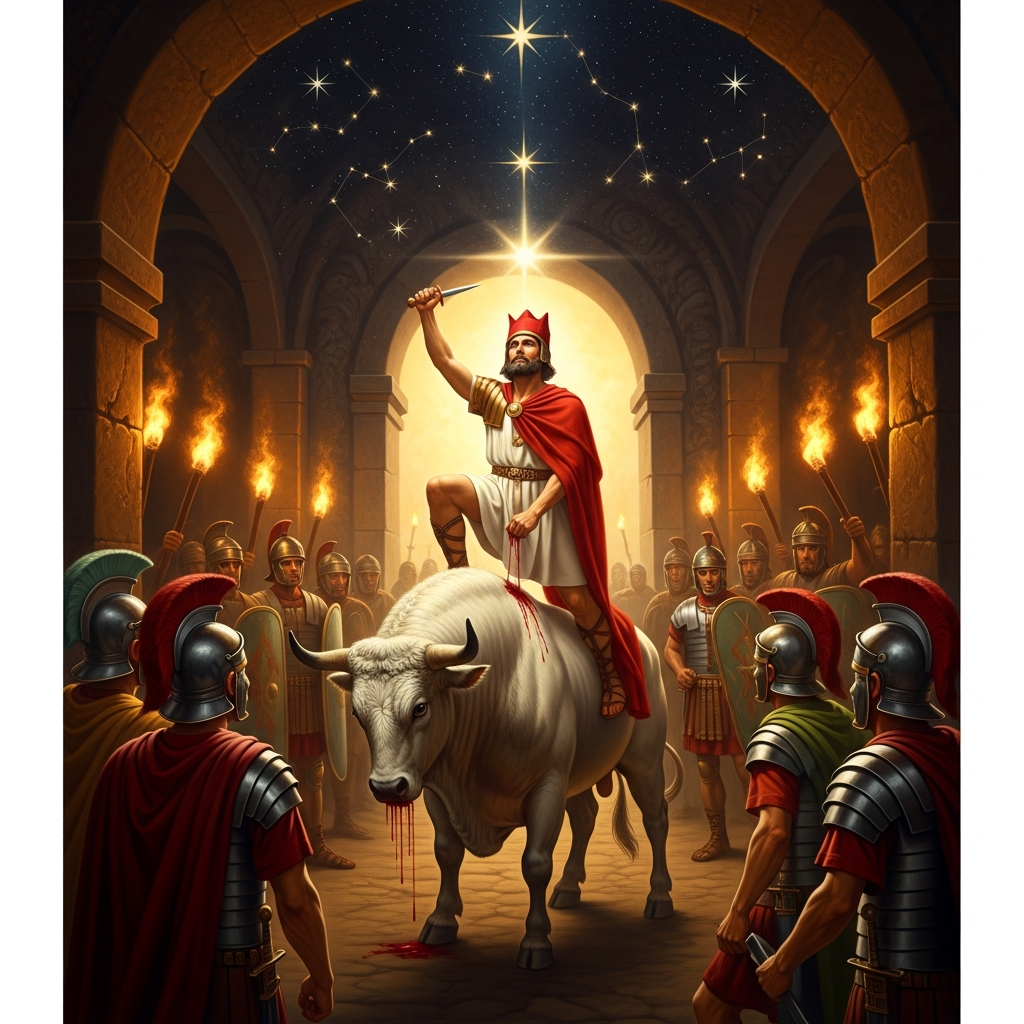
The tauroctony — the bull-slaying — appears in relief sculpture, fresco, and mosaic in every excavated mithraeum. The composition is always identical or nearly so: Mithras, in a Phrygian cap and billowing cloak, straddles a bull and pulls its head back with one hand while driving a knife into its neck with the other. His face is turned away from the kill, looking sideways at the bull’s neck with an expression that has been variously interpreted as sorrow, determination, or indifference. The bull’s tail ends in a sheaf of grain. At the bull’s neck, a snake and a dog drink the flowing blood. At the bull’s genitals, a scorpion grips. Two figures — Cautes and Cautopates, torch-bearers, one with torch raised and one with torch lowered — flank the scene. Above, Sol and Luna watch from the corners.
This image was not merely decorative. It was the theological center of the cult, the icon before which all ritual was performed. The initiates ate their ritual meal lying on benches along the long sides of the cave, facing the tauroctony at the far end. They ate and drank with the image in front of them. Whatever the meal meant, it was eaten in the presence of the slaying.
The scene has been interpreted in every possible way. Franz Cumont, who created the modern study of Mithraism in the late 19th century, believed the tauroctony was directly derived from Persian Mithra mythology — that it depicted a cosmic creation sacrifice in which the bull’s death generated the world. David Ulansey argued in 1989 that the tauroctony is a star map, with each animal representing a constellation and the slaying representing the astronomical precession of the equinoxes. Roger Beck has proposed that the image maps the soul’s journey through the planetary spheres. Manfred Clauss, more recently, argues that we simply do not know what it meant and should stop pretending we do.
The initiates knew. They kept the secret.
There were seven grades.
The grades are named in a single mosaic from the Felicissimus mithraeum at Ostia, the port city of Rome: Corax (raven), Nymphus (male bride), Miles (soldier), Leo (lion), Perses (Persian), Heliodromus (sun-runner), Pater (father). Each grade was associated with a planet, a symbol, and — it appears — a ritual role in the ceremonies. The raven delivered messages. The lion handled fire. The pater presided. The grades were not merely honorific; they organized the community and distributed liturgical function.
Tertullian, the Christian writer of the late 2nd century, describes seeing the Mithraic soldier grade — Miles — in terms that make clear it involved a ritual test: the candidate was offered a crown on the tip of a sword and refused it, declaring that Mithras was his only crown. This is the most specific description of a Mithraic initiation rite that survives. One test, from the third of seven grades.
What the other six grades involved, we do not know.
The geographic spread follows the legions.
Between roughly 100 CE and 400 CE, the Roman legions were stationed in a wide arc from Britain through the Rhine-Danube frontier into Syria and Mesopotamia. Mithraic sites appear with near-perfect correlation to this arc. In Rome and Ostia, where the military population was mixed with civilians, the cult spread into the merchant and official class. But the driver was always the military.
The mithraeum at Carrawburgh on Hadrian’s Wall sits a few hundred yards from the fort of Brocolitia, in the cold of Northumberland. The mithraeum at Dura-Europos on the Euphrates is in a military town on the far eastern frontier. They are separated by three thousand miles of empire and they contain the same image, facing the same direction, with the same animals at the same positions.
The cult provided what the military needed: a structured brotherhood, a secret identity separate from unit identity, a cosmic frame that made the soldier’s violent life meaningful. The seven grades gave advancement independent of military rank. The shared meal in the cave created bonds that crossed the hierarchies of the legion. The secret — the thing that could not be told to outsiders — was the bond itself.
A curious detail about the temples: they were small.
Most mithraea accommodate forty or fifty people maximum. The underground or basement location meant that they could not easily be expanded. There is no evidence of large congregations, no evidence of a central authority coordinating the hundreds of individual mithraea, no Mithraic equivalent of the Roman pontifex maximus or the Eleusinian hierophant.
This was not a religion with a hierarchy above the local lodge. Each mithraeum was autonomous. The pater was the local authority. The grades were locally administered. The theology — whatever the theology was — was transmitted locally through the grades, not from a central institution.
This makes the consistency of the tauroctony all the more remarkable. Across four centuries, across the full extent of the empire, the same image appeared in every cave. The local autonomy did not produce local variation. The icon was transmitted as faithfully as if there were a central authority enforcing it.
The secret, it appears, was self-replicating.
Constantine ended it.
The emperor’s conversion to Christianity in 312 CE did not immediately suppress Mithraism — the last Mithraic inscriptions date to the 380s CE — but the withdrawal of imperial and military patronage was fatal. The cult needed the legions. The legions were now Christian. The mithraea were abandoned, sealed, or converted: at San Clemente in Rome, a Mithraic cave lies directly below a 4th-century Christian church built above it, which lies below the current 12th-century basilica. The layers of religious history are literally stratified.
In the cave under San Clemente, the tauroctony is still there. The bull still dies. The snake and the dog still drink. The scorpion still grips. The torch-bearers still flank the scene, one raising the flame and one lowering it.
We still do not know what it meant.
The initiates knew. They never wrote it down. They took the grades seriously enough that they took the secret with them when they died, and the secret has stayed kept for sixteen hundred years, which is — whatever else it is — proof that the system worked.
Echoes Across Traditions
Entities
- Mithras (Sol Invictus)
- The tauroctony (bull-slaying image)
- The seven grades of initiation
- The Roman legions
- Sol and Luna flanking the scene
Sources
- Manfred Clauss, *The Roman Cult of Mithras* (2000)
- Roger Beck, *The Religion of the Mithras Cult in the Roman Empire* (2006)
- David Ulansey, *The Origins of the Mithraic Mysteries* (1989)
- Richard Gordon, 'The Sacred Geography of a Mithraeum: The Example of Sette Sfere,' *Journal of Mithraic Studies* I (1976)
- Walter Burkert, *Ancient Mystery Cults* (1987)
- M.J. Vermaseren, *Corpus Inscriptionum et Monumentorum Religionis Mithriacae* (1956–60)