Narcissus and Echo: The Voice That Cannot Begin, The Face That Cannot Leave
c. 700 BCE (mythic time) · Boeotia, the woods near Mount Helicon, a hidden pool in the forest
Contents
A nymph cursed to repeat only the last words she hears falls in love with a beautiful boy who cannot love her back. The boy, punished for his coldness, falls in love with his own reflection in a pool — and cannot tear himself away.
- When
- c. 700 BCE (mythic time)
- Where
- Boeotia, the woods near Mount Helicon, a hidden pool in the forest
There was a prophecy at the boy’s birth.
His mother was the river-nymph Liriope. His father was the river-god Cephisus. The boy was born already beautiful — beautiful in a way that arrested traffic, that made every nymph in the woods look up — and his mother, who knew the way these things tended to go, took him to the seer Tiresias and asked: Will my son live to old age?
Tiresias considered for a moment. Then he said: Yes — if he never knows himself.
Liriope did not understand the answer. She put it aside.
The boy grew up. By sixteen he was the most beautiful person in Boeotia. Suitors of every kind — boys, girls, nymphs, satyrs, men, women — pursued him. He refused them all. Not gently. He refused them the way a deer refuses a stand of brush: by walking through and not noticing. He felt nothing for any of them. He could not be reached.
Among those who watched him pass through the woods was a nymph named Echo.
Echo had a problem of her own. She had once been a chatterbox — the kind of nymph who would intercept Hera in the forest and keep her in long, looping conversations while Hera’s husband Zeus, somewhere nearby, was sleeping with another nymph. When Hera discovered the trick, she did not destroy Echo. She altered her speech. You will keep your voice, Hera said, but you will only ever be able to repeat the last words spoken to you. You will never speak first. You will never finish. You will only echo.
So Echo could no longer initiate. She could only respond. And she had fallen, watching the hunter pass, in love with Narcissus.
One day Narcissus, separated from his hunting companions, called out into the woods: Is anyone there?
Echo, hidden behind a tree, was given a phrase to work with. She called back: Here.
He turned. He could not see anyone. He called: Come!
She called back: Come!
He called: Why do you flee from me?
She called back: Flee from me.
He stood still and called: Come — let us meet.
She came running out from behind the tree. Her arms were open. She had been waiting for the words let us meet and now she had them and she was sprinting to embrace him.
Narcissus saw her. His face changed. He stepped back. I will die, he said, before I give you power over me.
She had only one phrase left to give him: I give you power over me.
He turned and walked away into the forest. Echo, humiliated, fled into a cave. She refused to come out. She stopped eating. Her body wasted to almost nothing — to bones and a voice — until at last her bones became stones, scattered in the floor of caves, and only her voice remained, drifting in hollow places, repeating last words.
Other rejected lovers, less retiring, prayed for vengeance. One of them — a young man Narcissus had spurned — prayed: Let him love what he cannot have. Let him feel what we have felt.
Nemesis heard. Nemesis is the goddess who balances books that have been left unbalanced.
She arranged the encounter precisely.
In a deep part of the forest, far from any path, there was a pool. The water was clear and still. No shepherds or goats had ever come there; no leaves had fallen on it; the surface was unbroken. The grass around it was thick and the surrounding trees screened it from the sun, so the water stayed cold and silver.
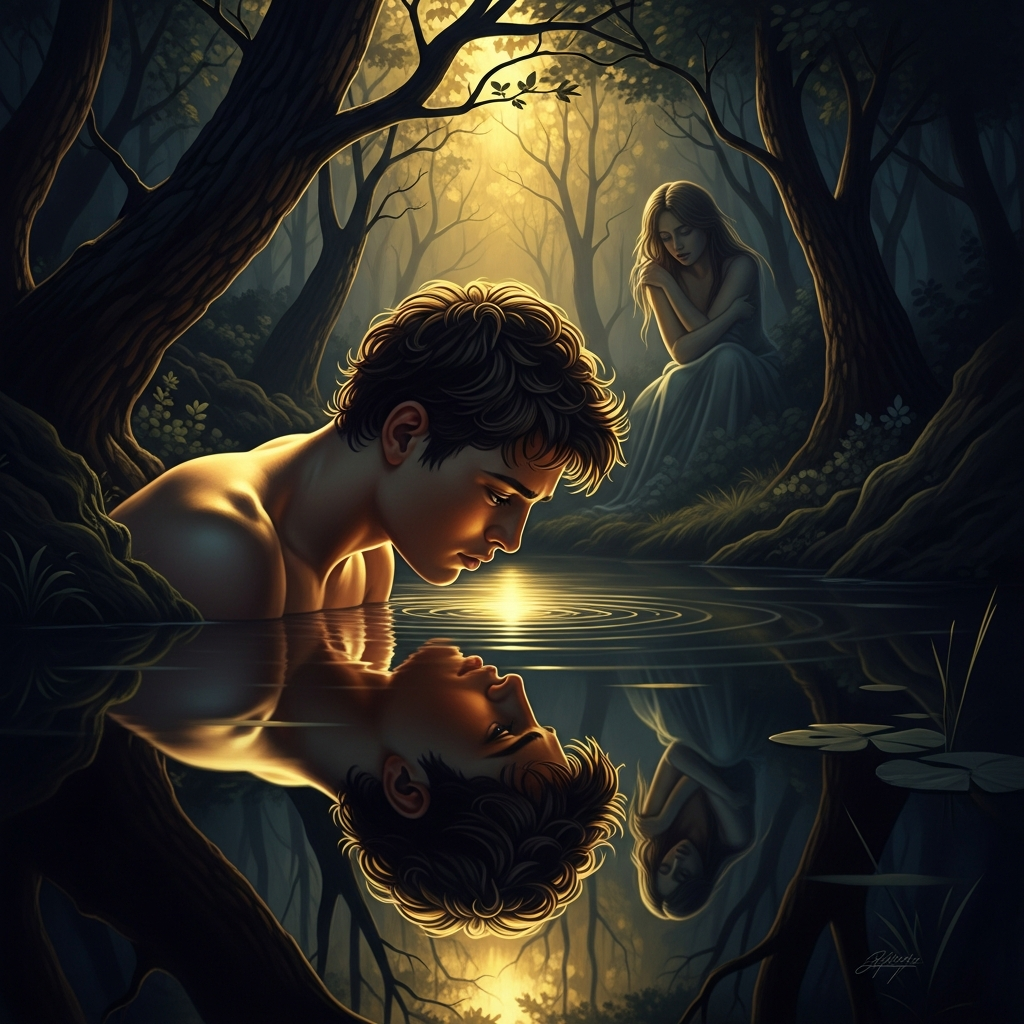
Narcissus came to it on a hot afternoon, hunting. He was thirsty. He knelt at the edge to drink. As he bent forward, he saw, in the water, a face — beautiful beyond description, looking up at him with an expression of perfect attentive sorrow, as though the face also had been waiting all its life for this meeting.
Narcissus could not speak. He reached out a hand. The face reached up a hand. He did not understand. He thought: a beautiful young man lives under this water, and he loves me as I love him, and we cannot reach each other through this barrier of glass.
He lay down on the bank. He spoke to the face. He said the things he had refused to hear from anyone else. He said: Why do you flee me? My beauty does not deserve this rejection. The nymphs and women have loved me; surely you, who look at me with such longing, can love me too. The face’s lips moved when he spoke; the eyes brightened when he brightened; the face was a perfect listener, the perfect responder.
But when he leaned to kiss it, the face shattered. When the surface settled, the face came back.
He understood, eventually. He understood toward evening, when the angle of the light was different and he saw, finally, that the face’s hair moved when his moved, that the face’s hand met his at the surface only because it was his hand. Iste ego sum, he said in Ovid’s Latin: I am that one. I have understood. The image I love is myself.
The understanding did not free him. It only deepened the trap. What I love is in me, he said, but I cannot get to it. The lover and the loved are the same person. I am divided from myself by myself. There is no possible union.
He could not leave the pool. He had become unable to look away. Echo, whose voice still drifted in the woods, came near. He grew thin. He grew thinner. He stopped eating. He stopped sleeping. He spoke only to the face. Alas, he said as he was dying. Echo, hidden in the woods, replied: Alas. He said: Farewell, beloved boy in vain. She said: Farewell.
When the friends came looking for him — when at last the nymphs of the wood found the pool — the boy’s body was gone. In his place, on the bank, where he had lain, a flower had grown. White petals, narrow as fingers. A small golden center. A long stem bowed slightly so that the flower’s head leaned over the water as if still looking.
They named the flower narcissus, and it grew thereafter only at the edges of pools and slow streams.
Tiresias’s prophecy had come true. The boy had lived as long as he did not know himself. He had known himself in the only sense that destroys: he had recognized in his own face an object he could not stop wanting. The recognition killed him.
Echo, voiceless and bodiless, drifts in caves still — repeating, never beginning. The pair are the two halves of the same disease: a self that cannot reach outward and a love that cannot start. Between them, the silver pool, and the flower that grows where lovers cannot stop looking.
Scenes
Echo, half-hidden behind a tree, watches the hunter Narcissus pass through dappled light
Narcissus kneels at the edge of a still pool
Where the boy's body lay, a single white flower has appeared — narrow petals, golden center, bowed head
Echoes Across Traditions
Entities
- Narcissus
- Echo
- Hera
- Nemesis
- Tiresias
Sources
- Ovid, Metamorphoses III.339-510
- Pausanias, Description of Greece IX.31.7-9
- Conon, Narrationes 24