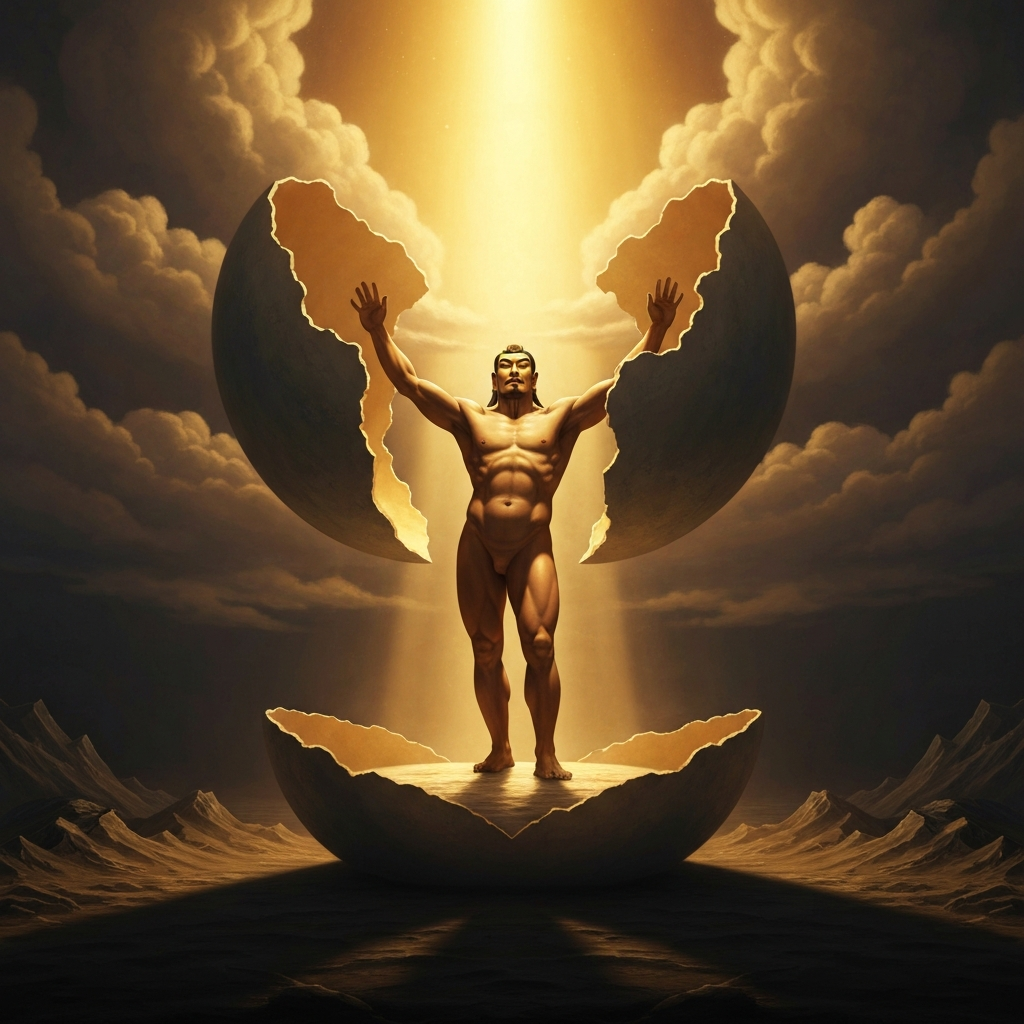
Nézha Tears Off His Own Flesh and Bone
The mythological Shang dynasty — the age of the Investiture of the Gods · The shores of the Eastern Sea near Chentang Pass, and the Qianyuan Mountain cave of Taiyi Zhenren
Contents
After killing the Dragon King's son and sparking a divine war, the child-god Nézha sacrifices himself by stripping away his own body — returning every piece of his flesh to his parents — and is reborn from a lotus flower as something that owes nothing to anyone.
- When
- The mythological Shang dynasty — the age of the Investiture of the Gods
- Where
- The shores of the Eastern Sea near Chentang Pass, and the Qianyuan Mountain cave of Taiyi Zhenren
He is born after three years and six months inside his mother’s womb — born already holding a gold ring and wearing a red armband and carrying the energy of someone who has been waiting too long to get started. He is three years old when he kills the Dragon King’s son.
The killing is not his intent. He is playing by the sea, spinning his red armband in the water, and the waves his play creates disturb the Dragon Palace below. Ao Bing, the Dragon Prince, comes up to investigate and is rude about it. Nézha, who is three and does not have a template for managing the rudeness of sea royalty, kills him. He kills him with the armband, or the gold ring, or the fire-tipped lance he also carries, depending on the account. The Dragon Prince is dead.
The Dragon King of the Eastern Sea goes to Nézha’s father, the garrison commander Li Jing, and demands justice.
Li Jing is a conscientious official and a terrified father. He knows his son. He knows that Nézha, at three, has already killed the demon Yaksha Huntian who came to the sea, has already done things that a three-year-old should not be capable of and that an adult would be judged harshly for. He gives the Dragon King what the Dragon King wants: a commitment to punish the boy.
Nézha is not interested in being punished.
What follows is a series of escalations — Nézha fighting the Dragon King’s soldiers, Nézha refusing to be bound, Nézha in the court of heaven making arguments that are technically correct but politically disastrous. The situation reaches the point where the Dragon King threatens to go to the Jade Emperor and report the entire matter and bring consequences down on Li Jing and on the garrison and on everyone in range.
Nézha makes his decision.
He goes to his mother first. He tells her: I am returning what you gave me. He says his body was made from her flesh and bones and his father’s breath and he is returning it to them, piece by piece, rather than let the consequences of his nature fall on people who did not ask to be his parents. He strips the flesh from his bones and gives it to her. He strips his bones and gives them to his father. The Dragon King’s debt is paid with Nézha’s own body. The garrison is safe. The consequences fall nowhere.
His master, Taiyi Zhenren, finds him.
The master builds a lotus platform from lotus flowers — the Buddhist flower of rebirth, the symbol of purity emerging from mud — and he uses the platform as a mold and the lotus as the material and Nézha’s essential identity as the pattern, and he rebuilds the boy from pure spiritual substance. No flesh from his mother. No bones from his father. No debt to anyone. Just Nézha, born again from the lotus, with his gold ring and his red armband and the fire wheels under his feet and the Wind Fire Wheels that let him move through the sky.
He is born free.
He is also, now, genuinely estranged from his father, who burned the lotus shrine that Nézha’s devotees built after his rebirth, cutting off the avenue of Nézha’s worship and reducing him again. The story between them continues through the Investiture of the Gods and never entirely resolves — the son who returned his body to his parents and the father who cannot forgive the son for having done it, the debt that was paid and the wound the payment made.
The lotus that remade him still carries his lotus. He stands on it in every image: the three-year-old with the ancient eyes, standing on a platform of flowers that grew from the mud of the sea where he first played, where the trouble began, where the original body went into the water piece by piece and the rebirth came up clean.
Echoes Across Traditions
Entities
- Nézha
- Li Jing (Nézha's father)
- the Dragon King of the Eastern Sea
- Ao Bing (Dragon Prince)
- Lady Yin (Nézha's mother)
- Taiyi Zhenren
Sources
- Investiture of the Gods (封神演義), Xu Zhonglin, c. 1620
- Journey to the West (西遊記), Wu Cheng'en, c. 1592 — Nézha as heavenly warrior
- Meir Shahar, *The Shaolin Monastery: History, Religion, and the Chinese Martial Arts* (Hawaii, 2008)
- Lihui Yang & Deming An, *Handbook of Chinese Mythology* (Oxford, 2008)