Odysseus and the Sirens: The Wax in the Ears, the Rope on the Mast
c. 1200 BCE (mythic time) · The open Mediterranean, the rocky island of the Sirens, the sea between Aeaea and the strait of Scylla
Contents
A witch warns him: the song will kill you. He cannot resist hearing it; he also cannot afford to die. He invents a precommitment device — wax in his men's ears, his own body roped to the mast, an order to tighten the ropes if he begs to be released.
- When
- c. 1200 BCE (mythic time)
- Where
- The open Mediterranean, the rocky island of the Sirens, the sea between Aeaea and the strait of Scylla
The witch Circe had warned him.
He had spent a year on her island. He had been her lover; she had been his guide; when at last he was leaving, she sat with him through a long night and told him every danger that lay between Aeaea and Ithaca.
The first danger, she said, was the Sirens. They sat in a meadow by the sea, on an island, and they sang. Their song was not seductive in the ordinary sense — it did not promise pleasure or beauty. It promised knowledge. It promised that anyone who heard it would learn everything that had ever happened, every story of the world, every secret of the gods. We know all that the Argives and Trojans suffered on the broad plain of Troy, the song would say. Stay and learn it.
Whoever heard the song stayed. Whoever stayed did not eat. Whoever did not eat, died. The meadow was white with the bones of dead listeners and bright with their drying skin.
Circe gave him instructions.
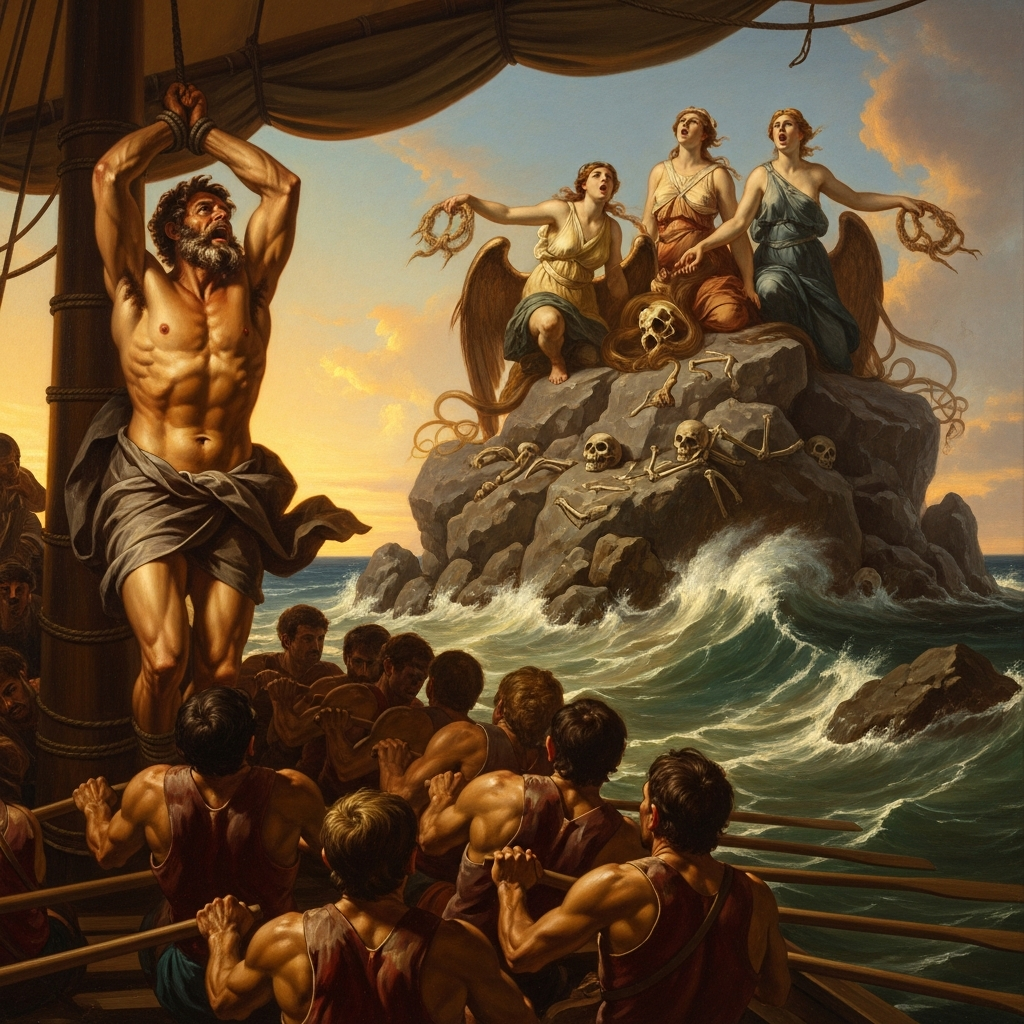
Take a great wedge of beeswax aboard ship. Knead it in your hands until it is soft. Stop the ears of every man with it before you reach the island, and let none of them hear. As for yourself — if you are mad enough to want to hear, that is your business — have your men bind you upright to the mast. Bind your hands and feet. Bind you so that you cannot move. And give them this order in advance: if you struggle, if you weep, if you scream to be released, they are to ignore you. They are to tighten the ropes further. They are to row harder.
When the island is past, only then are they to release you.
Odysseus listened. He did not pretend, even to himself, that he could resist the song. He was Odysseus. He knew himself. The song would work on him, and he would beg, and his begging would sound like the most reasonable speech he had ever made — better than any argument he had ever made on the plain of Troy or in the council of the kings — and the men, who knew his cleverness, would believe it. So the men must not hear at all. And he must not be obeyed.
The plan was a kind of legal instrument: a contract between his present self, who knew the danger, and his future self, who would not. The present self bound the future self. The crew, like notaries, were to enforce the contract against the future self’s own arguments.
They sailed.
When the wind dropped — Circe had warned them the wind would drop, that the sea around the island would lie flat and silent in advance of the sound — the men stowed the sail and sat to the oars. Odysseus produced the great round wedge of beeswax. He took out his sword and chopped it into pieces and kneaded each piece in his palms until it grew warm and soft. He went down the line of rowers, one by one, and pressed the wax into their ears. He sealed every man.
He did not seal himself.
He told them to bind him to the mast. They did. He told them to bind his hands. They did. He told them to bind his feet. They did. He repeated the order: If I beg you to release me, do not. Bind me with more rope. The men nodded. They could not hear him; they had learned the orders earlier. They returned to the oars and rowed.
The ship glided into the windless silver sea around the island.
Odysseus, lashed to the mast, looked toward the meadow. He saw the singers — figures in the grass, indistinct, women in shape — and then the song began.
It was not loud at first. It came across the water in single words, then in phrases, then in long limpid lines. Come here, glorious Odysseus, great glory of the Achaeans. Stop your ship. Listen to our song. No one has ever sailed past us in his black ship without hearing the honey-sweet voice from our mouths. Each goes on, having taken pleasure, knowing more than before. We know all that the Argives and Trojans suffered on the broad plain of Troy by the will of the gods. We know everything that happens on the fertile earth.
The song went into him like water into dry sand.
He had been at Troy. He had watched men die there whose stories had not been told. He had spent ten years listening, in his head, for an account of what those years had been for. The song was offering it. We know all that the Argives and Trojans suffered. Stop. Listen. Learn the meaning of the years.
He twisted in the ropes. He shouted. He nodded violently to the men: Release me. Release me now. He glared at them. He used the eyes that had carried fifty arguments through the council of the Greeks. He used everything he had.
The men did not look at him.
They had been told. They had been bound by an order their captain had given before he was capable of giving any other. Two of them — Eurylochus and Perimedes — got up from the rowing benches, came to him, and tightened the ropes. They did not unstop their ears. They did not look at his face. They went back to the oars.
The song continued. He listened. He suffered. The ship moved.
Slowly the singers grew indistinct again. The voices grew small. The wind, in time, returned. The island fell behind them. The crew, when their captain stopped struggling and lay slumped against the mast, took the wax out of their ears, came forward, and untied him.
He did not speak for a while.
He had heard the song. No one had ever heard it and lived. He had heard it because his men, by his earlier orders, had been deafer than the gods themselves to his pleas. He sat down on a coil of rope. He looked back at the receding island. He looked at the men who had refused to obey him.
It was the first lesson of the second half of the Odyssey: a man cannot save himself by his own resolve from the things that work on him at the level he resolves. He can save himself only by binding himself, in advance, with witnesses, before the song begins.
The wax is the design. The mast is the constraint. The crew is the institution. The voyage continues because all three were in place before the music started.
Scenes
On the deck before the encounter, Odysseus kneads soft wax with his fingers and presses it into the ears of his rowers, sealing each one before they can hear what is coming
The mast amidships
On the rocky meadow, the sirens — bird-bodied with women's faces — sit among the bones of previous sailors, mouths open, the song rising as the ship passes
Echoes Across Traditions
Entities
- Odysseus
- The Sirens
- Circe
- The crew of the Odyssey
Sources
- Homer, Odyssey XII.39-54, 165-200
- Apollonius of Rhodes, Argonautica IV.891-919
- Apollodorus, Library, Epitome 7.18-19