Contents
A king and his men are trapped in the cave of a one-eyed giant who eats them two at a time. The king has only his wits. He gets the giant drunk, tells him his name is 'Nobody,' and drives a heated stake into the single eye while the monster sleeps.
- When
- c. 1200 BCE (mythic time)
- Where
- An island off Sicily, the cave of the cyclops Polyphemus, the open sea
They had been sailing home from Troy for some time already, and they were tired and they were running low on supplies, and so when they saw an island with smoke rising from a cave on a high cliff, Odysseus and twelve of his best men beached the ship and went up.
The cave belonged, though they did not know it, to one of the cyclopes — the one-eyed shepherd-giants who lived alone on this island, each in his own cave, each tending his own flocks, neither plowing nor planting nor governing. They lived without law. The cave was vast. Inside it were stacked wheels of cheese, pens of penned lambs, troughs of milk separating into curds and whey. There was no one home.
The men wanted to grab the cheeses and run.
Odysseus said no. He wanted to meet the host. There was a custom in the Greek world — the law of xenia, guest-friendship — and a host owed a guest food, drink, gifts, and safe passage. Odysseus was curious to see if it held this far west.
It did not hold.
The giant came home at evening. He was huge — like a wooded mountain peak, Homer says — with a single eye in the center of his forehead. He was driving his flock back into the cave for the night. He saw the men. He did not greet them. He went to the cave’s mouth and rolled across it a stone that twenty four-wheeled wagons could not have moved.
The men were sealed in.
Polyphemus — for that was his name — turned and looked at his guests. He asked who they were. Odysseus, polite, gave a careful answer: men of Agamemnon, returning from Troy, in need of hospitality, by the laws of Zeus the protector of strangers.
Polyphemus laughed. The cyclopes, he said, did not fear Zeus. The cyclopes were stronger than the gods. Then he reached down, picked up two of the men by their feet, dashed their brains out against the floor, and ate them. He drank a bowl of milk. He went to sleep.
In the dark, Odysseus considered killing him with his sword.
He thought it through. If he killed the giant, the men would be stuck in the cave forever — they could not move the stone. The only way out was to keep the giant alive long enough to roll the stone aside, and then escape.
He needed a longer plan.
In the morning Polyphemus ate two more men for breakfast, rolled the stone aside, drove his flocks out, and rolled the stone back behind him. The cave was sealed and the men were trapped inside until evening.
Odysseus used the day. There was a green olivewood club in the cave — the giant’s club, drying for use. Odysseus and the men cut a portion off it, sharpened one end to a point, and hardened the point in the embers of the fire. They hid it. They drew lots for who would help drive it.
When the giant returned at evening, ate two more men, and settled down to drink, Odysseus came forward with a skin of wine — strong wine, the gift of a priest of Apollo at Ismarus, dark and unmixed. He offered it to the giant. A small token, he said, of guest-gift, in case you are willing to send us home. Polyphemus drank. He liked it. He demanded more. Odysseus poured a second bowl. A third.
The giant grew sentimental. Tell me your name, friend, he said, and I will give you a guest-gift in return.
Odysseus said: My name is Outis. Nobody. That is what my mother and father and friends call me — Nobody.
Polyphemus laughed in his beard. Then Nobody, he said, will be the last of his companions I eat. That is your guest-gift. He fell over backward, drunk, and slept.
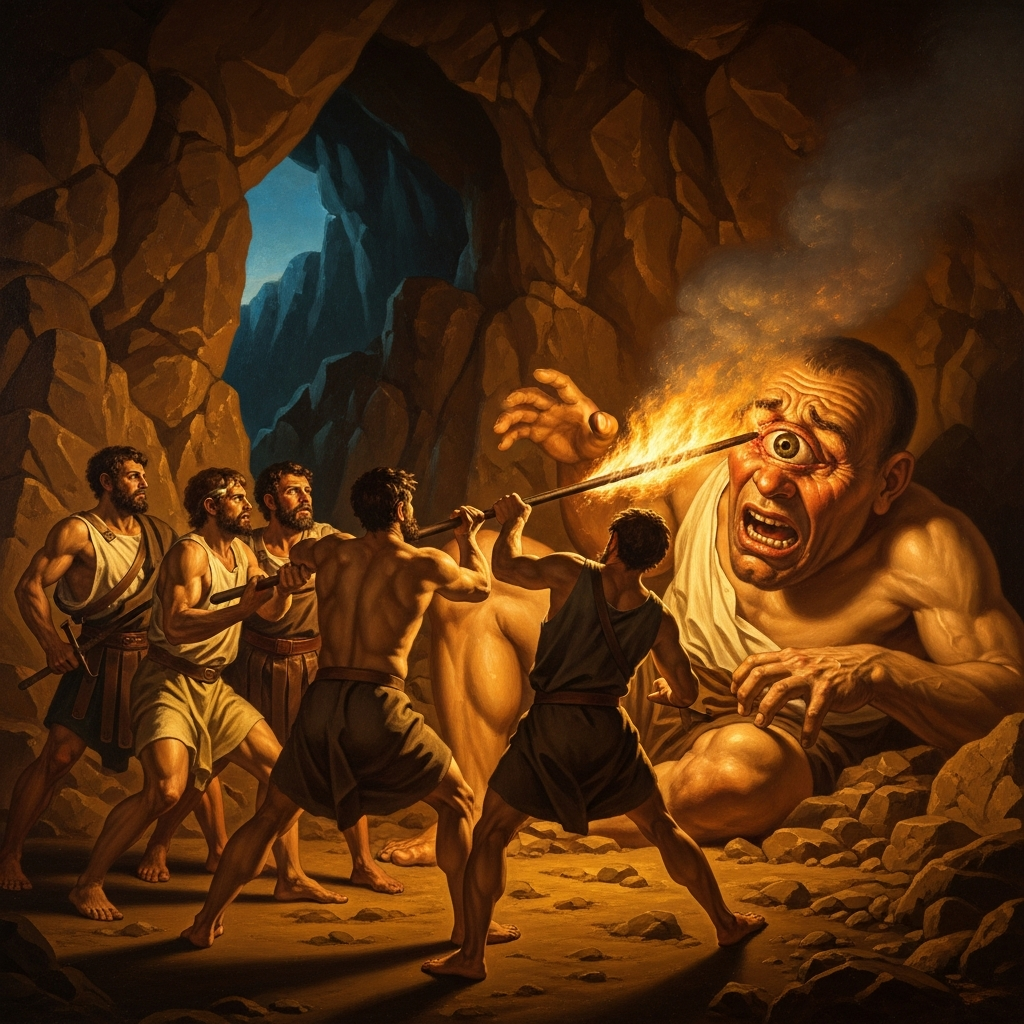
Odysseus and four men took the stake from its hiding place. They heated the point in the embers until it glowed. They lifted it together, ran with it, and drove it into the single eye of the sleeping giant — Odysseus turning it like a shipwright drilling a beam, the eye hissing and bubbling around the wood like a hot iron quenched in water.
Polyphemus screamed. He woke. He pulled the stake out of his face and threw it across the cave. Blood and ruined eye-fluid ran down his cheek. He shouted to his neighbors — the other cyclopes in their separate caves on the mountain — for help.
They came to the mouth of the cave. They asked through the stone what was wrong.
Polyphemus shouted: Nobody is killing me by treachery! Nobody is killing me by force!
The cyclopes outside considered this. Well, they said — if nobody is killing you, you must be sick, and sickness is from Zeus, and there is nothing we can do. Pray to your father Poseidon. Goodnight.
They went back to their caves.
Inside, Odysseus had to get past the stone. The giant, blind now, moved to the cave entrance and rolled the stone aside, but he sat in the gap with his arms wide — feeling the back of every ram as it filed out, in case the men tried to slip out among the flock.
Odysseus had thought of this.
He took thongs of willow and tied the rams together in groups of three. Each man clung to the belly of the middle ram of his trio — fingers in wool, body lifted — so the giant’s hands, passing over the backs of the outer rams, missed the men entirely. Odysseus took the largest ram for himself, the favorite, the leader, and clung beneath its belly. The leader-ram was slow — Polyphemus, fond of it, paused to speak to it in the gap, asking why it was last today instead of first; perhaps it was grieving for the master’s eye — and then let it pass.
They made it to the ship. They hauled the rams aboard. They pushed off. They were fifty yards from shore.
Odysseus could not let it stand.
He stood up in the stern. He shouted across the water: If anyone asks who blinded you — say it was Odysseus, son of Laertes, sacker of cities, who lives in Ithaca!
This was the mistake.
Polyphemus, on the cliff, heard the name. He raised his voice in prayer to Poseidon his father, and the prayer was specific and complete: If I am truly your son, grant that this Odysseus never reach home; or, if it is fated that he does, grant that he reach it late, alone, on a foreign ship, with all his companions dead, and find evil things in his house.
The prayer was heard.
The cyclops then tore off the top of a mountain and threw it. It landed just astern of the ship and the wave it raised drove the ship back toward the beach; the men rowed with all their strength, and Odysseus, finally, was persuaded by his crew to stop shouting. They rowed until the island was a low line on the horizon. They rowed until it was nothing.
Ten more years of wandering lay ahead of him. The storm at sea, the witch Circe, the descent to the dead, the sirens, Scylla and Charybdis, Calypso’s island, the suitors waiting in his hall — all of it was set in motion, the moment he had to add his name.
The cleverness saved them. The boast cost everything. The same mouth.
Scenes
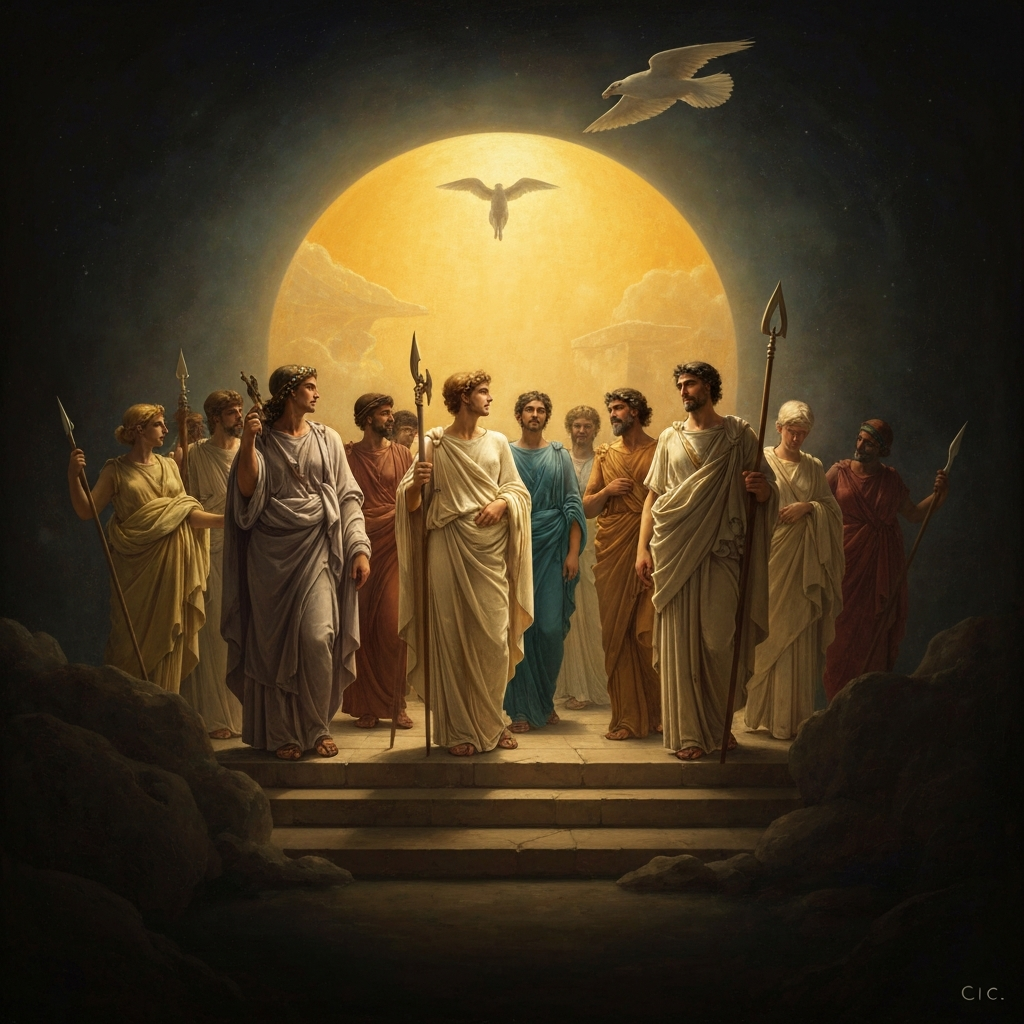
The companions stand in the entrance of the vast cave amid stacked cheeses and penned lambs, the dim interior smelling of milk and woodsmoke
By firelight, Odysseus and four men hoist the heated olivewood stake
At dawn the blinded giant feels the back of each ram leaving the cave
Echoes Across Traditions
Entities
- Odysseus
- Polyphemus
- Poseidon
- The companions
Sources
- Homer, Odyssey IX
- Euripides, Cyclops
- Theocritus, Idylls 11