Contents
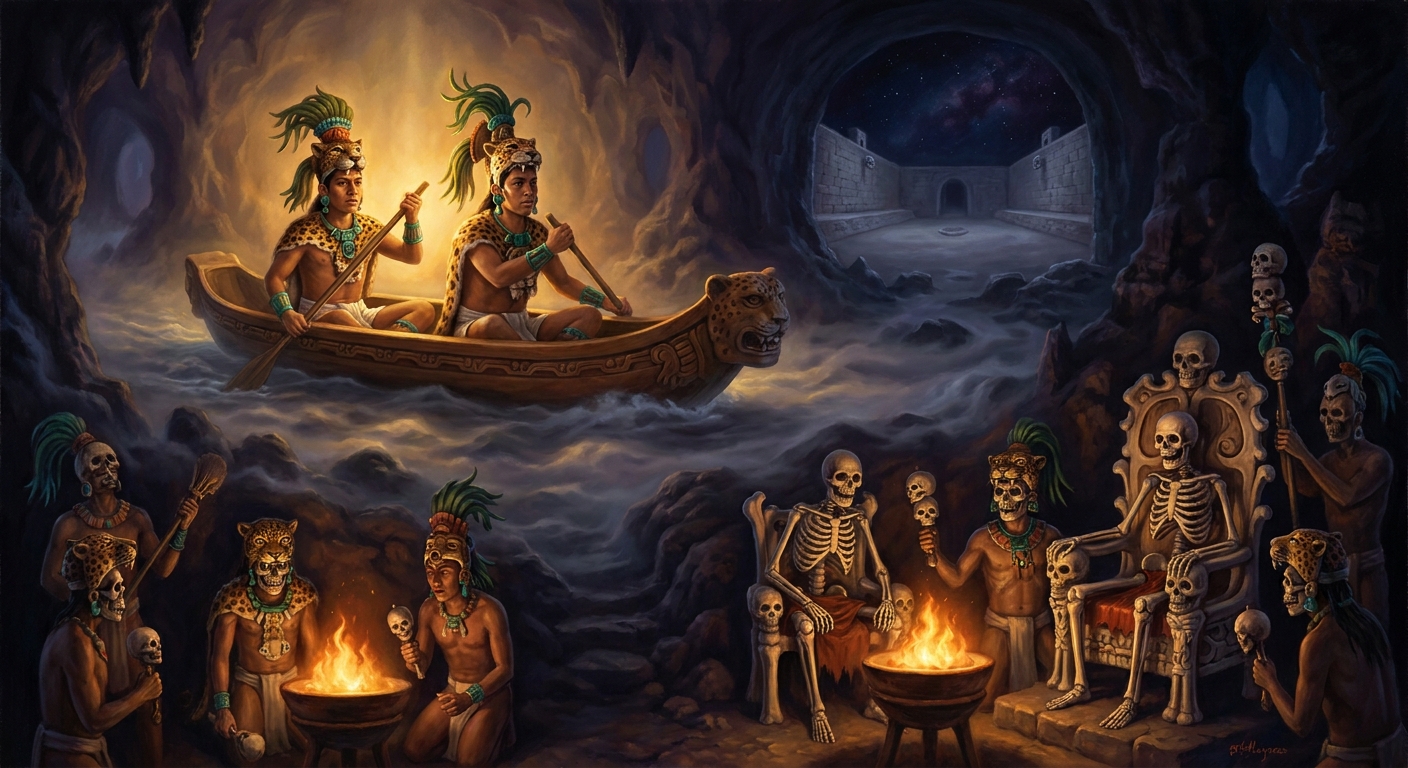
The road to the Maya underworld passes through four rivers — pus, blood, water, and a river that flows all ways at once — before the traveler reaches the crossroads where the dummy lords wait to embarrass the unwary and the real lords wait beyond.
- When
- Mythic time; Classic Maya eschatological tradition
- Where
- The road to Xibalbá — the underground passage beneath the surface of the earth
The road goes down.
Not metaphorically down, not down as in morally degraded, but literally: the road to Xibalbá descends through the earth, going below the surface of the world the way a cave descends, going through the layers of limestone and water and darkness that underlie the Maya world. The Yucatán is built on honeycombed limestone — caves and underground rivers everywhere, the earth is porous, the below is always accessible if you know where the opening is.
The first difficulty is crossing the rivers.
The road passes through four rivers before it reaches the central settlement of Xibalbá. The first river carries pus — the pale yellow discharge of infection, of wounds that have gone wrong, of the body fighting something it cannot fight off. The second river carries blood. These are not small streams; they are rivers that must be crossed, and the crossing requires both the physical act of crossing water and the psychological act of entering the material of disease and death up to your waist.
The Popol Vuh says the previous generation of ballplayers — Hun Hunahpú and his brother — crossed these rivers without difficulty but with no preparation. They just waded through. They did not know what they were entering. The Hero Twins crossed differently: they sent a mosquito ahead to report on the crossing, and they crossed knowing what they were in.
Knowledge is the essential difference between the two approaches to the underworld.
After the rivers comes the crossroads.
Four roads intersect in the road to Xibalbá: one red road, one black road, one white road, one yellow road. Each road claims to be the correct road. The red road is the road the lords of Xibalbá want you to take — it is the road that leads to their reception hall, the road they control. The other roads go elsewhere, to places even worse or to places that simply disappear.
The lords of Xibalbá have placed wooden dummies at the intersection, dressed as lords, seated in the positions of reception. The previous ballplayers approached these dummies and greeted them respectfully, received no response (wood cannot respond), and suffered the social humiliation of having bowed to a mannequin — which diminished their composure and signaled to the actual lords watching from a distance that these visitors were not who they needed to worry about.
The Hero Twins had a mosquito bite each seated figure first.
The dummies did not flinch. The real lords did. When the mosquito reached the flesh and blood lords, they cursed and swatted, identifying themselves. The twins greeted the real lords by name and ignored the dummies entirely.
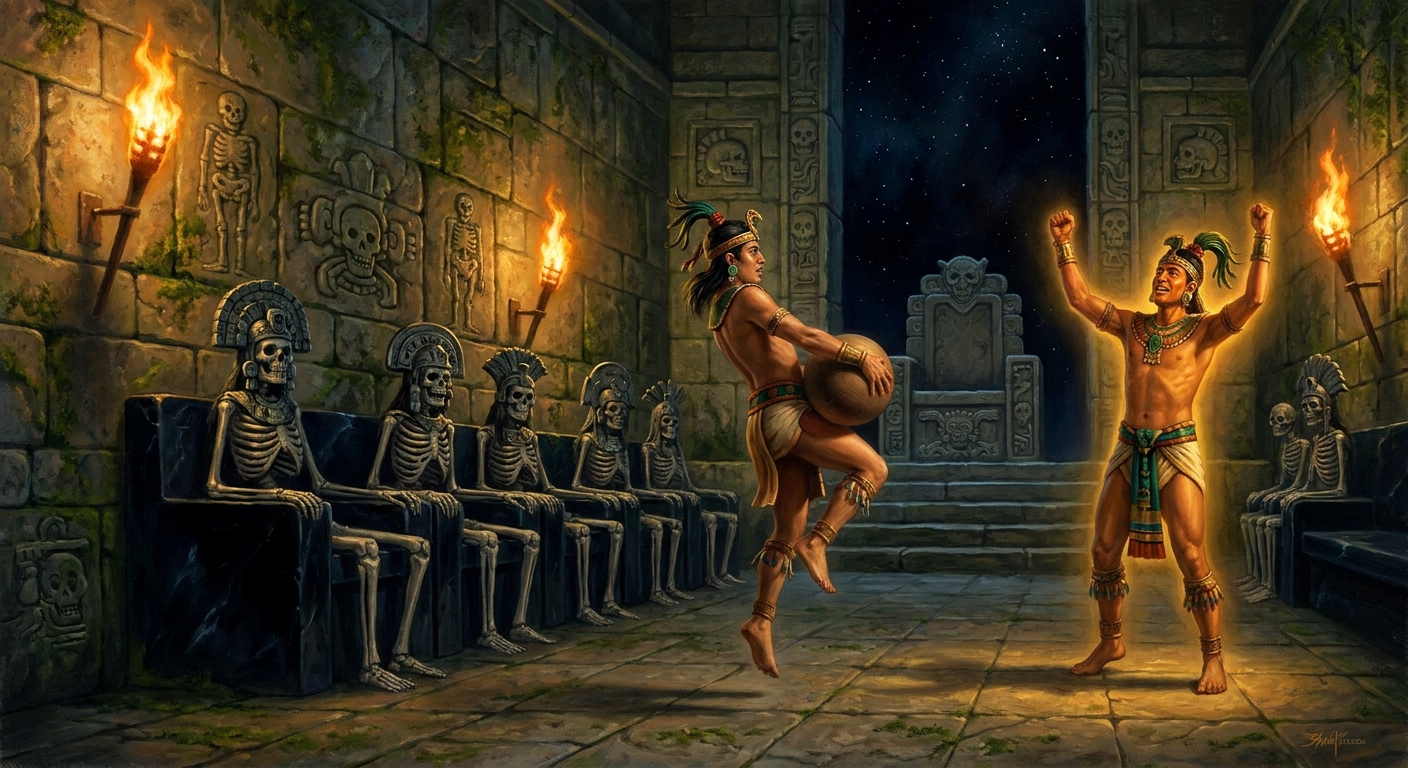
The settlement of Xibalbá is not a cave in the ordinary sense.
It has streets. It has houses — the Dark House, the Cold House, the House of Jaguars, the House of Fire, the Razor Wind House, the Bat House. It has a ball court. It has council buildings where the lords hold meetings, arrange their hierarchies, receive visitors. It is a city under the earth, organized on the same social principles as the cities above the earth but inverted in its values: where the cities above value abundance, warmth, growth, Xibalbá values scarcity, cold, and the arrest of growth.
The river of blood is the city’s moat.
The pus river is the city’s memory of what it does to bodies. The water river — the third river, pure water — is the hint that not everything below is corruption, that the underground has its own cleanness, that the Maya cenotes tapping into underground rivers are not pollution but purity. The fourth river, the one that flows all ways at once, is the confusion itself: the part of death that cannot be mapped because it is disorder, the moment when the directions stop meaning what they usually mean.
The Hero Twins walked through all of it.
They were prepared, and they were afraid, and they went anyway, which is the only way the road to Xibalbá can be traveled: knowing what it is and continuing.
Echoes Across Traditions
Entities
- One Death
- Seven Death
- the lords of Xibalbá
- the four rivers
Sources
- Popol Vuh, translated by Dennis Tedlock (Simon & Schuster, 1985)
- Allen J. Christenson, *Popol Vuh: The Sacred Book of the Maya* (University of Oklahoma Press, 2007)
- Linda Schele and David Freidel, *A Forest of Kings* (William Morrow, 1990)