The Yazatas: Servants of the Flame
Throughout the cosmic era — the yazatas are eternal functions of the divine order · Throughout all creation — each yazata governs the domain of its nature wherever that domain exists
Contents
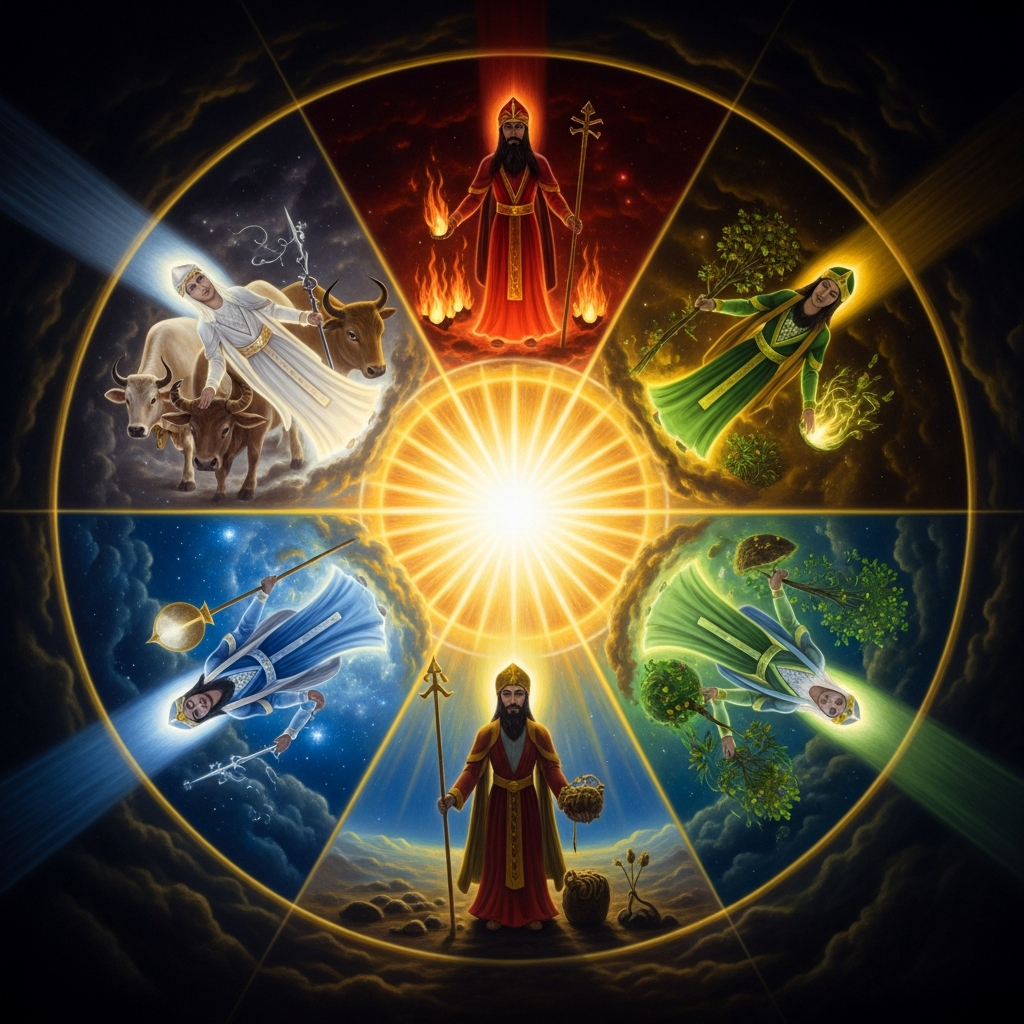
Ahura Mazda's divine order is maintained by the yazatas — worshipful beings who oversee the elements, the virtues, and the cosmic calendar, each one a guardian angel of a specific reality that the righteous human reinforces by naming it.
- When
- Throughout the cosmic era — the yazatas are eternal functions of the divine order
- Where
- Throughout all creation — each yazata governs the domain of its nature wherever that domain exists
Before the daevas were daevas, they were yazatas.
The two words share a root — both mean, at the deepest level, beings worthy of worship — but they diverged at the moment Angra Mainyu’s assault sorted the divine world into those who aligned with Asha and those who chose Druj. The daevas are the spirits who chose the Lie. The yazatas are those who chose truth, and who have been choosing it in every cosmic moment since.
They are numerous: the Avesta names thirty-three major yazatas and implies many more. Each one is a principle made present — not merely a personification of an abstract idea but a living reality that sustains its domain by its own ongoing choice of righteousness.
Mithra is among the greatest. He is the yazata of covenants — of the agreements between people and peoples and between humans and the divine. Every oath sworn, every contract kept, every promise honored is an act that strengthens Mithra. Every oath broken, every contract violated, every promise abandoned is a small assault on his domain. He rides a chariot across the sky ahead of the sun, and he has ten thousand eyes that see all covenant-breaking. The Zoroastrian saying about him is remembered for two thousand years: Do not break a covenant, Mithra watches. His worship spread from Iran west through the Roman Empire, where soldiers built his temples in caves along every garrison road from Britain to Mesopotamia.
Anahita is the yazata of the waters — of rivers and streams and the fertilizing rainfall and the waters of fertility in women and in the earth. She is described in the Aban Yasht as a young woman dressed in golden garments with a crown of eight rays, wearing jeweled earrings and a necklace. Her physical description is unusually specific for a divine being: the tradition wants you to see her clearly, wants you to feel her as a presence rather than an abstraction. She governs the waters that carry life, which means she governs the conditions for all biological existence. She has a temple at Istakhr that will outlast the Achaemenid empire.
Sraosha is the yazata of obedience — but the word carries more than submission. Sraosha means the quality of hearing the cosmic order and responding to it, the attentiveness that aligns the human will with the divine will not through compulsion but through understanding. He fights Aeshma, the daeva of wrath, whose chaos is the direct opposite of Sraosha’s ordered responsiveness. Every morning prayer, every act of ritual attentiveness, every moment of genuine listening to what the world requires is an invocation of Sraosha.
Tishtrya is the yazata of the star Sirius and of the monsoon rains. His myth is one of the most dramatic in the Avestan texts: he fights the demon Apaosha, the demon of drought, in the form of a white horse against a black horse. If the worshippers of Ahura Mazda perform the yasna ritual with sufficient devotion, Tishtrya receives the strength to defeat Apaosha and the rains come. If they do not, the drought continues. Here is the Zoroastrian understanding of ritual in its most direct form: the worshipper’s devotion is not merely symbolic but cosmically effective, lending real strength to the divine beings who fight the daevas.
The calendar maps this theology onto time. Each of the thirty days of the month is assigned to a yazata: the first day to Ahura Mazda himself, the second to Vohu Manah, the third to Asha Vahishta, and so on through the month. To name the day correctly is to acknowledge the divine principle it embodies. To perform the day’s appropriate ritual is to reinforce that principle against its demonic opposite.
The yazatas are not worshipped as independent deities. The distinction matters: they are worshipped in the context of the worship of Ahura Mazda, as facets of the single divine order rather than as competing divinities. This is the monotheistic architecture that makes Zoroastrianism the ancestor of the Abrahamic angelic hierarchies: the divine functions are real, present, and worthy of acknowledgment, but they derive their divinity from the one source and return it to the one source.
To light the fire in the morning is to invoke them all at once.
The flame does not belong to any single yazata. It belongs to all of them.
Echoes Across Traditions
Entities


Sources
- Ilya Gershevitch, *The Avestan Hymn to Mithra* (Cambridge, 1959)
- Mary Boyce, *Zoroastrians: Their Religious Beliefs and Practices* (Routledge, 1979)
- Prods Oktor Skjærvø, *The Spirit of Zoroastrianism* (Yale, 2011)
- Almut Hintze, *Zamyad Yasht* (Reichert, 1994)