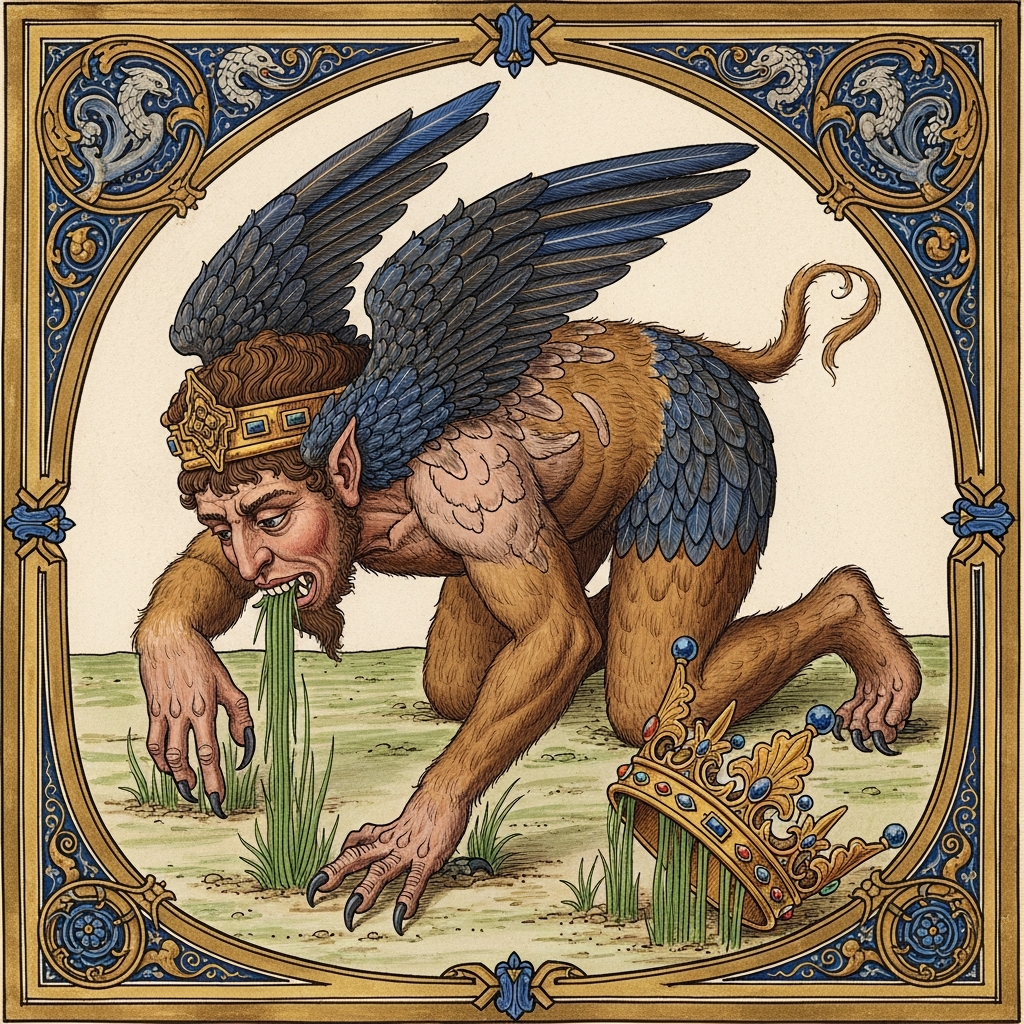
The kingdom of Judea in 167 BC was a province of the Seleucid Empire — the easternmost successor state to Alexander the Great. Its king was Antiochus IV, who had taken the surname Epiphanes, “God Made Manifest.” His subjects called him Epimanes, “the Mad.” He had ambitions in Egypt, ambitions in Mesopotamia, and a war chest that needed replenishing. The Temple in Jerusalem, with its centuries of accumulated tithes and treasures, was the closest available source of revenue.
In 169 BC, returning from a campaign in Egypt, Antiochus plundered the Temple of its golden vessels and its hidden treasure. In 167, after Roman ambassadors forced him to abandon a second Egyptian invasion in a public humiliation known as “the Day of Eleusis,” he turned his frustration on Jerusalem with a thoroughness no previous foreign king had attempted. He banned circumcision. He banned Sabbath observance. He banned the public reading of the Torah and ordered every copy destroyed. He erected an altar to Olympian Zeus in the Temple court, sacrificed a pig on it, and required Jews under penalty of death to participate in the new cult. The book of Daniel calls this act the “abomination of desolation.”
The hammer falls
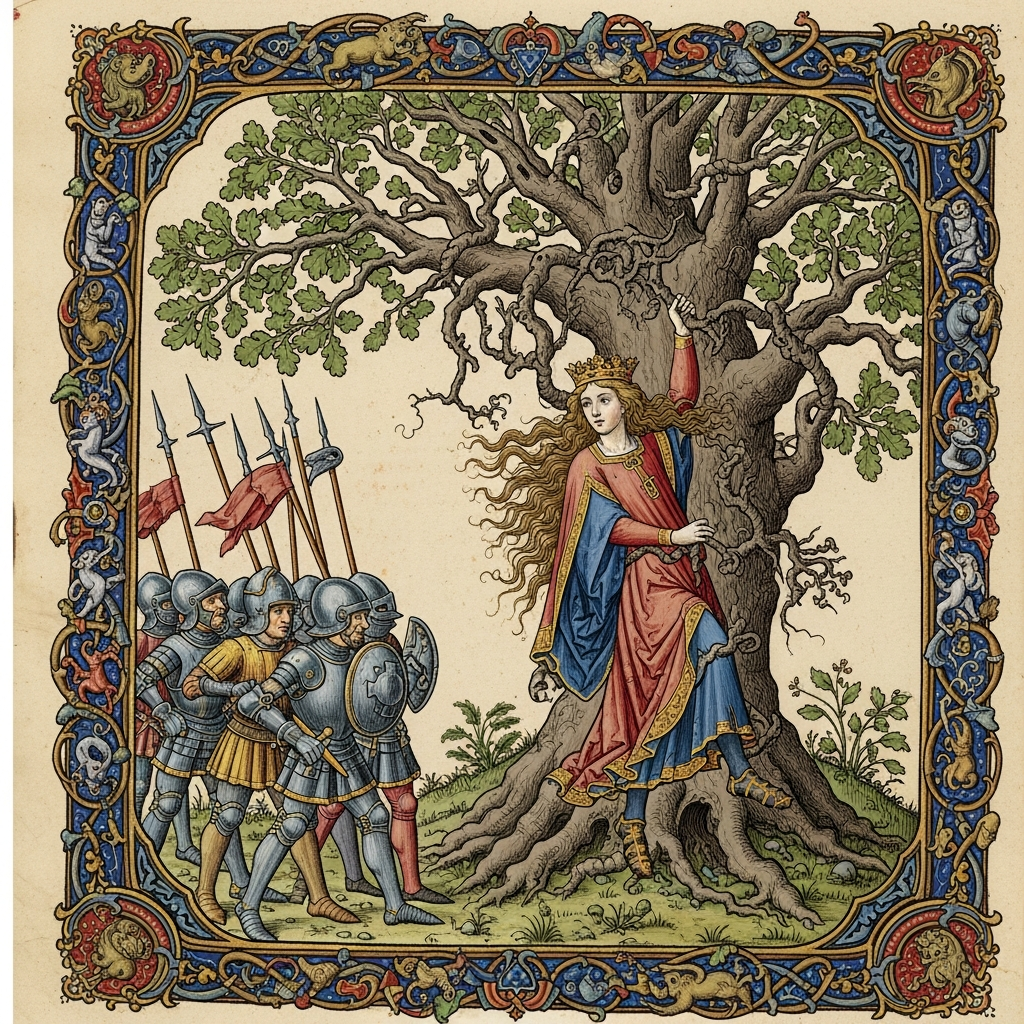
Resistance began in a village called Modein, about seventeen miles northwest of Jerusalem. When royal officers arrived to enforce the new sacrifices, they ordered an elderly priest named Mattathias to set the example. He refused. A more compliant villager stepped forward to offer the pagan sacrifice in his place. Mattathias killed both the villager and the royal officer at the altar, tore down the altar itself, and fled into the hills of Judea with his five sons. “Whoever is zealous for the law and supports the covenant,” he is said to have called out, “let him come out with me.” The peasants who answered would form the core of a guerrilla army.
Mattathias died within a year. Leadership passed to his third son, Judah, whom history would remember by the nickname Maqqabi — “the Hammer.” The Maccabean army never won by fielding superior numbers; it won by knowing the terrain and choosing the ground. In 166 at Wadi Haramia, Judah destroyed a Seleucid column under Apollonius. At Beth-horon, he ambushed Seron’s army descending the pass. At Emmaus in 165, he marched his men through the night around the Seleucid camp and attacked at dawn from the unexpected direction, scattering a force several times his size. At Beth-Zur he turned back the regent Lysias himself.
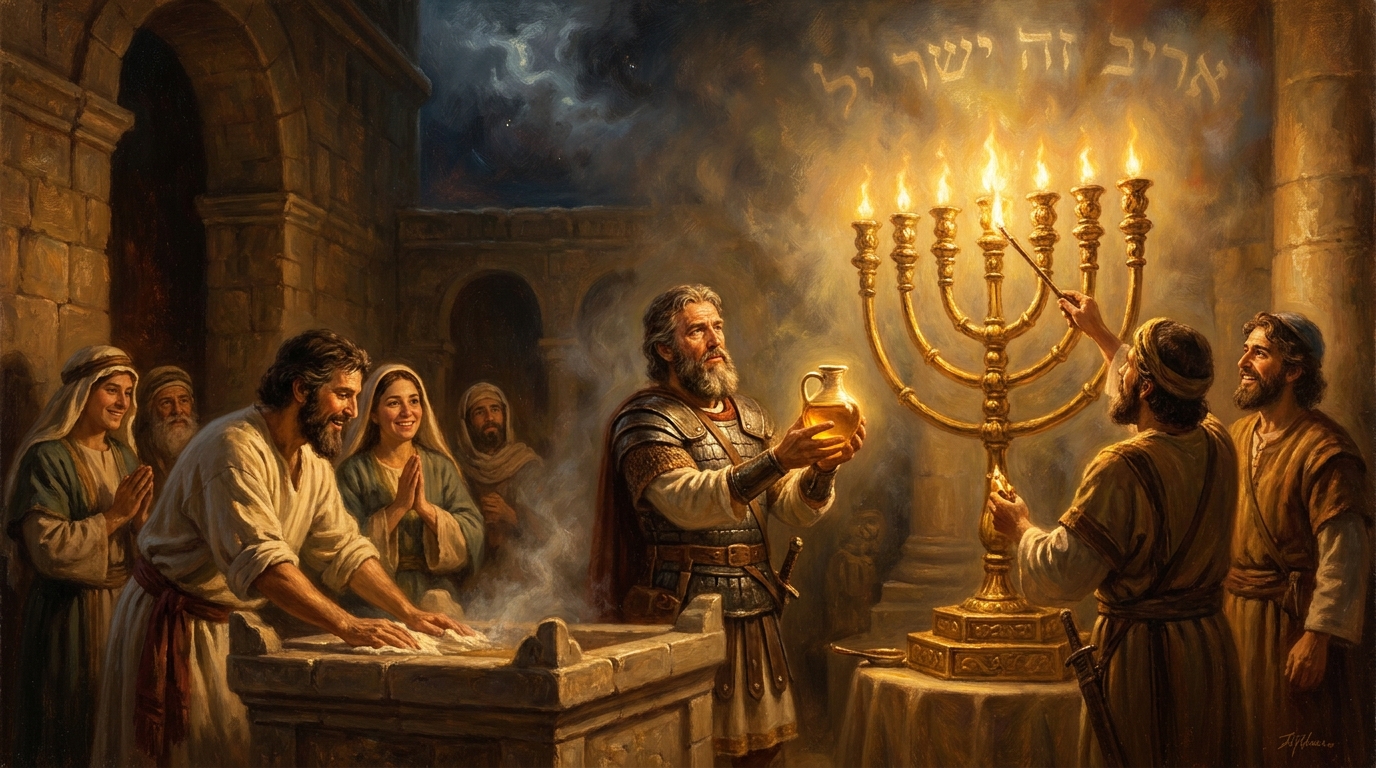
In December 164 BC, Judah retook Jerusalem. The Temple was filthy — three years of disuse, with weeds growing in the courts and the altar still bearing its pig-blood. He tore down the desecrated altar stone by stone, built a new one of unhewn stones, fashioned new vessels, kindled a new lamp, and rededicated the sanctuary on the twenty-fifth of Kislev.
The eight-day festival that commemorates this event — Hanukkah, “Dedication” — has been kept every year since. The traditional miracle of a single day’s consecrated oil burning for eight days is not in 1 and 2 Maccabees, the earliest sources; it appears for the first time in the Babylonian Talmud, several centuries later, as a rabbinic gloss on a festival whose original meaning was military and political.
After Judah
The war did not end with the rededication. Judah was killed in battle at Elasa in 160 BC, fighting against a Seleucid army under Bacchides; his men, outnumbered by more than ten to one, refused to retreat. His brother Jonathan took over and won, by diplomacy more than by force, the formal recognition of Judean autonomy. After Jonathan’s assassination in 143, the youngest of the original five brothers, Simon, secured full political independence in 142 BC. The Seleucid yoke was off. Judea had a Jewish king again for the first time since the Babylonian exile, four centuries earlier.
The dynasty Simon founded — the Hasmoneans — ruled Judea for the next eighty years. They were not without their critics. The community at Qumran broke with the Hasmoneans because the Maccabees were not Davidic kings or Zadokite priests, and yet they had claimed both offices. The civil war between the brothers Hyrcanus II and Aristobulus II in the 60s BC weakened the kingdom so thoroughly that the Roman general Pompey was invited in as an arbiter in 63 BC. He stayed. The independence the Maccabees had won at such cost lasted barely a century.
The texts
The principal sources are 1 and 2 Maccabees, both written in the late second century BC. 1 Maccabees is sober, chronological, and pro-Hasmonean. 2 Maccabees is rhetorical, theologically charged, and shorter; it focuses on the persecutions and the martyrdoms — most famously the deaths of Eleazar the scribe and of the mother of seven sons, each of whom was tortured to death in turn for refusing pork.
Both books were excluded from the Jewish canon when it was fixed in the late first century AD. They were preserved in the Greek Old Testament, the Septuagint, and from there into the Latin Vulgate and the Christian Bible. Catholic and Orthodox Bibles still include them; most Protestant Bibles classify them as Apocrypha.
Why it still matters
The Maccabean Revolt is the reason there is a recognizably Jewish people in the first century AD. Without the rebellion, Antiochus’s program — outlaw Torah observance, fold the temple cult into the Greek pantheon, dilute the Jewish nation into the Hellenistic mainstream — would in all probability have succeeded. The Pharisees, the Sadducees, the Essenes, the apocalyptic literature of the late Second Temple period, the synagogue system, the rabbinic tradition that would emerge after 70 AD: every one of these depends on the prior existence of a self-governing Jewish community in Judea, which is what the Maccabees secured.
The revolt is also the origin point for a theology of martyrdom — the belief that fidelity to God under torture has redemptive value, that the bodies of the faithful will be raised at the last day, that no foreign king can finally take what belongs to the Most High. 2 Maccabees 7, the death of the seven brothers, is among the earliest explicit affirmations of bodily resurrection in any Jewish text.
Hanukkah, lit each winter in homes from Jerusalem to São Paulo, commemorates a revolt that no power in the ancient world expected to succeed.