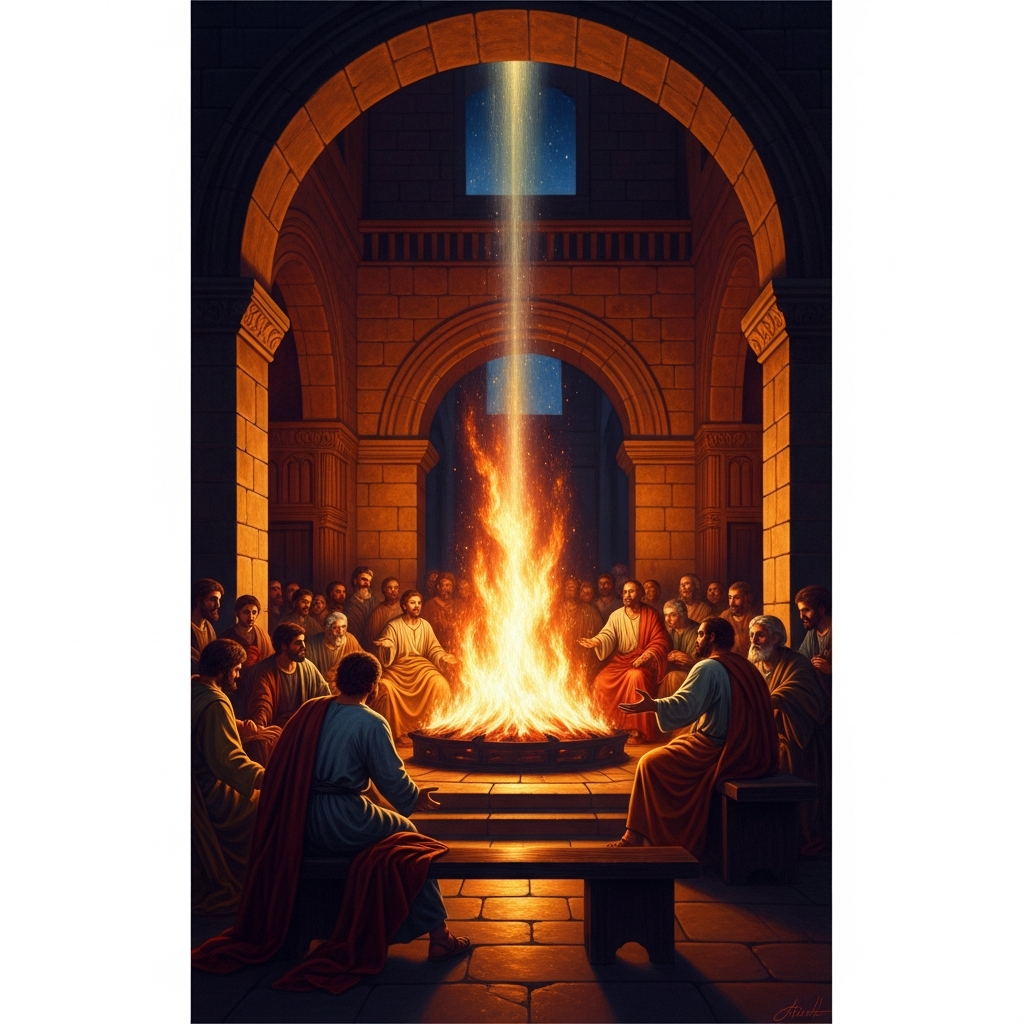
Fifty days after the Sabbath of the Passover at which Jesus was crucified, the small community of his followers gathered in a single room in Jerusalem and, by their own account, were taken hold of by the Spirit of God. The book of Acts places the number at “about a hundred and twenty.” The room was almost certainly an upper-story chamber — the hyperōon — where the disciples had reassembled after the resurrection. What happened there is the official starting point of the Christian Church.
The fiftieth day
The festival they were keeping was not, originally, a Christian one. Pentecost is simply the Greek word for “fiftieth”; in the Jewish calendar the day is called Shavuot, the Feast of Weeks. It falls fifty days after the second day of Passover and marks two things: the conclusion of the spring grain harvest, when the first wheat was brought to the Temple as an offering, and — by an inner-biblical tradition that was already old by the first century — the anniversary of the giving of the Law at Sinai.
In 33 AD the festival fell on a Sunday morning. Jerusalem was crowded. Acts 2 lists fifteen national or linguistic groups present in the city for the feast: Parthians, Medes, Elamites, residents of Mesopotamia, Judea, Cappadocia, Pontus and Asia, Phrygia and Pamphylia, Egypt and the parts of Libya around Cyrene, visitors from Rome — both Jews and proselytes — Cretans and Arabs.
The disciples were “all together in one place” when, according to Luke’s account, “there came a sound from heaven as of a rushing mighty wind, and it filled all the house where they were sitting. And there appeared unto them cloven tongues like as of fire, and it sat upon each of them.” They began, immediately, to speak — not in unintelligible syllables but in the languages of the pilgrims outside, who heard each one in his own dialect being told “the wonderful works of God.”
Peter’s sermon
The crowd that gathered split between astonishment and ridicule. Some accused the disciples of being drunk. Peter — who fifty days earlier had denied that he even knew Jesus — stood up and answered. The speech he gave, preserved in Acts 2:14–36, is the earliest Christian sermon on record. It does three things.
First, it interprets what has just happened by quoting the prophet Joel: “And it shall come to pass in the last days, saith God, I will pour out of my Spirit upon all flesh; and your sons and your daughters shall prophesy.” Joel’s “last days” have begun, Peter says, and the visible signs are not portents in the sky but the speech of ordinary Galileans.
Second, it preaches the resurrection. Peter cites Psalm 16 — “thou wilt not leave my soul in hell, neither wilt thou suffer thine Holy One to see corruption” — and applies it not to David, whose tomb was visible from where they stood, but to Jesus. “This Jesus hath God raised up, whereof we all are witnesses.”
Third, it calls for response. “Repent, and be baptized every one of you in the name of Jesus Christ for the remission of sins, and ye shall receive the gift of the Holy Ghost.” Three thousand people, Acts says, were baptized that day.
What followed
The community that emerged from Pentecost is described in the closing verses of Acts 2 in language that has been read with envy or skepticism ever since: “they continued steadfastly in the apostles’ doctrine and fellowship, and in breaking of bread, and in prayers… and all that believed were together, and had all things common; and sold their possessions and goods, and parted them to all men, as every man had need.” The four practices listed — apostolic teaching, common life, the Eucharist, and corporate prayer — are still recognizable as the four shapes of Christian worship in every liturgical family.
Within weeks the new community had drawn the attention of the Jerusalem authorities. Peter and John were arrested, examined, and released with a warning. Within a few years Stephen had been stoned, the church had scattered into Judea and Samaria, and a young Pharisee named Saul was riding for Damascus to root out the movement at its eastern edge.
Why it matters
For Christians, Pentecost is not the beginning of the church’s teaching — that began with the apostolic preaching of the resurrection in the weeks after Easter — but the beginning of the church’s life. The descent of the Spirit is what separates a frightened, post-traumatic community of disciples from a body that goes out into the streets of Jerusalem and within thirty years has founded congregations from Antioch to Rome. The traditional language for this is empowerment: the same Spirit who animated Jesus’ ministry now animates a corporate body.
The day is theologically rich for additional reasons. Because Shavuot commemorates the giving of the Law at Sinai, early Christian writers — beginning with Augustine — read the descent of the Spirit on Pentecost as a counterpart: the Law was given to Moses fifty days after the Passover lamb in Egypt; the Spirit was given to the disciples fifty days after the Passover crucifixion in Jerusalem. The point is not replacement but completion. What was inscribed on stone is now written, in the language of Jeremiah 31, on hearts of flesh.
The multilingual character of the first Pentecost has also shaped how the church has thought about its own catholicity. The crowd at Pentecost heard the gospel each in his own dialect; the church that grew out of that morning has, ever since, defined itself as a community in which no language is privileged and no nation is excluded. Whether or not the gift of “tongues” continues in the contemporary church is one of the longest-running disputes in Christian history; that the original event was a multilingual one is not in dispute.
The Christian liturgical year places Pentecost fifty days after Easter Sunday — closing the Paschal season and opening the long stretch of “Ordinary Time” that follows. In Eastern Christianity it is also Trinity Sunday. In the West, Trinity is the following Sunday, and Pentecost retains its older name, Whitsunday, from the white robes traditionally worn by the newly baptized.
One hundred and twenty people in an upstairs room; three thousand baptized by sundown. The Church has not, since, gathered that quickly again.