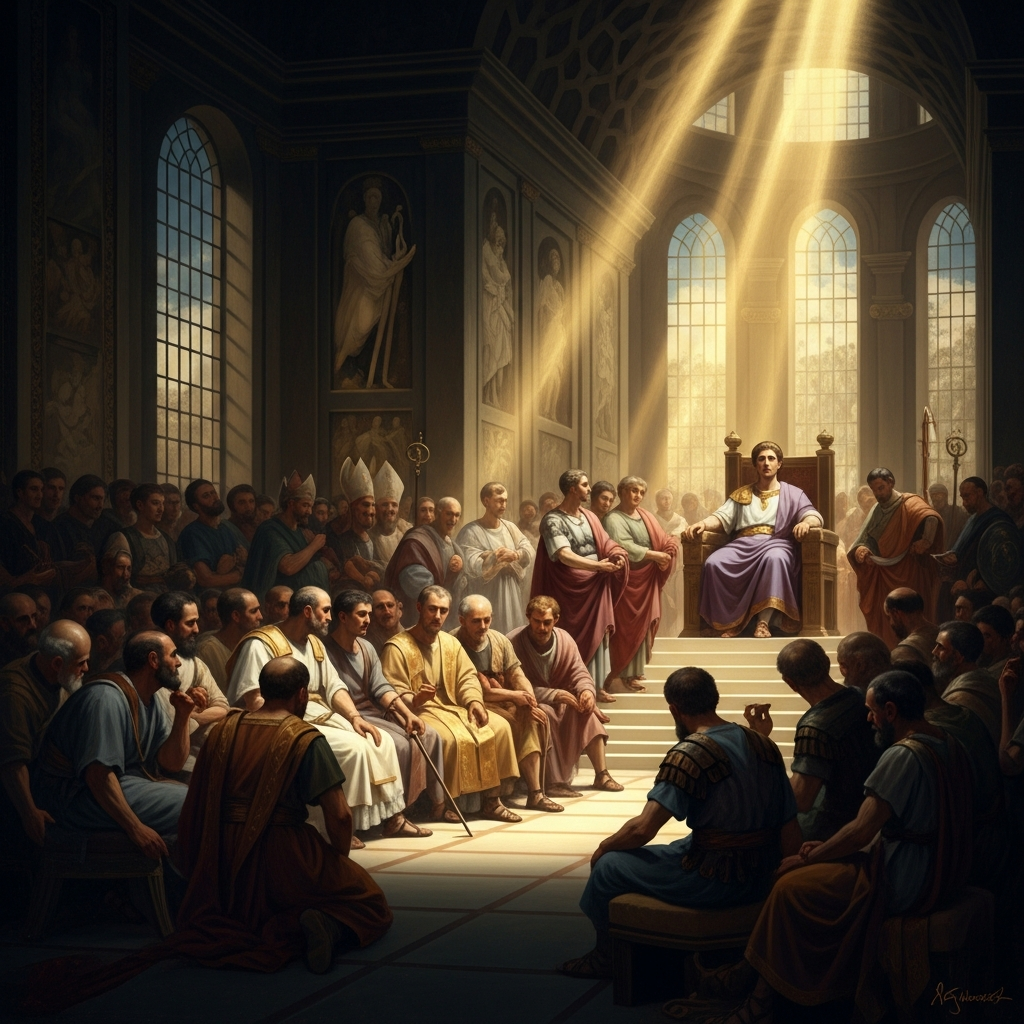
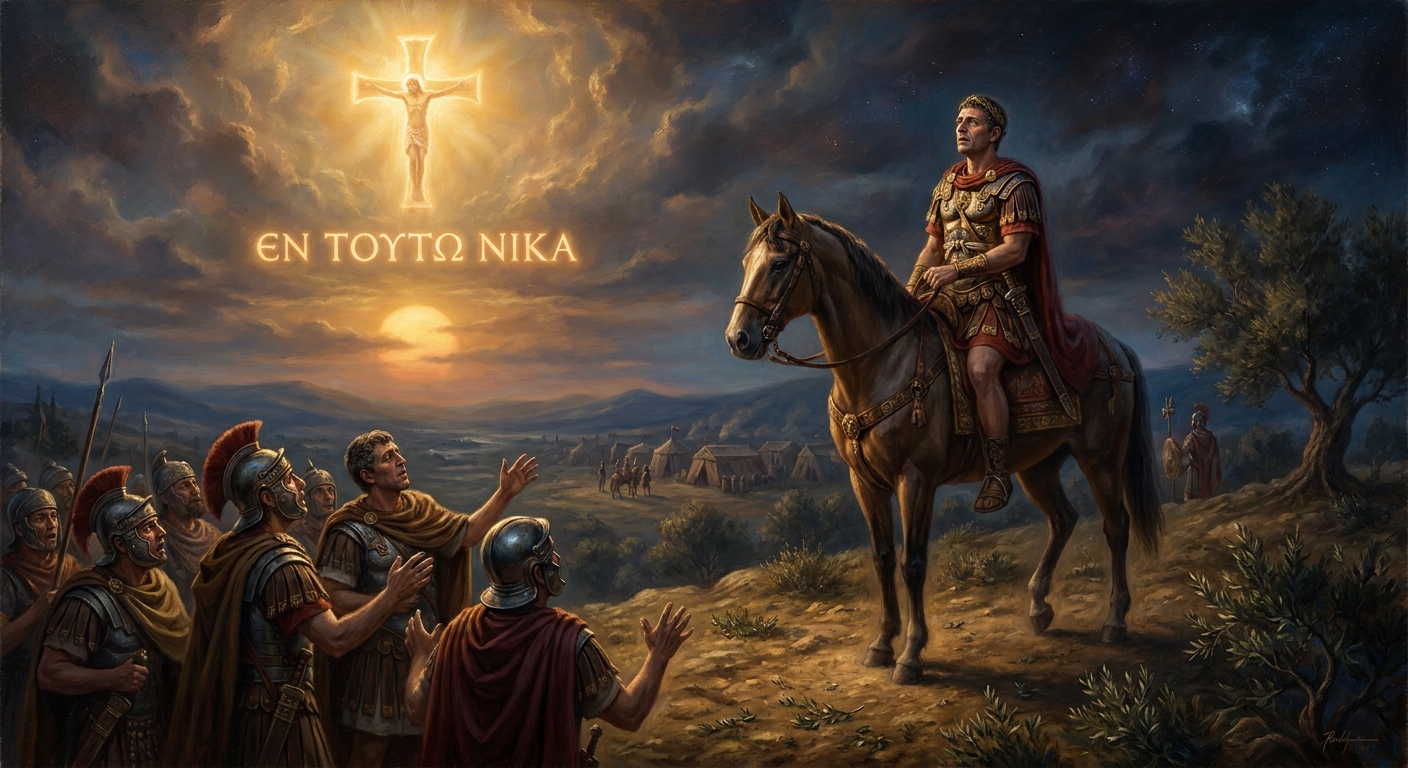
In the spring of 325 AD, the Roman emperor Constantine summoned bishops from across the empire to a lakeside city in northwestern Asia Minor called Nicaea — modern-day İznik in Turkey. He was twelve years into his reign, twelve years since the Edict of Milan had ended three centuries of intermittent imperial persecution, and a single doctrinal dispute had grown loud enough to threaten the peace of the church he had just stopped killing.
The dispute had a name: Arius. A presbyter of Alexandria, Arius taught that the Son of God was not eternal but had been created by the Father — exalted above every other created thing, but a creature nonetheless. “There was when he was not,” went the slogan his opponents quoted back at him. His bishop, Alexander of Alexandria, condemned the teaching. Arius refused to retract. By 324, the controversy had spilled out of Egypt into Palestine, Syria, and Asia Minor; clergy were taking sides; congregations were splitting. Constantine, who had unified the empire by sword and now wanted to unify it by faith, dispatched the bishop Hosius of Córdoba to mediate. Hosius failed. The emperor called a council.
Who came
Tradition fixes the number of bishops at 318 — a symbolic figure drawn from Genesis 14:14, where Abraham led 318 men to rescue Lot. The actual count was probably between 250 and 320. They came overwhelmingly from the Greek-speaking East. Only a handful — Hosius of Córdoba, two presbyters representing the bishop of Rome, the bishops of Carthage, Milan, and a few others — represented the Latin West. The Bishop of Rome, Sylvester I, was elderly and did not attend in person.
Among the easterners were men whose bodies bore the marks of the Great Persecution under Diocletian. Paphnutius of Egypt had lost an eye and the use of a leg to imperial torture. Paul of Neocaesarea could no longer use his hands. Theirs was not an abstract debate. They had been disfigured for refusing to worship anyone but Christ, and they were being asked, two decades later, to define exactly what that meant.
What was decided
The council met for roughly two months. Eusebius of Caesarea — the church historian, our most detailed contemporary source — drafted an early creed that the council expanded and sharpened. The decisive word was homoousios: “of one substance” or “of the same essence” with the Father. It was a non-biblical word for a biblical idea, deliberately chosen because the Arian party could not be made to accept it. Christ was not made; he was begotten of the Father, “true God from true God, begotten not made, of one substance with the Father, through whom all things were made.”
The council also ratified twenty canons of church discipline — rules on clerical celibacy, episcopal authority, the readmission of those who had lapsed during persecution, the timing of Easter (to be calculated independently of the Jewish calendar), and the prohibition of self-castration for clergy. Two bishops refused to sign the creed and were exiled along with Arius. Within a year, however, Constantine softened, recalled Arius from exile, and pressured the church to receive him back. He died before the reconciliation could be enforced.
What was unresolved
The creed of 325 was not the Nicene Creed recited in churches today. That longer version — with its expanded clause on the Holy Spirit, the resurrection of the dead, and the life of the world to come — was finalized at the First Council of Constantinople in 381. The half-century between the two councils was the period of greatest Arian success: emperors after Constantine often favored the Arian position; the great Athanasius of Alexandria was exiled five times for refusing to compromise; for a stretch in the 350s and 360s, most of the empire’s bishops held some form of the Arian view. Jerome would later write that “the world groaned and was astonished to find itself Arian.”
Nicaea, in other words, did not end the controversy. It supplied the vocabulary that eventually won.
Why it still matters
Three things came out of Nicaea that have outlasted every other product of the fourth century.
The first is the creedal form itself: a short, dense, recitable summary of belief that any Christian, anywhere, can be expected to affirm. Almost every later confession — Apostles’, Athanasian, Reformed, Lutheran, Anglican — descends from this template.
The second is the principle of conciliar authority. By gathering bishops from across the empire and treating their consensus as binding on the universal church, Nicaea established the model for the six ecumenical councils that followed and the Roman Catholic and Eastern Orthodox practice that continues today.
The third is the precise theological commitment encoded in homoousios. Whatever else Christians have disagreed about in the seventeen centuries since, those who confess the Nicene Creed are committed to the claim that Jesus of Nazareth was not a created being but the eternal Son — full deity, undiminished and uncreated. The Trinitarian theology developed over the next century, in the work of Athanasius, the Cappadocian Fathers, and Augustine, is an extended commentary on the single Greek word the council insisted on.
The bishops who signed in 325 were, in many cases, men who had been broken by persecution and then handed an empire they were not equipped to govern. They produced, almost by accident, the most durable theological text in Western history.