Combat Profile
Realm of Eternal Night
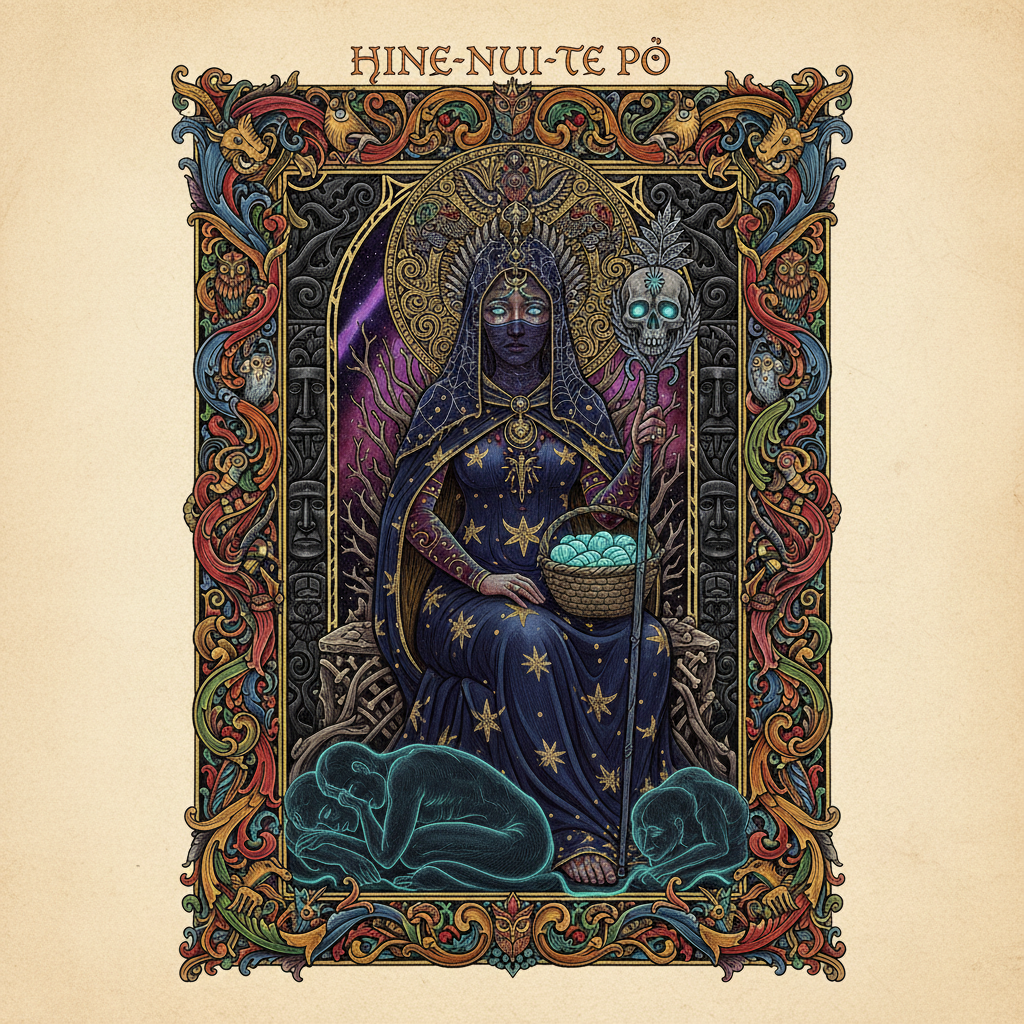
Hine-nui-te-pō draws all living things into her underworld domain, where none may escape her maternal grasp and transition is absolute.
Guardian of Transition
She perpetually shields the spirits of the dead within her realm, granting them protection and passage while enforcing the boundary between life and death.
She cannot return to the world of the living. Her choice was permanent. She waits in the dark, and she will wait forever
“I will go to the underworld, and there I will stay to catch our children as they fall into the darkness. Turn back, Tāne. You stay in the light and push them toward me. I will be waiting.”
Lore: Hine-nui-te-pō is simultaneously the first woman, the goddess of death, and the moral center of Māori mythology. Her story is one of the most extraordinary theological narratives in any tradition: a woman who was created, deceived, enlightened, and then chose her own fate — and in doing so, defined the fate of all humanity.
She was born as Hine-ahu-one, shaped from the red clay of Kurawaka by Tāne, who breathed life into her (Grey, Polynesian Mythology). She became Tāne’s wife. She bore him a daughter, Hine-tītama. Tāne married Hine-tītama as well. But Hine-tītama grew curious about her father — she had never been told who he was. When she asked the posts of the house (or, in some versions, the other gods), the answer came back: Tāne. Your husband is your father. You are your own grandmother.
The discovery shattered her. But what she did next is what makes this story unique in world mythology. She did not go mad (like Jocasta). She did not blind herself (like Oedipus). She did not rage or destroy. She made a decision. She descended to Rarohenga, the underworld, and stayed. She renamed herself Hine-nui-te-pō, the Great Woman of the Night. And she sent a message back to Tāne: “Stay in the world of light. Push our children toward me. I will be here to catch them when they fall into the dark.” Death, in the Māori tradition, is a mother waiting for her children. Not punishment. Not entropy. Care.
Parallel: Every culture has a death goddess: Ereshkigal (Sumerian, trapped in the underworld by circumstance), Hel (Norse, appointed to rule the dead), Izanami (Japanese, rotting in the underworld after dying in childbirth), Persephone (Greek, abducted). What makes Hine-nui-te-pō unique is agency. Ereshkigal was placed in the underworld. Hel was sent there by Odin. Izanami died and decayed. Persephone was kidnapped. Hine walked there on her own feet. She was not punished. She was not tricked. She was not defeated. She learned the truth, and she chose. Compare Eve (Genesis), who also makes a choice that introduces death into the world — but Eve’s choice is framed as disobedience, as sin, as the Fall. Hine’s choice is framed as wisdom. She saw the lie at the heart of creation and she said: I will not live in this. I will go to the dark and make it a place of receiving. The origin of death is not a curse. It is an act of radical maternal sovereignty.
2 min read
No one counters Hine-nui-te-pō. Māui tried and died. Death is the one thing in the Māori cosmos that cannot be overcome
Grey, *Polynesian Mythology*; Orbell, *Illustrated Encyclopedia*; Best, *Maori Religion and Mythology*; Te Ara -- "Hine-nui-te-pō"