Wings and Words: Divine Messengers Across Five Traditions
Ancient, across all periods — Vedic Bronze Age through classical Islamic period · The Abrahamic heavens, Mount Olympus, the Egyptian divine hall, Ahura Mazda's court, the Vedic heavens
Contents
Every theology that places the divine at a distance from the human world eventually requires a messenger. Gabriel, Hermes, Thoth, Vohu Manah, and the Apsaras all fill this role — and their profiles reveal everything about what each tradition believes the divine is trying to say.
- When
- Ancient, across all periods — Vedic Bronze Age through classical Islamic period
- Where
- The Abrahamic heavens, Mount Olympus, the Egyptian divine hall, Ahura Mazda's court, the Vedic heavens
The divine messenger is a solution to a theological problem.
If God (or the gods) is entirely other — infinitely greater than human beings, transcendent, separated from ordinary human experience by a gap that human effort alone cannot close — then the divine cannot simply speak to humans the way humans speak to each other. The communication would destroy the recipient. Moses asks to see God’s face and is told he can only see the aftermath of God’s passing, because the face itself would kill him. The direct encounter between infinite divinity and finite humanity is not conversation — it is obliteration.
Every theology that develops a sufficiently transcendent concept of the divine eventually requires an intermediary — a being who can exist in both the divine and human registers, who can carry the divine message in a form that humans can receive without being destroyed by it. Wings are the symbol of this capacity: the messenger crosses the distance between heaven and earth, between the inaccessible and the accessible, and survives the crossing.
Gabriel: The Angel of Maximum Consequence
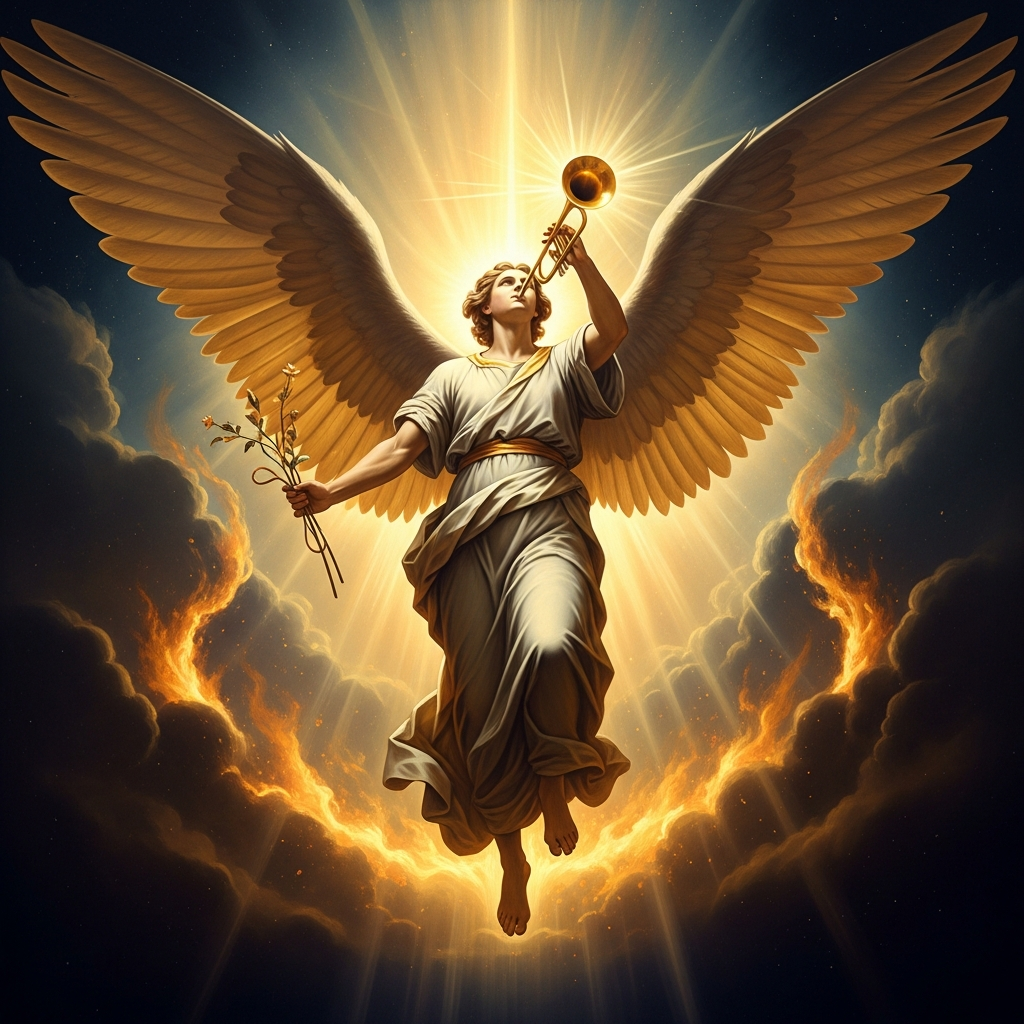
Gabriel’s biblical and quranic appearances have a consistent quality: they are never ordinary. He appears at the moments of maximum theological significance in the Abrahamic traditions, and he never delivers routine news.
In the Hebrew Bible, Gabriel appears in Daniel to interpret visions that Daniel could not decode — the visions of the four beasts, the ram and the goat, the seventy weeks. He is the explicator: he turns apocalyptic imagery into comprehensible (if still difficult) language. He is the divine interpreter placed between the raw symbolic content of prophetic vision and the human mind that must receive it.
In the Gospel of Luke, Gabriel announces the birth of John the Baptist to Zechariah and then, six months later, announces the virgin birth to Mary. “Do not be afraid” — the standard opening of the angelic address — appears in both visits. The divine messenger’s first task is to manage the terror of the encounter; only after the human has been calmed can the message actually be delivered.
In the Quran, Gabriel (Jibreel) is the Ruh al-Qudus (Holy Spirit), the divine agent who delivers the Quran to Muhammad over twenty-three years. This is not a single dramatic visitation but a sustained process of revelation — a theological claim that the Quran is not Muhammad’s composition but divine dictation, transmitted through Gabriel with such fidelity that every word is God’s word. Gabriel is the lossless channel between infinite divine speech and finite human language.
The profile that emerges across all three traditions: Gabriel carries the most important messages, his arrival is terrifying, he must first reassure, and the content of his messages changes the recipient’s life and, in many cases, the course of human history. He is the messenger whose news is never small.
Hermes: The Messenger Who Cannot Be Stopped
Hermes is the only Olympian who moves freely between all three cosmic domains: Olympus, earth, and the underworld. He is the divine ambassador, the guide of souls (psychopomp), the patron of all activities that require crossing a threshold.
His wings — the talaria on his sandals, the winged helmet petasos — are functional rather than merely symbolic. They allow him to cross distances no other divine being covers as freely. When Zeus needs to send a message to a mortal, he sends Hermes. When a soul needs to be guided from the living world to the dead, Hermes leads it. When a divine command needs to reach the most isolated location on earth, Hermes gets there.
The caduceus he carries is the symbol of the messenger’s authority: the entwined serpents (one interpretation: the reconciliation of opposing forces) and the wings at the top mark its bearer as someone whose passage cannot lawfully be obstructed. The messenger is a protected category — even in the underworld, Hermes moves safely because his function is recognized as necessary by every domain.
What makes Hermes theologically interesting is his second portfolio: he is the patron of thieves, merchants, and travelers — every human activity that involves crossing a boundary and that carries some ambiguity about whether the crossing is permitted. The messenger god and the patron of theft share the same divine nature: they are both beings whose nature is to cross the uncrossable. Hermes reveals that the divine authorization to move between categories — which the official messenger has — and the human unauthorized crossing of categories — which the thief and trader also do — are the same activity from different angles.
Thoth: The Messenger as Bureaucrat
The Egyptian Thoth’s messenger function is less dramatic than Gabriel’s and less boundary-dissolving than Hermes’, but it may be the most consequential for actual human civilization.
Thoth communicates among the gods — recording their decisions, conveying their judgments, maintaining the divine archive that is the ultimate basis of Egyptian law and administration. He is the secretary of the divine council. When Ra gives a command, Thoth writes it down. When Osiris reaches a verdict, Thoth records it. The divine communication system runs through Thoth the way the Roman courier system ran through official dispatch riders — not dramatic, not terrifying, but absolutely essential for the operation of a complex divine order.
His transmission to humans is through writing, mathematics, and medicine — the cognitive infrastructure that allows human civilization to organize itself on the pattern of divine order. Thoth does not appear to individual humans with shattering annunciations. He made his communication to humanity once, at the beginning of civilization, by giving humanity the capacity to write. The ongoing message is in the alphabet.
This is the most institutional of divine messenger theologies: the god of communication as the god of record-keeping, of the transmittable text, of the permanent inscription that survives the mortality of the original speaker. Thoth’s wing is the written word.
Vohu Manah: The Message That Is Also the Messenger
The Zoroastrian Vohu Manah (Good Mind) is theologically distinctive among divine messengers because the messenger is also the message.
Vohu Manah is the first of the Amesha Spentas — the “Holy Immortals” who embody the aspects of Ahura Mazda’s divine nature. His particular aspect is Good Mind, the divine intelligence that perceives truth and goodness and responds to them. He appeared to the prophet Zarathustra and led him into the divine presence to receive the revelations that became the Gathas.
The theological structure here: the divine messenger is not a separate being from the divine but an emanation of the divine’s own intelligence. When Vohu Manah visits a human mind and leads it toward the divine, what is happening is that the divine’s own Good Mind is activating within human consciousness. The messenger and the capacity to receive the message are the same faculty.
This is the most interior of divine messenger theologies. Gabriel comes from outside and speaks. Vohu Manah is the capacity for the mind to recognize what is true and good — when it is awakened. The divine communication is not an external event but an internal one: the moment when human intelligence aligns with divine intelligence and both know it.
Wings as Theology
The wings of the divine messenger are not decorative. They encode the core theological claim: the messenger is a being that can cross the distance between heaven and earth, that can exist in both registers simultaneously, that belongs to neither domain fully and therefore can serve both.
In traditions where the divine is not severely transcendent — where gods walk the earth and speak directly to humans as easily as humans speak to each other — you do not need a dedicated messenger class. In the Greek myths, Zeus appears directly when he wants to, often in disguise. The Hermes figure becomes necessary exactly to the degree that the divine becomes distant.
The angel, the divine messenger, the celestial envoy: these figures appear at the precise theological moment when a tradition decides that the divine is too great, too other, too holy to communicate directly with human beings. Their wings measure the distance between God and humanity that the tradition has opened up. And their presence insists that the distance, however vast, is crossable — that the divine has not fallen silent, only distant, and that something with wings can still make the journey both ways.
Echoes Across Traditions
Entities
- Gabriel
- Hermes
- Mercury
- Thoth
- Vohu Manah
- Apsaras
- Michael
- Raphael


Sources
- Walter Burkert, *Greek Religion* (1985)
- Richard Wilkinson, *The Complete Gods and Goddesses of Ancient Egypt* (2003)
- Mary Boyce, *A History of Zoroastrianism* (1975)
- Wendy Doniger, *The Hindus: An Alternative History* (2009)
- David Leeming, *The Oxford Companion to World Mythology* (2005)