Contents
The sage Chyavana, ancient and decayed, is left for dead by his young wife Sukanya — until the divine twin horsemen, the Ashvins, find him. They restore his body so completely that the woman cannot tell which of three identical young men is her husband. In gratitude Chyavana wins the Ashvins their share of the soma, breaking the gods' ban on these two physician-heroes.
- When
- Late Bronze Age to early Iron Age, c. 1200–1000 BCE
- Where
- A forest hermitage by the river
Chyavana was very old when Sukanya found him. He had been sitting in meditation so long that the ants had built a hill over him. Only his eyes were visible, glittering in the dark of the mound. Sukanya was a young princess, walking in the forest with her companions, and she saw the two glints and thought they were jewels and poked them with a thorn.
She blinded him. The princess had blinded a great rishi in his ant-hill, and the rishi’s rage answered: the wind ceased, the king’s army was struck with constipation, and only by giving Sukanya in marriage to the old sage was the curse lifted. So a young woman became the wife of an ancient body. She tended him without complaint. She brought his food. She washed his ruined skin. The hymns are not sentimental about this — Vedic marriage was a covenant, and she kept hers.
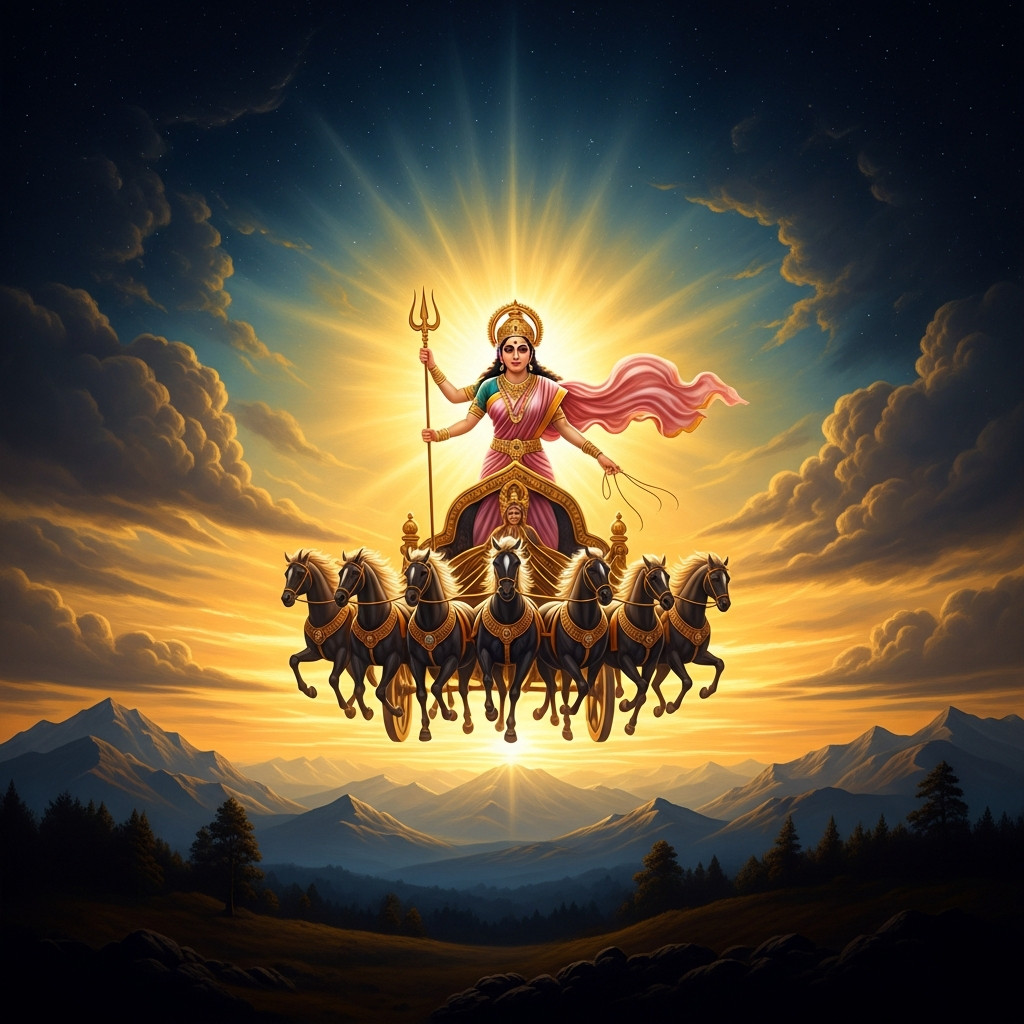
It was during this time that the Ashvins came. The twin gods — sons of the dawn, riders of the golden chariot, physicians whose hands could close any wound — were wandering and saw the beautiful woman tending the broken old man. They paused. They are described in the hymns as honey-makers, the bringers of madhu, sweet as the soma they were not allowed to drink. Their eyes were always on what was lovely.
They tried to seduce her. They told her: leave this husk; come with us; we are young, we are golden, we will give you sons of the gods. Sukanya refused. The Ashvins admired her loyalty. They said: very well — let us prove our power. Let your husband come down with us into the lake.
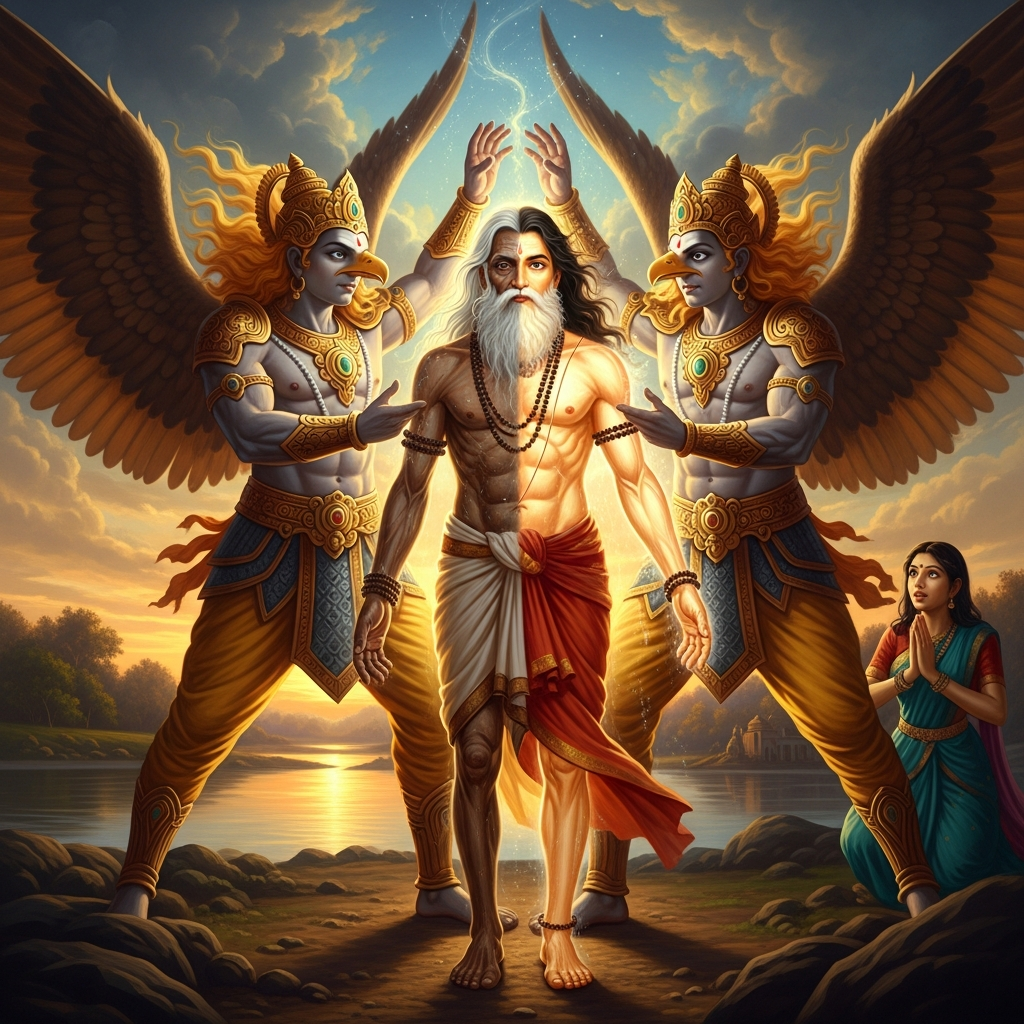
Chyavana stepped into the water. The Ashvins stepped in beside him. The three men submerged together. And when they rose — three young men rose, identical, beardless, gleaming, equally radiant. Sukanya stood on the shore and could not tell them apart. The Ashvins had not just healed Chyavana; they had made him so much like themselves that even his wife could not pick him out.
The hymn does not say what passed between her and the three men in that long moment. It says only that she chose correctly. Some commentators say she recognized something in his eyes; others say the Ashvins, satisfied with the test, gave her a sign. She took the hand of one of the young men, and he was Chyavana, and the other two laughed and rose into the air on their golden chariot.
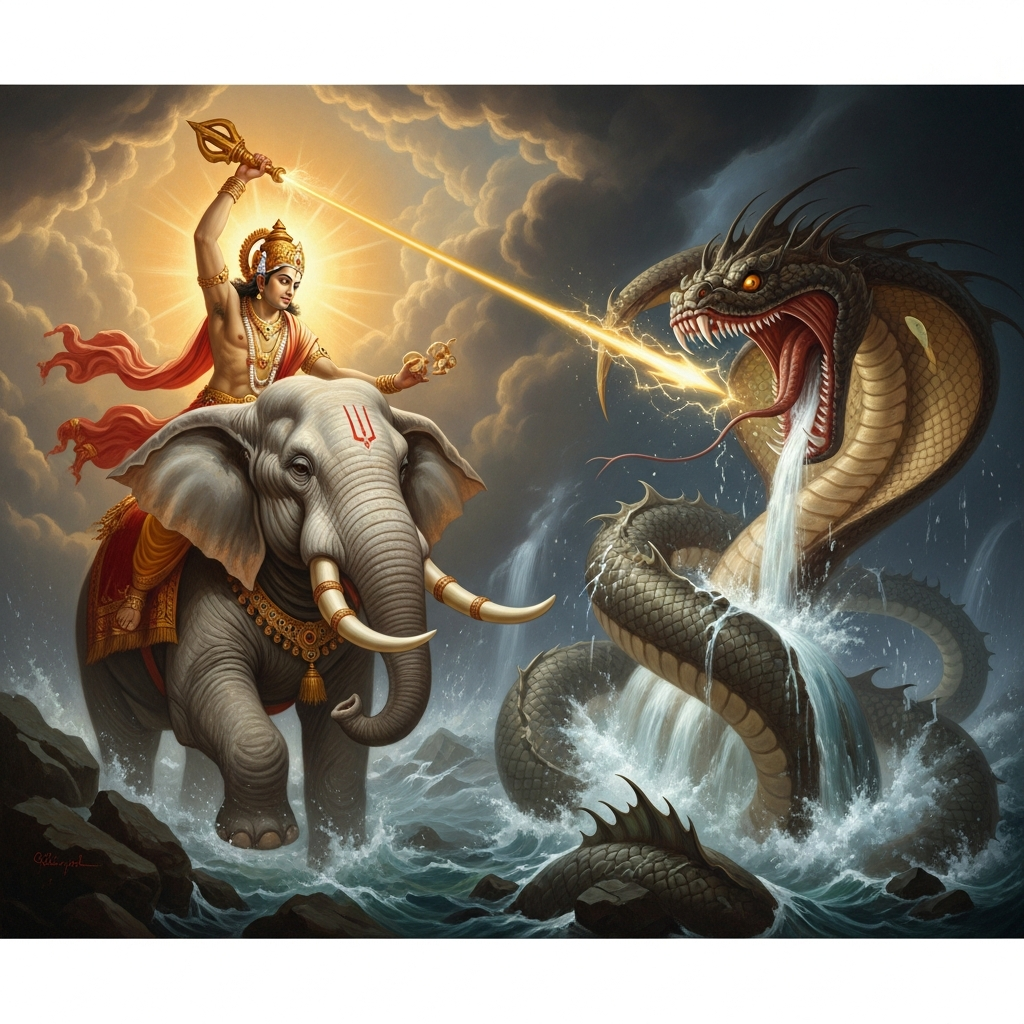
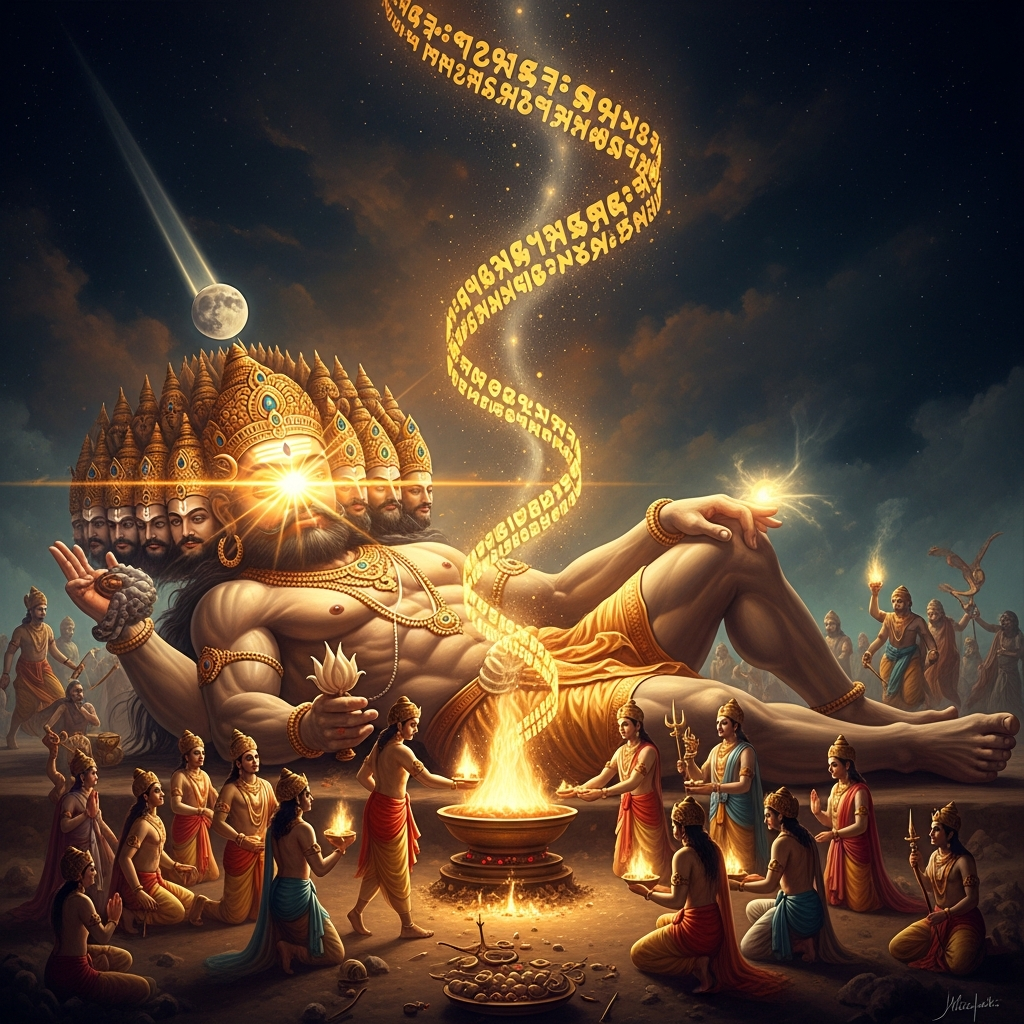
Then Chyavana — restored, vigorous, full of the new life that had been given him — performed a great act of gratitude. He went to the assembly of the gods, where the soma was being pressed at the cosmic sacrifice, and he announced that the Ashvins must be given a share. Indra refused. The Ashvins, Indra said, were not pure; they had wandered too freely among mortals; they had healed common men and even women; they were not fit to drink the drink of the gods.
Chyavana raised his sacrificial spoon and produced a demon — Mada, the personification of intoxication — with jaws large enough to swallow the universe. Indra felt the world being eaten. He yielded. From that day the Ashvins drank soma with the other gods, and from that day the Vedic priest at any healing rite would invoke them by name: Nasatya and Dasra, the True and the Wonderful, the twin riders, the makers-young.
The Rig Veda lists their cures with a kind of wonder. They gave the lame Parashu legs to walk on. They gave the blind Kanva eyes to see. They rescued Bhujyu from the sea when his father had abandoned him on a sinking ship — they made a hundred-oared ship out of nothing and brought him home. They gave a barren cow milk for her calf. They gave the old, the broken, the despairing the one thing the other gods rarely gave: another chance at the body.
This is what the Ashvins are: the gods who say, your case is not closed. The Vedic mind, which loved to ritualize and systematize and assign every god a function, gave to these twins the function of refusing the closure of fate. Other gods kept the order. The Ashvins broke it gently — opening eyes, mending legs, lifting old men out of ant-hills and into the light.
And Chyavana lived a long second life. The hymns do not say how long. But every time a Vedic priest poured the soma for the Ashvins, he was remembering: an old body in the water, three young men rising, a wife on the shore who chose the right one, and a god of healing who took it as proof that he had earned his cup.
Echoes Across Traditions
Entities


Sources
- Rig Veda 1.116, 1.117, 5.74, 7.68 (the Ashvin hymns of healing)
- Shatapatha Brahmana 4.1.5 (the Chyavana narrative)
- Mahabharata Vana Parva 122–125