The Rainbow Serpent Shapes the River Country
Dreaming time — which is simultaneous with the present · Northern Australia — Arnhem Land, the Kimberley, and the regions where rivers and waterholes are the organizing feature of the landscape
Contents
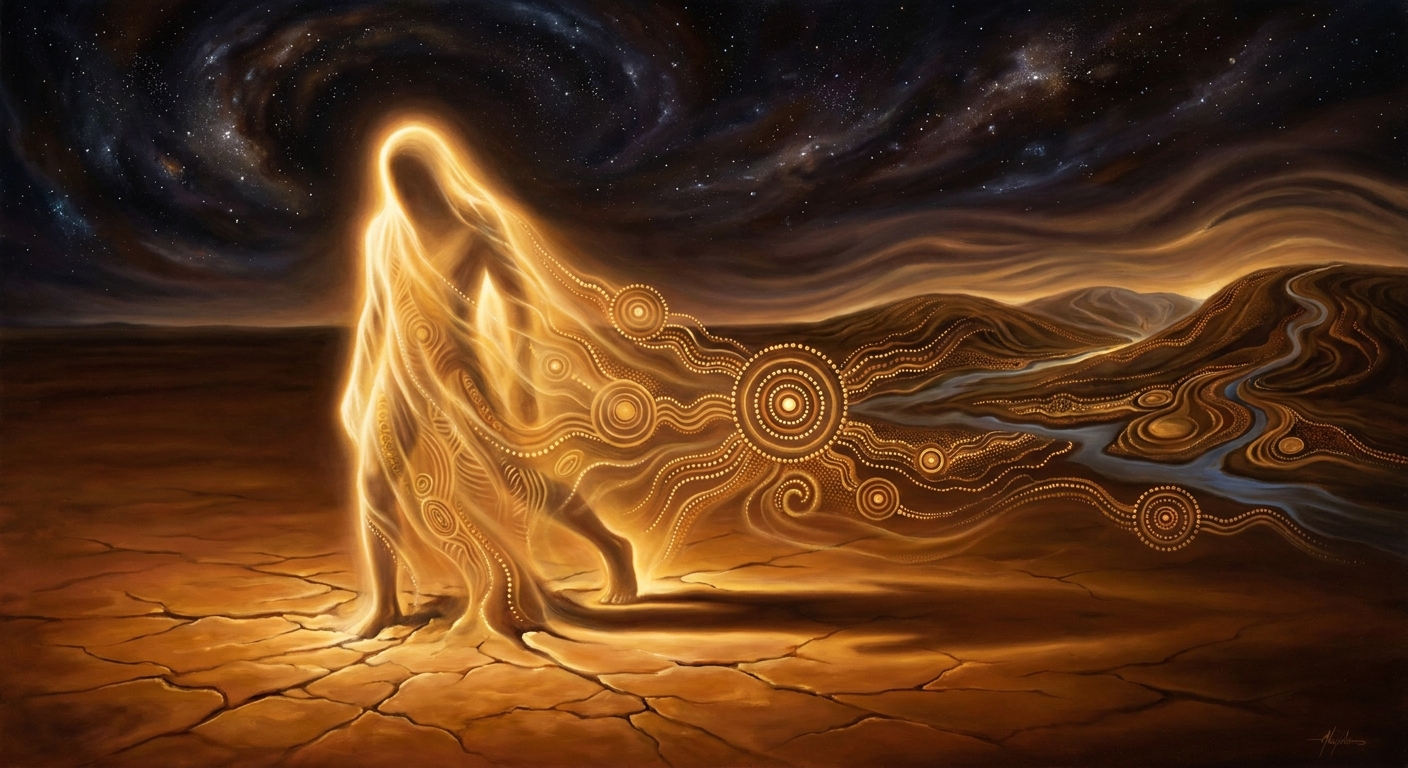
In the Dreaming time, the Rainbow Serpent moves through the Australian landscape and her body creates the river valleys, the waterholes, and the rock formations — and she is still moving, still present in the water, and must be treated with respect.
- When
- Dreaming time — which is simultaneous with the present
- Where
- Northern Australia — Arnhem Land, the Kimberley, and the regions where rivers and waterholes are the organizing feature of the landscape
She comes up from the ground.
In the Dreaming time, when the world is still soft — when the landscape has not yet been given its final form, when the watercourses and the rock formations and the sacred sites are still potential rather than fixed — the Rainbow Serpent pushes up through the earth from the deep underground water country.
She is enormous. Her body is the length of rivers.
She moves through the soft world and her movement creates form. Where she slides, the valleys form — the river channels, the gorges, the paths that the water will take when the rain comes. Where she coils, the waterholes form. Where she rears up, the rock formations rise. The Australian landscape, with its ancient eroded quality, its weathered sandstone and its deep creek systems and its sacred waterholes, is the record of her passage.
She does not merely make things. She names them as she makes them.
In the Aboriginal understanding of the Dreaming, naming and being are the same act. To give a place its name is to anchor its existence, to connect it to the web of the Dreaming that underlies all physical reality. The Rainbow Serpent names the places she creates, and those names are the songs that the people will sing to maintain the country’s vitality.
She is still here.
This is the aspect of the Rainbow Serpent that is most difficult to convey in a language that places mythology in the past: the Dreaming time is not over. The Serpent’s creative journey through the landscape was a Dreaming event, which means it is simultaneously historical — it happened — and present — it is always happening. The waterhole where the Serpent coiled is the waterhole now, and the Serpent’s presence is in it, and disturbing the waterhole without the correct protocols is disturbing the Serpent directly.
She is the rain’s master. This too is not past — she controls the rainfall in her country, and the ceremonies that call rain are addresses to her. The people who have been given custodianship of her sacred sites hold obligations for the maintenance of her country: the ceremonies performed at the right times, the stories told to the young people, the protocols observed at the sacred waterholes.
When these obligations are neglected, the consequences are not supernatural punishment but natural disorder: the rain patterns change, the waterholes dry, the animals who depend on those waterholes move or diminish. The Serpent is not punishing. She is simply withdrawing the maintenance she provides when the relationship is maintained.
The rock art at the edge of the waterhole is at least eight thousand years old.
The painting shows a sinuous figure in red ochre — long, serpentine, with what appears to be a head with projections. It is not the oldest image of the Rainbow Serpent, but it is among the oldest clearly identifiable ones, and the researchers who study it agree: this figure has been recognized, named, maintained, and repainted for eight thousand years. The same being. The same relationship.
The elder who shows the image to the young people does not frame it as history. She says: this is who lives in the waterhole. This is who you must greet when you approach. This is what you must never do here, and this is what you must do.
The young people learn.
The Serpent in the waterhole, which has a greenish-dark quality that deep waterholes in the red-rock country have, is still in the Dreaming and still in the present simultaneously — the way the water in a waterhole is simultaneously the water that has always been there and the water that arrived with yesterday’s rain.
She moves.
She is still moving.
The valley she created is your water.
Echoes Across Traditions
Entities
- Ngalyod (Rainbow Serpent)
- the ancestral beings she encounters
- the rock formations and river valleys she creates
- the rain she controls
- the people who maintain relationship with her
Sources
- Isaacs, Jennifer, *Australian Dreaming: 40,000 Years of Aboriginal History* (Lansdowne, 1980)
- Berndt, Ronald M. and Berndt, Catherine H., *The Speaking Land: Myth and Story in Aboriginal Australia* (Penguin, 1989)
- Flood, Josephine, *Rock Art of the Dreamtime* (Angus & Robertson, 1997)