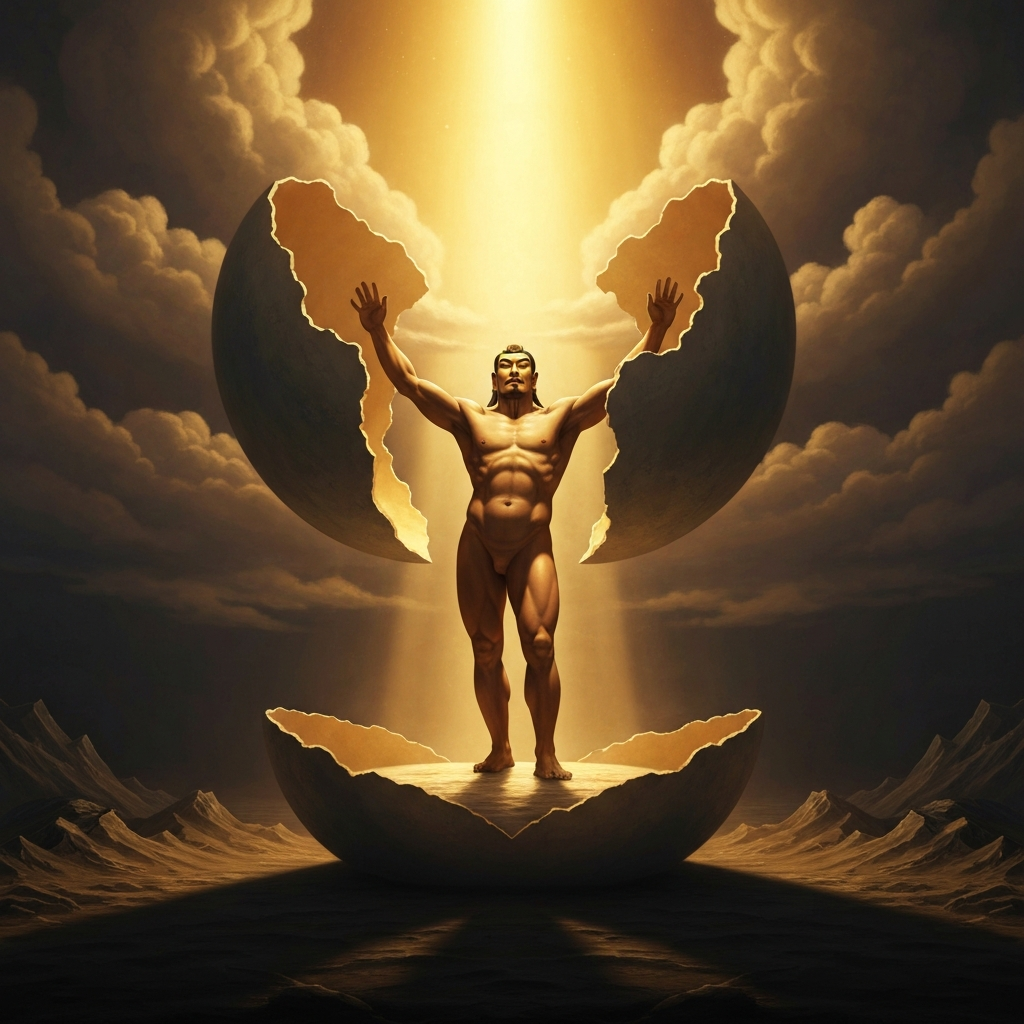
Qū Yuán Falls Into the River
c. 278 BCE — the fall of the Chu capital to Qin forces · The Miluo River in Hunan Province, a tributary of the Dongting Lake
Contents
The greatest poet of the Warring States period, exiled and betrayed, wades into the Miluo River on the fifth day of the fifth month — and the fishermen who love him throw rice dumplings into the water to feed his ghost rather than let the fish eat him.
- When
- c. 278 BCE — the fall of the Chu capital to Qin forces
- Where
- The Miluo River in Hunan Province, a tributary of the Dongting Lake
He wrote the most beautiful poems in the Chinese language and was exiled for telling the truth.
This is not an unusual sequence. It is, in fact, the standard sequence for the Chinese literati who make truth-telling their vocation: the exceptional talent that earns proximity to power, the honesty that makes power uncomfortable, the exile that power uses to manage the discomfort. Qū Yuán served King Huai of Chu as a senior official and diplomatic advisor. He was brilliant at both functions. He was also, from the king’s perspective, an inconvenience: he warned against the alliance with Qin that the king was being flattered into, correctly identifying it as a trap. Other ministers, who had taken Qin’s money, persuaded the king that Qū Yuán was wrong and treasonous.
He was exiled. The alliance with Qin was made. The king was taken prisoner by Qin and died in captivity. The Chu capital fell.
Qū Yuán spent his exile wandering the mountains and rivers of southern China, writing the poems that will be collected as the Chuci — the Songs of the South, the founding text of the Chinese lyric tradition. The Li Sao — the great opening poem, five hundred lines of grief and political commitment and botanical metaphor — is the record of a man cataloguing his own virtue precisely as it becomes useless, like an inventory of a burning house.
He writes about flowers. The whole poem is flowers and plants and the cultivation of rare beauty in the form of personal integrity, with the understanding that the rare plant cannot survive in a court that prefers weeds. He walks with flowers in his hair in the poem, cultivating his virtue in the wilderness because the court has no room for it.
He meets a fisherman on the Miluo River.
The fisherman asks him why he looks so wretched. Qū Yuán explains: the whole world is dirty and he alone is clean; the whole world is drunk and he alone is sober. The fisherman’s advice is practical: if the world is muddy, muddy your feet and splash along. Why drown yourself over your principles? Qū Yuán’s answer is what makes him the patron saint of the Chinese literati and not merely an interesting historical footnote. He says: a man who has just washed his hair does not put on a dirty hat. A man who has just bathed does not put on dirty clothes. How can I let a dirty world soil my purity? He cannot. He walks into the Miluo River holding a stone.
The fishermen love him.
This is the part the festival is about: not his death but the community’s response. The fishermen of the Miluo beat the water with their oars to drive away the fish so the fish would not eat his body. They threw rice wrapped in bamboo leaves into the water to give his spirit something to eat so the water-creatures would not eat him instead. They raced their boats across the water searching for him.
They were too late. They have been too late every year since 278 BCE. The Dragon Boat Festival is the enacted form of the knowledge that you are too late and you go out anyway — that you beat the water and throw the dumplings and race the boats not because it will bring him back but because the love that generates the action is the point, not the result.
The rice dumplings are still thrown. The boats still race. The water of the Miluo River has been beaten every fifth day of the fifth month for over two thousand years by people who love a poet they never met, whose poems tell them what they already know: that integrity is a rare plant, that the dirty world is very large, and that the choice to remain clean is available to anyone willing to pay what it costs.
The stone is still at the bottom of the river. So is everything he chose to take with him when he went.
Echoes Across Traditions
Entities
- Qū Yuán
- King Huai of Chu
- the fishermen of the Miluo
- the Dragon Boats
Sources
- Chuci (楚辭) / Songs of the South — Qu Yuan's own poems, especially *Li Sao* (Encountering Sorrow)
- Shiji (史記), Sima Qian, biography of Qu Yuan
- David Hawkes, trans., *The Songs of the South* (Penguin, 1985)
- Laurence Schneider, *A Madman of Chu: The Chinese Myth of Loyalty and Dissent* (UC Press, 1980)