Sallekhana: The Chosen Death
Practice recorded from earliest Jain texts; Chandragupta Maurya's death c. 297 BCE; modern legal controversy 2006–2015 · Shravanabelagola, Karnataka (Chandragupta); across Jain communities in Rajasthan, Gujarat, Maharashtra; the Supreme Court of India (legal question)
Contents
Sallekhana — also called santhara — is the Jain practice of fasting unto death when the body can no longer serve the soul's liberation. Not suicide: no sudden violence, no despair. A gradual voluntary reduction of food and water, over months or years, with family and community present, concluding in complete stillness. Jain monks and occasionally laypeople have practiced it for two thousand years. The last major public practitioner died in 2015. It is the most counter-intuitive act of non-violence: harming nothing, ending quietly.
- When
- Practice recorded from earliest Jain texts; Chandragupta Maurya's death c. 297 BCE; modern legal controversy 2006–2015
- Where
- Shravanabelagola, Karnataka (Chandragupta); across Jain communities in Rajasthan, Gujarat, Maharashtra; the Supreme Court of India (legal question)
The word means, literally, thinning the passions.
Sallekhana — from sal (proper, good) and lekhana (thinning, scraping away) — is not the same word as suicide. The Jain tradition is precise about this distinction, and the precision is not legal evasion but philosophical argument. Suicide, in the Jain analysis, is violence: a sudden, karma-generating act driven by despair or passion, the soul’s most agitated possible departure from a body it still has use for. Sallekhana is the opposite: the soul’s deliberate, gradual, fully conscious withdrawal from a body that has nothing more to offer the practice of liberation.
The conditions are specific. The practitioner must be terminally ill, or so old that the body can no longer support monastic practice, or facing a famine or disaster from which recovery is impossible. The decision must be made freely, without compulsion, after consultation with teacher and community. The withdrawal of food and water is gradual — over months, sometimes years — and the practitioner spends the time in meditation, scripture recitation, and the explicit practice of equanimity toward all beings, which is the theological purpose of the dying. The body is being reduced to nothing. The soul is being clarified.
The community stays.
The most famous practitioner in Jain history is the most powerful man in Indian history.
Chandragupta Maurya — the founder of the Maurya Empire, the general who unified the Indian subcontinent for the first time, the man who, by 305 BCE, had pushed Alexander’s successors out of the Punjab and governed an empire from the Hindu Kush to Bengal — converted to Jainism in the last years of his reign.
The conversion is attested in Digambara Jain tradition and accepted by most historians as probable. The Parishishtaparvan of Hemachandra, written in the twelfth century, gives the fullest account: Chandragupta received the Jain sage Bhadrabahu as his teacher, learned of the twelve-year famine approaching the Gangetic plains, and abdicated the throne to his son Bindusara. Then he walked south, on foot, to Shravanabelagola in what is now Karnataka.
He walked south with Bhadrabahu and a growing group of monks and laypeople following the same path. He walked south away from the empire that bore his name, away from the administrative machinery he had built and the armies he had commanded and the taxes he had organized and the roads he had paved, in the same direction that Rishabha walked away from the civilization he had organized two billion years earlier. The structural echo is not coincidental. The Jain tradition reads it as confirmation.
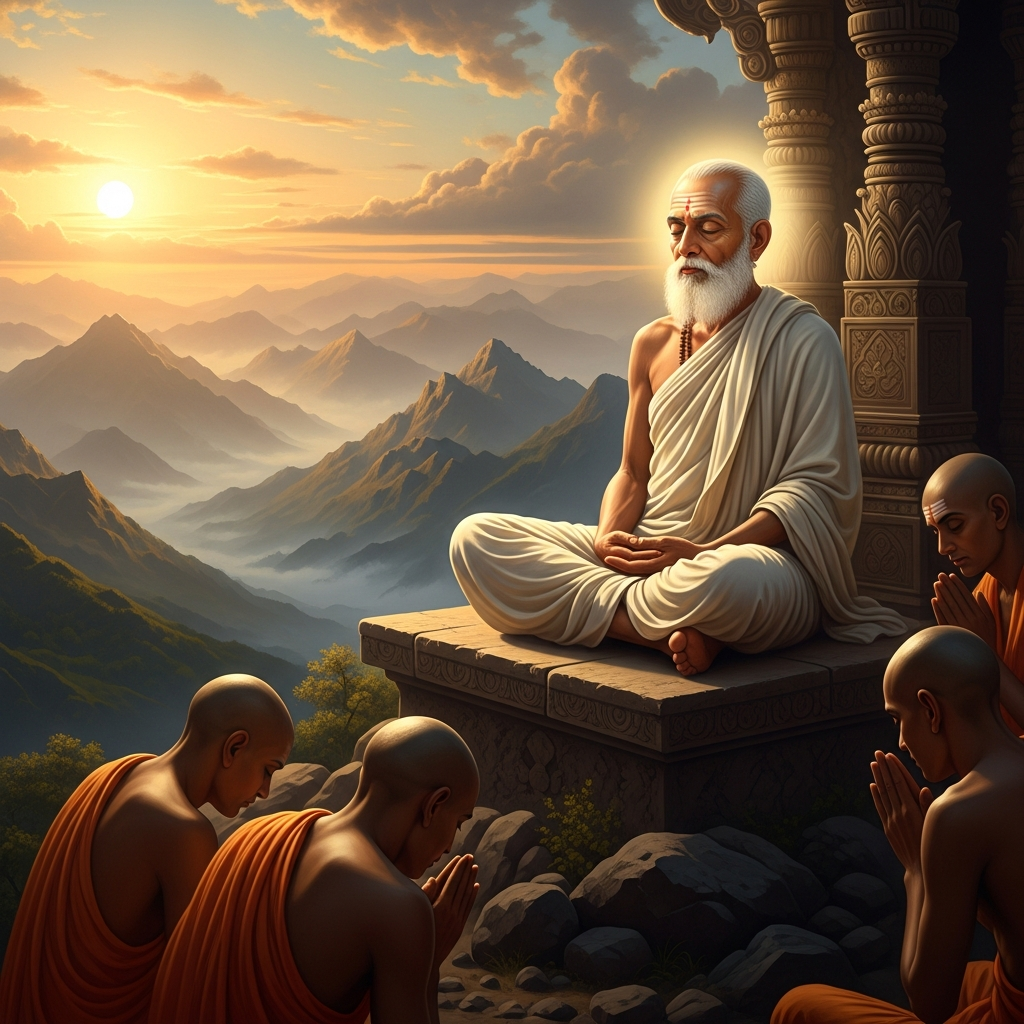
At Shravanabelagola, on a rocky hill above the town that the Digambara tradition still considers one of its holiest sites, Chandragupta sat down and began the fast.
He was approximately fifty years old. He had been emperor since he was twenty. He had defeated the Nanda dynasty, fought Seleucus Nicator to a draw, organized the subcontinent’s first centralized bureaucracy, and received ambassadors from Greece, Persia, and Egypt. He had done this so completely, so efficiently, so finally, that his grandson Ashoka would inherit an administrative structure so robust that it would last, in various forms, until the Gupta period.
He sat on the hill and reduced his food until there was none, and then reduced his water until there was none, and sat in meditation as the body did what bodies do when they are given nothing.
The Jain texts describe his state as samadhimarana — death in equanimity. Not the gritted-teeth endurance of a man forcing himself through something terrible. Equanimity: the mental state in which the body’s dissolution is registered but does not disturb, the way a pond registers rain without being disturbed by it. The hunger was present. The thirst was present. The progressive weakness was present. None of it generated the grasping or the aversion that would have deposited new karma-particles on the soul.
He died, the texts say, in the posture of meditation, on the hill above Shravanabelagola.
The hill is now called Chandragiri — Chandragupta’s Hill.
The rock inscriptions at Shravanabelagola date to the ninth century and confirm the tradition’s presence there. The nearby hill, Vindhyagiri, holds the eighteen-meter statue of Bahubali — Gomateshvara — carved in 981 CE, standing naked in the same posture of body-abandonment that Chandragupta died in. Pilgrims pour milk and turmeric and sandalwood paste over the statue every twelve years in the Mahamastakabhisheka, the great head-anointing ceremony. The ceremony’s timing is not arbitrary: twelve years, like the twelve years of Mahavira’s wandering, like the twelve years of Rishabha’s liberation. The number marks the length of time serious practice takes.
Chandragupta’s sallekhana is the most politically dramatic instance of the practice, but it is not unusual. The Jain chronicles record hundreds of monks, nuns, and laypeople who practiced sallekhana across the centuries. The inscriptions at Shravanabelagola include memorial pillars (nishadis) for monks who died this way, dating from the seventh century onward. The inscriptions are matter-of-fact: the monk took the vow, reduced his food over such-and-such months, died in equanimity, was memorialized. The tone is the tone of an obituary that has decided the fact of the death is not the important thing.
In 2006, the Rajasthan High Court ruled that sallekhana was illegal under Section 309 of the Indian Penal Code — attempted suicide.
The Jain community responded with what can only be described as precise philosophical fury.
The petitions, affidavits, and legal briefs filed in response to the ruling constitute, collectively, the most thorough legal exposition of the difference between suicide and sallekhana ever assembled. The argument was not only theological. It was phenomenological: sallekhana requires a functional will, extended over months or years, which is the opposite of the impaired-will state that makes suicide both a harm and a symptom of harm. It requires community support and oversight, which is the opposite of isolation. It requires terminal or severely incapacitated condition, which means it cannot be chosen by a person who still has other options.
The Supreme Court of India stayed the High Court ruling in 2015, the same year that Satish Kumar, a eighty-nine-year-old Jain layman in Rajasthan, completed his sallekhana after fasting for several months, attended by family and community, and died in the posture of meditation. He was the most publicly documented lay practitioner of the modern era. His death made the newspapers. The coverage was uncertain in tone: not quite obituary, not quite controversy, not quite admiration. The reporters could not decide what category they were in.
The practice asks the question that every medical system, every legal system, and every religious tradition must eventually answer: at what point is the continuation of biological life no longer the same thing as the continuation of a person?
The Jain answer is not metaphysical but practical. When the body can no longer support samyak caritra — right conduct, the ethical dimension of the path to liberation — then the body has served its purpose and its reduction is not a harm to the soul. The soul needs the body as a vehicle. A vehicle that can no longer move is not a vehicle. A vehicle that you are trapped inside is not freedom.
This is why the tradition insists that the decision must come from the practitioner, must be free of despair, must have community witness, and must be gradual. These are not formalities. They are the conditions under which the act remains what it claims to be: not a violence against the self, but the final act of a self that has worked out its debts and is ready to leave.
The thing that makes sallekhana genuinely difficult for most modern observers is not the dying. It is the peace.
We have a category for suffering-unto-death in most traditions: martyrdom, sacrifice, tragic accident. We have a category for despair-unto-death: suicide as crisis. We do not have a well-developed category for dying slowly, consciously, in community, without pain medication or drama, as a deliberate act of spiritual practice, attended by people who understand what you are doing and support it.
Sallekhana occupies the gap in that category system. It is not available for the person who wants to die because life is unbearable. It is available only for the person who has practiced for a lifetime, who has nothing left undone, who has examined the body and found that it cannot give the practice any more of what the practice needs, and who is ready — not desperate, not resigned, but ready — to close the account.
Chandragupta Maurya conquered the known world. Then he sat on a hill in Karnataka and gave it back.
Echoes Across Traditions
Entities
- Chandragupta Maurya
- Bhadrabahu (the Jain sage who led Chandragupta's renunciation)
- Bindusara (Chandragupta's son who received the empire)
- the Digambara monastic tradition
- Satish Kumar (the last major lay practitioner, 2015)
Sources
- *Acaranga Sutra* 9.3 — the earliest canonical description of sallekhana
- *Ratnakaranadashravakachara* (Samantabhadra, c. 2nd century CE) — systematic treatment of lay sallekhana
- Patrick Olivelle, 'Deconstruction of the Body in Indian Asceticism,' in *Asceticism* (Oxford, 1995)
- Padmanabh S. Jaini, *The Jaina Path of Purification* (University of California Press, 1979), ch. 7
- Paul Dundas, *The Jains* (Routledge, 2nd ed. 2002), ch. 6
- Rajasthan High Court ruling (2006) and subsequent Supreme Court review (2015) — legal controversy documentation