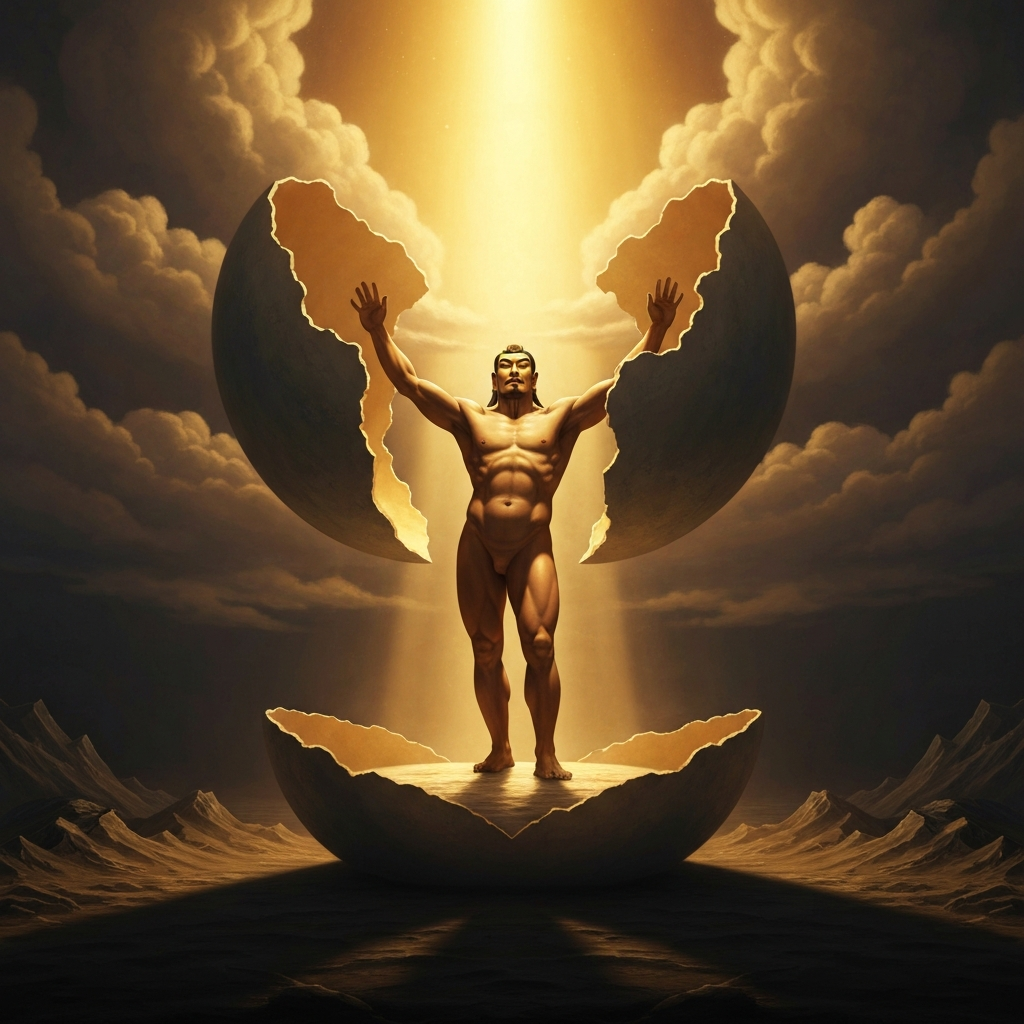
Hòu Yì Shoots Down Nine Suns
Mythological age — between the Yellow Emperor and the Xia dynasty · The burning plains of China and the heights of the Fu Sang tree at the world's edge
Contents
When the ten suns of heaven rise together and begin to burn the world to ash, the divine archer Hòu Yì draws his red bow on the sky and shoots down nine of them — saving humanity, but earning himself a destiny of exile.
- When
- Mythological age — between the Yellow Emperor and the Xia dynasty
- Where
- The burning plains of China and the heights of the Fu Sang tree at the world's edge
The ten suns are the sons of Di Jun, the Heavenly Emperor, and they live in the Fu Sang tree at the edge of the eastern ocean. The tree is vast enough to hold ten suns in its branches. Under normal arrangements, one sun rises each day in a chariot driven by their mother and takes its turn crossing the sky, and then it descends into the western ocean and returns through the underground rivers to the Fu Sang tree, and the next sun’s turn comes. This is the system.
One morning, all ten suns rise together.
Perhaps they are bored with the rotation. Perhaps they have been arguing about whose day is whose. Perhaps there is no reason at all and the myth is simply honest about the fact that catastrophes do not always have reasons. They rise together into the sky and their combined heat falls on the earth like a forge turned on a piece of metal that was meant to hold people.
The crops burn in three days. The rivers begin to steam. The forests ignite along the ridgelines and the fires come down into the valleys. The great beasts — the nine-headed serpent, the great wind beast, the wild boar with tusks the size of palace gates — emerge from the burning forests into the human settlements, because the only cool places left are the places where people have gathered water around their homes. People die of heat, of thirst, of the creatures’ hunger, of the despair of watching everything they built begin to burn.
Emperor Yao, the sage-king, does not know what to do. He prays to heaven. Heaven does not reply — or perhaps heaven replies in the form of Hòu Yì, the divine archer, who appears in Yao’s court with his red bow and his ten white arrows and an expression that is not quite calm but is the thing that comes after you have decided what you are going to do.
Hòu Yì goes to the eastern plain where the sky is lowest.
He draws his bow.
The first arrow takes the first sun. A fireball drops from the sky onto the plain. Where it hits the earth, the ground steams. The sun-crow inside — because each sun contains a crow, a golden crow with three legs — the sun-crow tries to fly up and cannot. The arrow has gone through both.
Hòu Yì draws again. And again and again. He shoots eight more. Nine suns fall. The temperature drops with each one. The fires cool. The rivers stop steaming. The beasts retreat into what is left of the forests.
Emperor Yao, watching, realizes that if Hòu Yì shoots the tenth sun, there will be no light at all. He slips behind the archer and steals one arrow from his quiver while Hòu Yì is drawing again. Hòu Yì reaches for his tenth arrow and his hand finds an empty space. He lowers his bow. He looks at Yao. Yao shows him the empty hands, the meaning clear: enough.
Hòu Yì lowers the bow.
The last sun, alone in the sky now, the only one left of its ten siblings, does not dare to rise for three days. The people come out of their shelters into the cool dark and wait. On the fourth day, the sun rises as it was always supposed to — alone, the right height, the right heat, the right duration. The world is saved.
Di Jun does not thank the archer who saved his world by killing nine of his children. He strips Hòu Yì of his divine status. He banishes him and his wife Cháng’é from heaven. They must live as mortals, which means they will die as mortals. Hòu Yì, the man who saved the world, must now die.
He goes to the Queen Mother of the West to ask for the elixir of immortality. She gives him one dose — enough for two people to ascend to the moon, or one person to become immortal on earth. He brings it home and leaves it with Cháng’é while he prepares for the ceremony. And Cháng’é drinks it alone. She rises to the moon without him.
Hòu Yì is the last man standing. He has saved the world, been exiled from heaven, watched his wife fly to a moon he cannot reach, and he is mortal now, alone on an earth that owes its existence to his shooting, growing older in the usual way, dying in the usual way, buried in the usual way.
The texts do not say whether he regretted shooting those nine suns. They record only that he remained one of the finest archers who ever lived, and that he spent the rest of his mortal life teaching, which is what people do when they have something worth passing on and nowhere left to go.
Echoes Across Traditions
Entities
- Hòu Yì
- Di Jun (Heavenly Emperor)
- Cháng'é
- the ten sun-crows
- the Queen Mother of the West
Sources
- Huainanzi (淮南子), chapter 8, 'Fundamental Norms'
- Shanhaijing (山海經), 'Classic of the Great Wilderness: East'
- Chuci (楚辭) / Songs of the South, 'Asking Heaven' (Tianwen)
- Anne Birrell, *Chinese Mythology: An Introduction* (Johns Hopkins, 1993)