Io's Long Wandering
Mythic age, generations before the Trojan War. Aeschylus stages the meeting with Prometheus c. 460 BCE. Ovid retells the story c. 8 CE. · Argos in the Peloponnese (Io's home and Hera's principal cult site); the Ionian Sea (named for her); the Bosphorus (the *cow's crossing*, also named for her); the Caucasus where Prometheus is chained; Egypt, where she finds rest
Contents
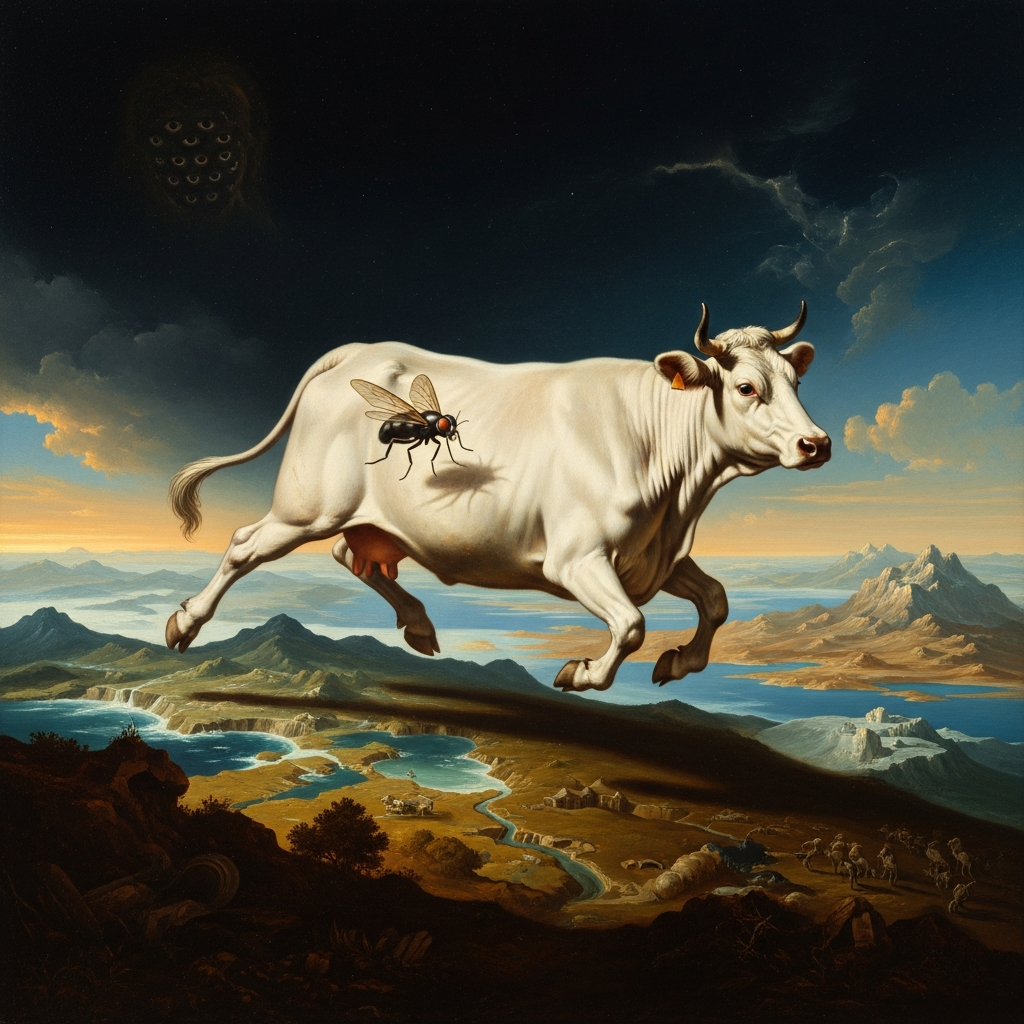
Zeus desired Io, a young priestess of Hera. When Hera came down to investigate, Zeus turned the girl into a white cow. Hera, not deceived, asked for the cow as a gift, and Zeus could not refuse. She set Argus of the hundred eyes to watch her. Hermes killed Argus by storytelling him to sleep. Hera then sent a gadfly to torment the cow, and Io ran — through Greece, across the Bosphorus (which is named for her crossing), through Asia, to the Caucasus where she met chained Prometheus, and finally to Egypt. There Zeus restored her, and she gave birth to a son named Epaphus, the founder of a royal line that would eventually produce Heracles.
- When
- Mythic age, generations before the Trojan War. Aeschylus stages the meeting with Prometheus c. 460 BCE. Ovid retells the story c. 8 CE.
- Where
- Argos in the Peloponnese (Io's home and Hera's principal cult site); the Ionian Sea (named for her); the Bosphorus (the *cow's crossing*, also named for her); the Caucasus where Prometheus is chained; Egypt, where she finds rest
She is a priestess at Argos.
Argos is Hera’s city — the great Heraion, the temple of the queen of the gods, sits on the ridge above the plain of Argos, and the priestesses who tend Hera there are drawn from the leading families of the Argolid. Io is one of them. She is the daughter of Inachus, the river-god of Argos. She is young, beautiful, devoted, and entirely committed to the goddess in whose temple she serves.
Zeus sees her.
He sees her at the temple, or near the river, or in the meadow — the sources differ on the exact location, but the geography matters less than the timing. He sees her, and what he does next is what he always does: he begins to come to her in dreams. The dreams are not subtle. The dreams are erotic, urgent, repeated. Come to me. Lay down by the riverbank. Do not refuse what every other woman in your line has accepted. Io tells her father about the dreams. Inachus consults the oracles. The oracles tell him to send his daughter from the house — Zeus is coming, and he will have her, and you cannot stop him; the only thing you can do is not be in the way.
Inachus banishes her.
She walks out of her father’s house onto the open road, and Zeus comes to her in his actual form, and the affair begins.
It does not stay secret long.
Hera looks down from Olympus.
She is the goddess of marriage. She is the goddess of Argos. She is, by long experience, a goddess attuned to her husband’s adulteries, and the disturbance over the Argolid plain — a sudden unaccounted-for fog, a dimness in the middle of a clear day — is unmistakable to her. Zeus, on earth, has noticed her noticing. He has perhaps three seconds before she descends.
He acts.
He turns Io into a cow.
This is the kind of decision Zeus makes when there is no good decision available. The cow is white — snow-white, Ovid emphasizes, with horns just beginning to grow — and she is standing in the field where Io had been a moment before. Zeus stands beside her with the look of a god who has been doing nothing all afternoon. The fog clears.
Hera arrives on the ground.
She walks across the field. She looks at the white cow. She looks at her husband. She does not speak for a long moment. Then, in the most pleasant possible voice, she says: what a beautiful animal. What is it doing in the middle of nowhere? It is so unusually fine. I would love to have it.
Zeus, trapped — to refuse would confirm exactly what he is denying — gives her the cow.
Hera takes the cow.
She binds Io with a rope around the neck and walks her back to Argos. She tethers her in a sacred grove. She sets a guard.
The guard is Argus.
Argus Panoptes — the all-seeing. He is a giant born of the earth, and he has a hundred eyes distributed all over his body — on his forehead, his back, his arms, his shoulders, his thighs. The eyes do not all close at once. Even when Argus sleeps, fifty of his eyes are open. There is no angle of approach to the cow that is unseen at any moment, day or night. Hera has chosen the perfect jailer.
Io is left under the watch of a hundred eyes.
She is still Io inside the cow. This is the part that the sources insist on. She has the mind of a young woman; she has the speech of a young woman; she has, somewhere behind the white face and the horns, the priestess of Hera who used to walk to the temple at dawn. But she cannot speak. The cow’s mouth cannot form words. The cow’s body cannot write. She tries — Ovid has her scratching her name into the dirt with a hoof, I-O, the simplest possible inscription, the only one her body can manage — and her father Inachus, finding her, recognizes the marks. He weeps over the cow that is his daughter. He cannot help her. He has to leave her under Argus’s watch, and Argus’s hundred eyes follow him out of the grove.
Zeus, on Olympus, cannot endure this.
He calls Hermes.
Hermes is the messenger, the trickster, the god of language and persuasion. Zeus tells him: go to the grove. Get the cow out. Do whatever you have to do. Hermes goes — not as a god, but disguised as a wandering shepherd, with a flute, with a stick, with an air of pastoral leisure.
He sits down beside Argus.
He plays the flute. He talks. He begins to tell stories. The stories are good. The stories are long. Argus, who is bored — the great problem of perpetual surveillance is that there is nothing to look at — is delighted to have a storyteller. Hermes tells him the story of Pan and Syrinx, the river-nymph who turned into reeds. He tells him the story of how the flute itself was invented. He tells stories that fold into other stories. The afternoon goes by.
Argus’s eyes start to close.
This is the cunning of it. Hermes is not putting Argus to sleep with magic; he is putting him to sleep with narrative. The eyes close one by one — first the ones on the back of the head, where the storyteller’s voice is softest; then the ones on the shoulders; then the ones on the arms; then, finally, the ones on the forehead. By evening, all hundred eyes are closed.
Hermes draws a knife.
He kills Argus where he sits. The hundred eyes do not open. The giant slumps over the rock he has been guarding from. Hera, hearing of the death, comes down — and finds her watchman dead and her cow gone. She gathers the hundred eyes from the corpse and arranges them on the tail-feathers of her sacred bird, the peacock, where they remain to this day. The peacock’s tail is the memory of Argus.
But Io is loose.
Hera sends a gadfly.
This is the punishment. Io has been freed from Argus, but she has not been freed from Hera. Hera, who could not contain her in the grove, decides that if she cannot be held still she will not be allowed to rest. The gadfly — oistros, in Greek; the same root as our estrus, the heat-cycle, the maddening sting — is sent to follow Io wherever she goes.
The fly bites her flank. She runs.
She does not stop running. She cannot. The fly stings her every time she slows, and she crosses the Argive plain at a gallop, the gadfly behind her, her own breath rasping in the cow’s chest she still inhabits. She runs north. She runs through Boeotia. She runs through Phocis. She crosses the Greek mainland.
She comes to a strait of water on the eastern coast.
She has never seen it before. She is a cow now; she has crossed water before, but only rivers. She runs into the sea and swims. The strait is narrow. She crosses it. The Greeks afterward will name this strait the Bosphorus — bous, cow; poros, crossing — the cow’s ford. Every ship that goes through it for the next three thousand years passes through a place named for the panicked swim of one girl in a borrowed body who could not stop because of a fly.
She crosses into Asia.
She runs east along the Black Sea. She crosses Scythia. She turns south through the Caucasus. The gadfly has not stopped. It has been stinging her for weeks now, for months, for the long time it takes a woman in a cow’s body to cross a continent. She is exhausted. She is starving. The cow’s body has not been allowed to graze for more than a few minutes at a time. She comes, eventually, to the side of a great cliff in the Caucasus mountains.
There is a man chained to the cliff.
His name is Prometheus.
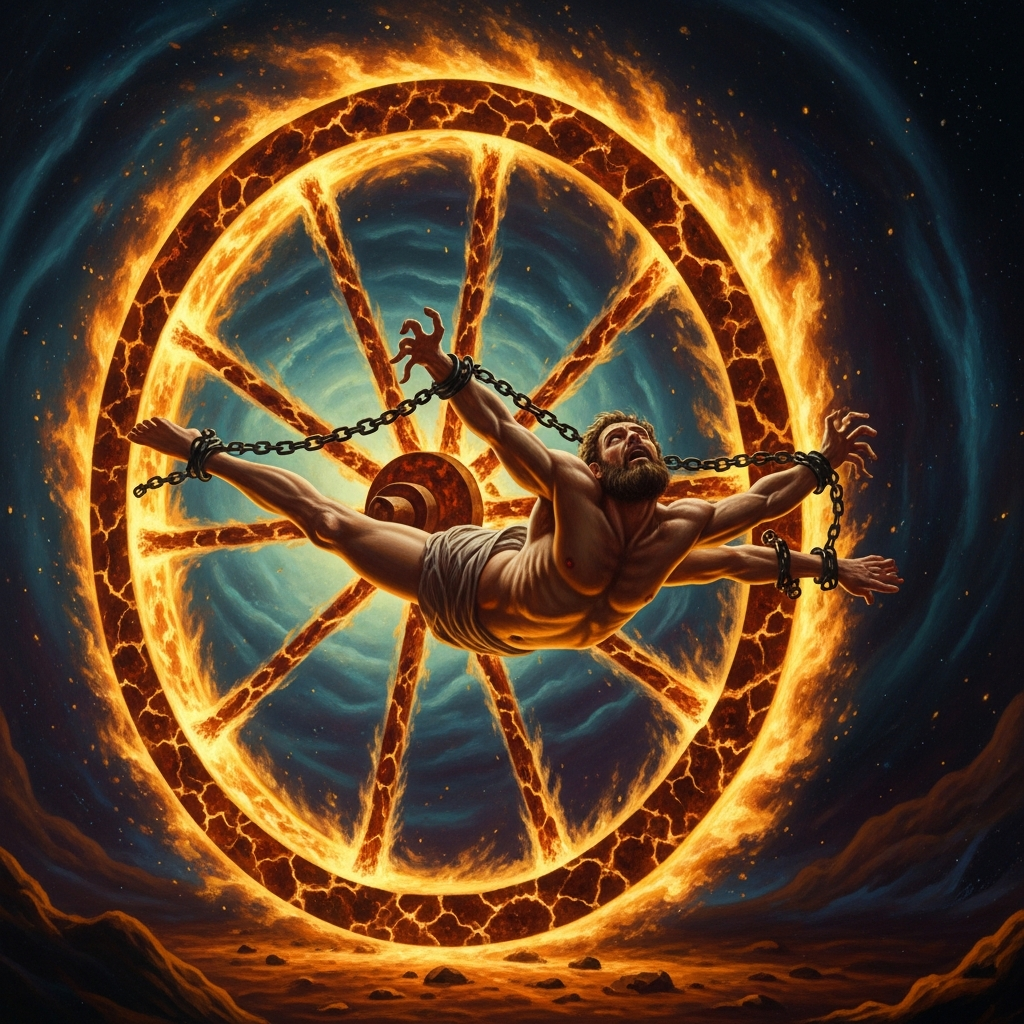
He is the Titan who stole fire from Olympus and gave it to humans, and Zeus has chained him to this rock in the Caucasus for it — chained at the wrists, at the ankles, with iron driven through his sides into the rock. Every day at noon an eagle comes and eats his liver. Every night the liver grows back. He has been here, by the time Io reaches him, for an unknown number of years; the punishment is open-ended; it has no scheduled end.
Aeschylus stages this meeting in Prometheus Bound.
Io comes around the curve of the mountain, panting, the gadfly visible on her flank, and sees the chained Titan. They speak. She is — somehow, in the play, despite the cow’s body — able to speak; the Greek tradition is inconsistent on whether her voice was restored at this point, or whether she could speak only at certain moments, or whether the playwright is simply setting the stage convention aside. She tells Prometheus her story. He tells her his.
They are mirror images. He cannot move; she cannot stop. He is held in place by chains; she is driven across the world by a sting. Both are being punished by Zeus — he for stealing fire, she for being the object of Zeus’s own desire. Both are innocents in the moral sense — Prometheus’s gift was a kindness to humans; Io did not invite Zeus’s attention — and both are suffering at his hand.
Prometheus prophesies her route.
This is what he gives her. He cannot give her freedom. He cannot end the gadfly. But he can tell her, in detail, where she still has to go: south through the rest of the Caucasus, across the lands of the one-eyed Arimaspians, past the Gorgons, across the desert to the river Nile. Egypt, he says. That is where you will be allowed to rest. Zeus will lay his hand on you in Egypt — gently, this time, not as a lover, but as the god who has finally let go of you — and you will be a woman again, and you will give birth to a son. He gives her the names of her descendants. He tells her that one of them, generations later, will be Heracles, and that Heracles will free Prometheus himself from this rock.
She listens.
The gadfly is still on her flank. She cannot stay even for the rest of the prophecy. She bows her head — the cow’s head — to the chained Titan, and runs.
She crosses Asia.
She runs across the Persian plateau. She crosses Mesopotamia. She crosses the Sinai. She arrives at last at the Nile.
This is the geography Aeschylus and Ovid both insist on. Io’s terminus is Egypt. The reason is partly mythological — the Egyptian goddess Isis is depicted with cow-horns and a moon-disc, and the Greeks, when they encountered Isis, recognized her as their own Io who had arrived there long before. That is our girl, the Greek travellers said; that is the white cow who ran from Hera; she ended up here, and the Egyptians have been worshipping her ever since. This identification is preserved by Herodotus, by Apollodorus, by all the later mythographers.
Io reaches the Nile. She kneels in the wet grass on the bank.
The gadfly stops.
This is the moment. Whatever Hera’s punishment was, it is over. The fly leaves her flank. She is, for the first time in months — or years; the timeline of cow-Io is genuinely difficult to reckon — still. She lies down on the bank of the Nile.
Zeus comes to her.
He touches her — gently, on her flank, on her cow’s brow. The touch transforms her back. She is a woman again. She is naked, exhausted, kneeling in the wet grass on the riverbank, and she is fully herself for the first time since the morning Hera came down to the Argive field.
She is also pregnant.
The pregnancy is from the original encounter — months or years earlier, in Greece — and has been carried inside the cow’s body the whole time. She gives birth on the riverbank. Her son is named Epaphus, the touched one, because he was conceived by the touch of Zeus and brought to birth by the touch of Zeus and named by the touch.
He grows up in Egypt. He is, the tradition says, the founder of the line of Egyptian kings — Belus is his grandson; Aegyptus and Danaus are great-grandsons; the Danaids are the next generation. The whole genealogy of Argive heroism descends through Epaphus. Generations later, when the line returns to Greece (when the Danaids flee Egypt back to Argos to escape forced marriage, the subject of Aeschylus’s Suppliants), they come back to the city Io was driven from. The cycle closes.
And generations after that, Heracles is born in Thebes — descended through this same line, from this same Egyptian son of the white cow — and Heracles, in fulfilling Prometheus’s prophecy, climbs the Caucasus and shoots the eagle and breaks the chains and frees the chained Titan who once stood at the side of the road and prophesied to a panting cow.
The line of Io frees the line of Prometheus. The two who met on the cliff in the Caucasus complete each other across the generations.
Aeschylus’s treatment of Io in Prometheus Bound is one of the great moments of fifth-century Greek tragedy. The chained Titan and the running cow-girl meet on the cliff face, both of them victims of Zeus, both of them unable to move in any direction they choose. Aeschylus stages the meeting at length — Io’s panting arrival, the recognition of mutual suffering, the long catalogue of geography Prometheus reads to her. The play uses the meeting to question the justice of Zeus’s regime. Prometheus, who knows the future, knows that Zeus’s reign is not eternal, that there is a son of Zeus yet to be born who will overthrow him. He hints at this. Io, the wandering ancestor of one of those sons (Heracles), is the visible symptom of Zeus’s tyranny that the Titan is using as evidence.
The trilogy of which Prometheus Bound is the surviving part — Aeschylus also wrote Prometheus Unbound and probably Prometheus the Fire-Bringer — apparently followed the line of Io’s descendants and the eventual reconciliation of Zeus with Prometheus when Heracles freed him. We have only the first play. We can guess at the arc.
Ovid’s treatment in the Metamorphoses is more focused on the comedy of the situation — Hera’s icy politeness asking for the cow as a gift, Hermes telling stories to put a hundred eyes to sleep, the cow scratching her name in the dirt. Ovid is interested in the bodily indignity of transformation and in the absurdity of the divine politics. But even Ovid does not soften the running. The gadfly is in his text. The continental crossing is in his text. Io reaches Egypt in his text and is restored.
The myth is, in passing, a piece of remembered geography. The Bosphorus is named for her. The Ionian Sea — the strip of water between Greece and Italy — is named for her. The strait between the Black Sea and the Sea of Azov, the Cimmerian Bosphorus, is also named for her, in some traditions, as a second crossing. Wherever Io ran, the Greeks left her name behind, the way other peoples leave saints’ names on rivers and capes. The whole eastern Mediterranean is, in a sense, the map of one woman’s panicked flight, with place-names as her footprints.
And the myth is, in its deepest reading, a parable about how divine love and divine jealousy together produce the world’s geography. Zeus’s desire for Io and Hera’s hatred of Io produce, between them, the route Io runs — and the route is the eastern Mediterranean itself, and the cities along the route are her descendants, and the genealogy of Greek heroism is the working out of the wandering. The whole heroic age is downstream of one cow’s gallop.
*She rested, finally, on the bank of the Nile. Egypt was where she was allowed to stop. The Greeks looked at the Egyptian goddess with the cow horns and the lunar disc and said, with some mixture of recognition and grief: that is her. She made it. She is being prayed to here now.”
Echoes Across Traditions
Entities
- Io
- Zeus
- Hera
- Argus Panoptes
- Hermes
- Prometheus
- Epaphus
Sources
- Aeschylus, *Prometheus Bound* 561-886 (c. 460 BCE)
- Aeschylus, *The Suppliants*
- Ovid, *Metamorphoses* 1.583-750 (c. 8 CE)
- Apollodorus, *Bibliotheca* 2.1.3
- Herodotus, *Histories* 1.1, 2.41
- Hesiod, *Catalogue of Women* fragments