Izanagi and Izanami: The Islands Born from a Spear
Compiled in *Kojiki* 712 CE and *Nihon Shoki* 720 CE; underlying oral traditions considerably older · The Bridge of Heaven (Ame-no-Ukihashi); the eight great islands of Japan; Yomi, the land of the dead, underground
Contents
Izanagi and Izanami stir the ocean with a jeweled spear and the Japanese islands rise. When Izanami dies giving birth to fire, Izanagi follows her into death — and fails the forbidden-look test.
- When
- Compiled in *Kojiki* 712 CE and *Nihon Shoki* 720 CE; underlying oral traditions considerably older
- Where
- The Bridge of Heaven (Ame-no-Ukihashi); the eight great islands of Japan; Yomi, the land of the dead, underground
At the beginning, there is oil.
The primordial chaos is like oil floating on water. From this, according to the Kojiki, the first deities emerge — heavenly beings that appear and vanish without record, generation after generation. Eventually the creator couple arrives: Izanagi, the male who invites, and Izanami, the female who invites. They are given a jeweled spear — the Amenonuhoko — and they stand together on the Floating Bridge of Heaven, a rainbow-bridge in the sky, and look down at the ocean of oil below.
They stir.
They lower the spear into the primordial brine and churn it. When they lift the spear and the brine drips from its tip, the drops congeal. They pile up. An island rises from the ocean.
Onogoroshima: the island of the self-congealing drop.
Izanagi and Izanami descend to it. They walk around a central pillar, meet on the other side, speak to each other — but in the first attempt, Izanami speaks first. Their first child is born boneless and soft, a failure, set adrift on a reed boat. The gods consult the heavenly deities, who determine that the problem was the woman speaking first. They try again. Izanagi speaks first. The ritual is correct. The proper children begin to be born.
The islands come first.
Eight great islands emerge from the couple’s union: Awaji, Iyo, Oki, Tsukushi, Iki, Tsushima, Sado, and finally Yamato — the largest island, the heart of Japan. Smaller islands follow. Then the deities: gods of wind, of trees, of mountains, of sea-straits, of meadows, of food, of fire.
The fire deity, Kagutsuchi, burns his mother as he is born.
Izanami’s genitals, her womb, her thighs are scorched by the fire child she produces. She writhes in agony. Deities arise from her vomit, from her excrement, from her urine — the Kojiki records this without embarrassment, the biological process of a goddess dying is itself generative; new gods keep arriving from the matter of her distress.
She dies.
Izanagi’s grief is immediate and total. He weeps beside her body, and from his tears the god Nakisawame, “the female who weeps in the valley,” is born. Then he draws his sword and cuts Kagutsuchi, the fire god who killed his mother, into pieces. More deities arise from the blood and the severed body.
He buries Izanami on Mount Hiba.
He goes after her.
The Kojiki says he went to Yomi, the land of the dead, because “he thought of” Izanami and followed. There is no elaborate plan, no divine consultation, no petitioning of underworld rulers. Izanagi’s decision is immediate and personal: she is gone, he will go get her.
He finds the entrance to Yomi — in the Nihon Shoki version it is a cave in what is now Shimane Prefecture, a place where an actual cave exists and is still visited — and he enters.
He calls to her in the darkness.
Izanami’s voice comes back. It is still her voice. She says: You have come too late. I have already eaten the food of Yomi. I am already of this world now. But she will go and ask the deities of Yomi if she can leave. She tells him: wait here. Do not look inside.
He waits.
She does not come back.
He cannot stand the waiting.
He pulls a tooth from his comb and lights it as a torch.
He goes inside.
The Kojiki describes what he sees without embellishment: Izanami’s body is rotting. Maggots are crawling through her, swarming, covering the eight hills and eight valleys of her decayed form. Deities of thunder have taken up residence in her body. Eight thunder deities in eight locations. The Yakusa-no-ikazuchi: Great Thunder, Fire Thunder, Black Thunder, Crack Thunder, Earth Thunder, Crying Thunder, Fissure Thunder, Reclining Thunder.
Izanagi recoils in horror.
Izanami’s voice: You have put me to shame.
She sends the Shikome — the ugly women of Yomi, the female death-spirits — to chase him.
Izanagi runs.
The Kojiki turns into a chase sequence that is also a magical duel. Izanagi reaches into his hair as he runs and throws his black headdress behind him. The headdress becomes wild grapes. The Shikome stop to eat them. He runs on. He throws a comb, and the comb becomes bamboo shoots. The Shikome stop to eat those too. He runs.
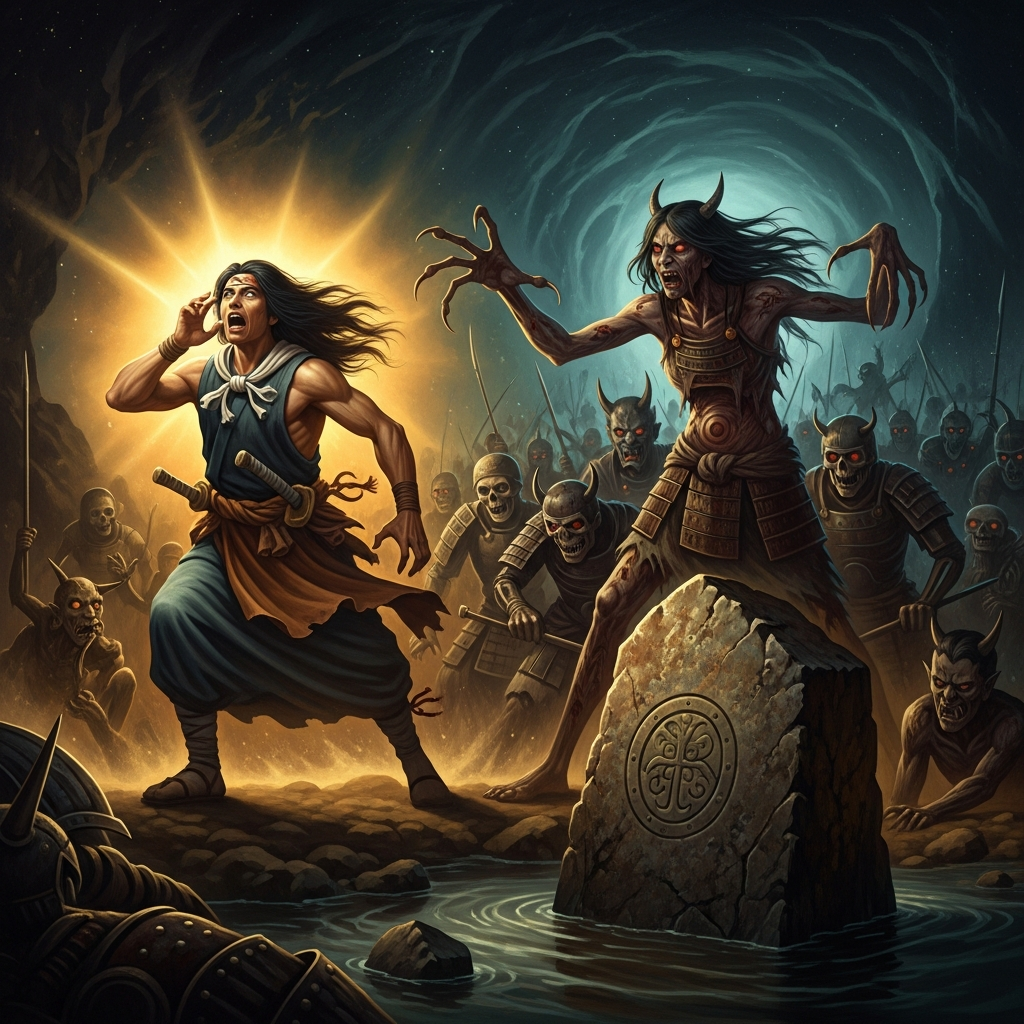
Izanami wakes up the eight thunder deities and sends fifteen hundred warriors of the underworld.
Izanagi draws his sword and fights his way toward the exit, scattering them.
He is almost at the pass between Yomi and the world of the living. He scoops up three peaches from a peach tree growing at the pass and throws them. The pursuing army flees. He says to the peaches: as you helped me, help all living people when they are in suffering. (Peaches became sacred protective objects in Japan partly from this moment.)
Izanami herself comes running.
Izanagi pushes a great boulder across the pass.
They stand on either side.
What follows is both a divorce and a cosmological proclamation.
Izanami says: If you do this, I will kill a thousand of your people every day.
Izanagi says: If you do that, I will build fifteen hundred birthhouses. Your thousand will be answered by fifteen hundred born.
Death begins to exist as a daily quantity. A thousand die. Fifteen hundred are born. The world will always have more living than dead, but the dead will always be coming.
Then Izanagi goes to purify himself.
He goes to a river — the Kojiki specifies a place in Kyushu — and he strips off his clothing. Each garment he removes becomes a deity as it touches the water. Twelve deities from twelve discarded items. He wades in.
As he washes his left eye, Amaterasu, the sun goddess, is born.
As he washes his right eye, Tsukuyomi, the moon god, is born.
As he washes his nose, Susanoo, the storm god, is born.
The three great children, the deities who will shape the world Japan actually inhabits, are born from the act of washing off the underworld. Amaterasu receives the heavens. Tsukuyomi receives the night. Susanoo receives the seas.
What Izanagi brought back from Yomi is not Izanami. He brought back the knowledge of what she had become, and he brought back the permanent separation of the living and the dead. But he also brought back the energy that, when washed away in clean water, became the sun, the moon, and the storm.
The Kojiki does not explain this logic. It presents it as sequence, not argument. The structure speaks for itself: the encounter with death, fully faced and fully fled from, produces the light.
The forbidden look in Yomi is not a failure in the same register as Orpheus’s look. Orpheus turns out of love and doubt. Izanagi turns a torch because he cannot bear the darkness any longer. Both find that what they could not bear to not-see was precisely what they were not supposed to see.
The difference is this: Orpheus’s look loses Eurydice. Izanagi’s look loses Izanami to him — but it also produces three gods that light up the world.
The Japanese myth is tragic and generative at once.
The sun rises because a man looked at his wife’s corpse and ran.
Echoes Across Traditions
Entities


Sources
- *Kojiki* ('Record of Ancient Matters'), compiled 712 CE, translated by Donald Philippi (1968)
- *Nihon Shoki* ('Chronicles of Japan'), compiled 720 CE
- Motoori Norinaga, *Kojiki-den* (1790)
- Donald Philippi, *Kojiki* (University of Tokyo Press, 1968)
- Juliet Piggott, *Japanese Mythology* (1969)
- Joseph M. Kitagawa, *On Understanding Japanese Religion* (1987)