Maui: The Demigod Who Almost Defeated Death
Oral tradition recorded from c. 1840s CE; the narrative tradition active across Polynesia for at least 1000 years; Polynesian settlement of New Zealand c. 1250-1300 CE · The sea from which the North Island of New Zealand (Te Ika-a-Māui, 'The Fish of Maui') was pulled; the path of the sun across the sky; the cave of Mahuika, goddess of fire; the domain of Hine-nui-te-pō, goddess of death
Contents
Maui fishes up New Zealand's North Island from the ocean, lassos the sun to slow it down, steals fire from his grandmother, and finally enters the body of the death-goddess to grant humanity immortality — and fails.
- When
- Oral tradition recorded from c. 1840s CE; the narrative tradition active across Polynesia for at least 1000 years; Polynesian settlement of New Zealand c. 1250-1300 CE
- Where
- The sea from which the North Island of New Zealand (Te Ika-a-Māui, 'The Fish of Maui') was pulled; the path of the sun across the sky; the cave of Mahuika, goddess of fire; the domain of Hine-nui-te-pō, goddess of death
He was not supposed to survive.
His mother Taranga, the sources say, believed the child she bore was premature, or not fully formed, or simply unlikely to live. She wrapped him in a topknot of her hair and cast him into the sea. He did not die. He drifted in the kelp, tended by waves and by the kindness of his ancestor Tama-nui-ki-te-rangi, and eventually he came ashore and found his family and sat with his brothers at the fire.
They didn’t recognize him. He recognized them.
He is the youngest, the last, the one who was thrown away and came back. In Polynesian tradition, this origin marks him immediately: the one who was discarded and survived is the one who will do the impossible.
He will do the impossible five times. He will fail once. The one failure matters more than the five successes.
He fishes up the North Island.
He makes a fishhook from the jawbone of his grandmother Murirangawhenua — persuading her first to tell him where she keeps her sacred jawbone, then persuading her to give it to him, then fashioning it into the hook Manaiakalani (“holding fast to heaven”). He baits it with blood from his own nose.
His brothers are reluctant. He is always doing things they haven’t agreed to, things that disturb the order. He persuades them to paddle far out to sea, farther than any canoe has gone, and he casts the hook down into the deep water.
The ocean floor takes it. He hauls up.
What rises is a great fish — Te Ika-a-Māui, the Fish of Maui. The North Island of New Zealand. The mountains are its spine. The harbors are its gills. The shape of the island, looked at from above, is a fish’s shape.
His brothers do not wait for the proper ceremonies before beginning to cut the fish. That is why the island’s surface is not flat — the cuts made too quickly, without ritual, produced the ridges and valleys and mountains that make the island difficult to cross.
He intended to bring them a gift. Their impatience shaped it imperfectly.
This is the recurring structure of Maui’s gifts.
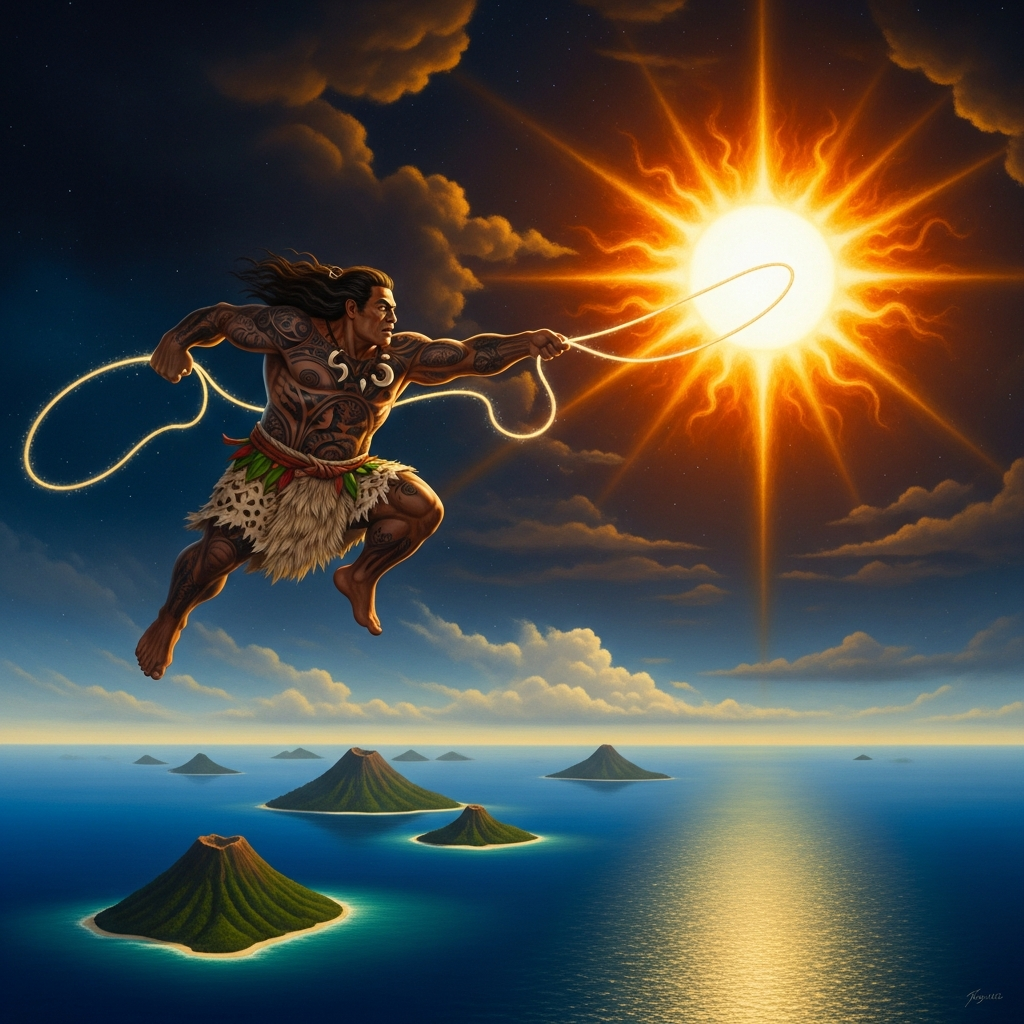
He lassos the sun.
Before Maui, the sun moved too fast. The days were short. Crops did not ripen. People could not finish the things they needed to finish before dark. His mother was particularly affected — she could not dry her tapa cloth before the day ended.
Maui tells his brothers they are going to catch the sun.
He twists ropes from his sister Hinauri’s hair. He leads his brothers to the pit where the sun rises each morning and they lie in wait. When the sun emerges, Maui and his brothers throw their ropes over it and hold it down.
Maui beats it with his grandmother’s jawbone — the same sacred jawbone — until the sun agrees to move more slowly.
The sun now moves at the pace we know. Days are long enough for the things that need doing. The jawbone that beat the sun is marked by the burns; its curve explains its shape.
He has given the world more time.
He steals fire.
His grandmother Mahuika is the keeper of fire. Maui goes to her and asks for fire — and wastes it, throwing each flame-finger into the water, returning for more, asking and asking until Mahuika is almost empty of fire and realizes she is being robbed.
She throws the last flames at him. He runs. She calls up fire from the earth itself — the grasses and trees burning behind him — and he calls up rain to escape. The fire retreats into the trees, into the wood, where it remains. That is why fire can now be drawn out of any dry wood by friction: Mahuika’s fire was driven there by the rain Maui called.
His grandmother forgives him eventually. She is not a figure of pure grievance in the tradition. She is, like all of Maui’s divine relatives, a source from whom he extracts what the world needs.
He fails to defeat death.
Maui has a plan.
Hine-nui-te-pō is the goddess of death — a great divine woman who lies sleeping at the horizon where the sun sets. Her body is the gate of death. Every human being passes through her when they die. Maui’s theory: if he can pass through her body in the reverse direction — entering between her thighs while she sleeps, passing through her, and emerging from her mouth — he will reverse the action of death. He will have passed through death and come out the other side, and the pathway he makes will remain open. Humanity will be immortal.
He tells his companions, the birds who travel with him, one thing: they must not laugh. If she wakes before he has passed through, he will die. She must not wake.
He begins.
He is small enough — Maui is always described as small, which is part of the trickster’s nature — and he is careful. He is partway through.
A small bird, the Piwakawaka (the fantail, in New Zealand tradition), cannot help itself. Maui, entering the thighs of the death-goddess, looks ridiculous. The bird laughs.
Hine-nui-te-pō wakes.
She crushes him.
The birds weep on the shore.
Death remained because of a bird’s laugh. Humanity is mortal because of a moment of accidental comedy.
The myth does not moralize the bird. It does not say the Piwakawaka was careless or wrong. The bird saw something genuinely ridiculous and laughed, the way any creature laughs at the genuinely ridiculous. The consequences were catastrophic, but the cause was innocent.
This is the Polynesian tradition’s most honest moment. Maui could have done the impossible — he was that far, that close. The obstacle was not strength, not wisdom, not courage. It was a bird laughing.
The world’s tragedies are not always the result of villains or weakness. Sometimes the plan was good, the hero was adequate, the distance was manageable, and something small and involuntary happened at exactly the wrong moment, and everything unraveled.
What Maui did accomplish stands.
The North Island is there, the mountains shaped by his brothers’ impatient cutting. The sun moves slowly enough for crops to ripen, for cloth to dry, for love to be made in long summer afternoons. Fire lives in every dry stick, waiting to be called out by friction.
He is honored across the Pacific. In Hawaii as Maui. In Samoa as Ti’iti’i. In Tonga as Maui Kisikisi. The feats vary in detail from island to island; the character is consistent: the one who was thrown away and came back, who does the things the other gods would not attempt, who gives the world more time.
He gave humanity everything he had.
The one thing he tried to give that was too big even for him was the one thing that would have mattered most.
Death is the limit he could not cross.
The bird laughed.
Echoes Across Traditions
Entities
- Maui
- Hine-nui-te-pō
- Tama-nui-te-rā
- Mahuika
- Tangaroa
- Tinirau


Sources
- George Grey, *Polynesian Mythology* (1855)
- Te Rangikaheke, as transcribed by Grey — primary Maori oral source
- Antony Alpers, *Maori Myths and Tribal Legends* (1964)
- Margaret Orbell, *The Illustrated Encyclopedia of Maori Myth and Legend* (1995)
- Katherine Luomala, *Maui-of-a-Thousand-Tricks* (1949)
- Keri Hulme, *The Bone People* (1984) — modern Maori literary reception