Mount Kūnlún: The Pillar Between Heaven and Earth
The mythological eternal present — with the King Mu visit c. 960 BCE · The far west of the known world — identified with the Kunlun Mountains in what is now Xinjiang/Tibet
Contents
At the center of the western world rises the mountain that holds up the sky — Kūnlún, where the Queen Mother of the West tends her peach garden, where the Yellow Emperor has his earthly palace, and where the rivers of the world take their origin.
- When
- The mythological eternal present — with the King Mu visit c. 960 BCE
- Where
- The far west of the known world — identified with the Kunlun Mountains in what is now Xinjiang/Tibet
It stands at the center of the world, or at the center of the western world, which is the same thing in the system that needs it.
The Shanhaijing describes Kūnlún Mountain in the terms of a geographical document that is also a theological document: nine-tiered summit, eight corners, nine wells, twelve gates. Each tier has a different function. The lowest tier is the human world; the highest tier is the abode of the Jade Emperor’s earthly court; between them are the levels where the immortals move between realms. The mountain is a ladder and a palace and a cosmic mechanism all at once.
At the base, three rivers originate: the Yellow River, which the Chinese call the mother of their civilization, takes its source in the Kūnlún glaciers and runs east to the sea. The rivers are the mountain’s veins, carrying what the mountain holds to the plains below, which is how mountains always work but matters more when the mountain is the axis of the world.
King Mu of Zhou drives his eight famous horses to Kūnlún in the third century BCE — or the third century BCE of traditional chronology, which is to say the mythological period when the distance between the human and the divine was still short enough to travel in a chariot.
He arrives at the mountain. He meets the Queen Mother of the West in her western garden, where the peach trees flower on their three-thousand-year cycle and the cinnamon-scented air carries the memory of every immortal who has passed through this way. She shows him the Yellow Emperor’s palace — the terraces and towers that the Yellow Emperor built here in the mythological past, the earthly representation of heaven’s architecture. She holds a feast for him with the foods of the immortals.
He cuts his name into a stone on the summit: Son of Heaven, King Mu, visited in the year such-and-such. The stone is still there, in the same way that the mountain is still there — not as a physical landmark that can be located on a modern topographic map, but as the marker of the place where human kings have always arrived and found themselves to be small in a way that the journey itself could not have predicted.
The Kūnlún of mythology is not the Kūnlún of modern geography, though the modern Kunlun range carries the name. The mythological mountain is at the center of the world, which means it is wherever the world needs a center. Every imperial palace in China was designed to echo its structure. Every mountain in China that achieves a certain altitude becomes, in the local imagination, an echo of Kūnlún — a subsidiary axis, a local connection between heaven and earth.
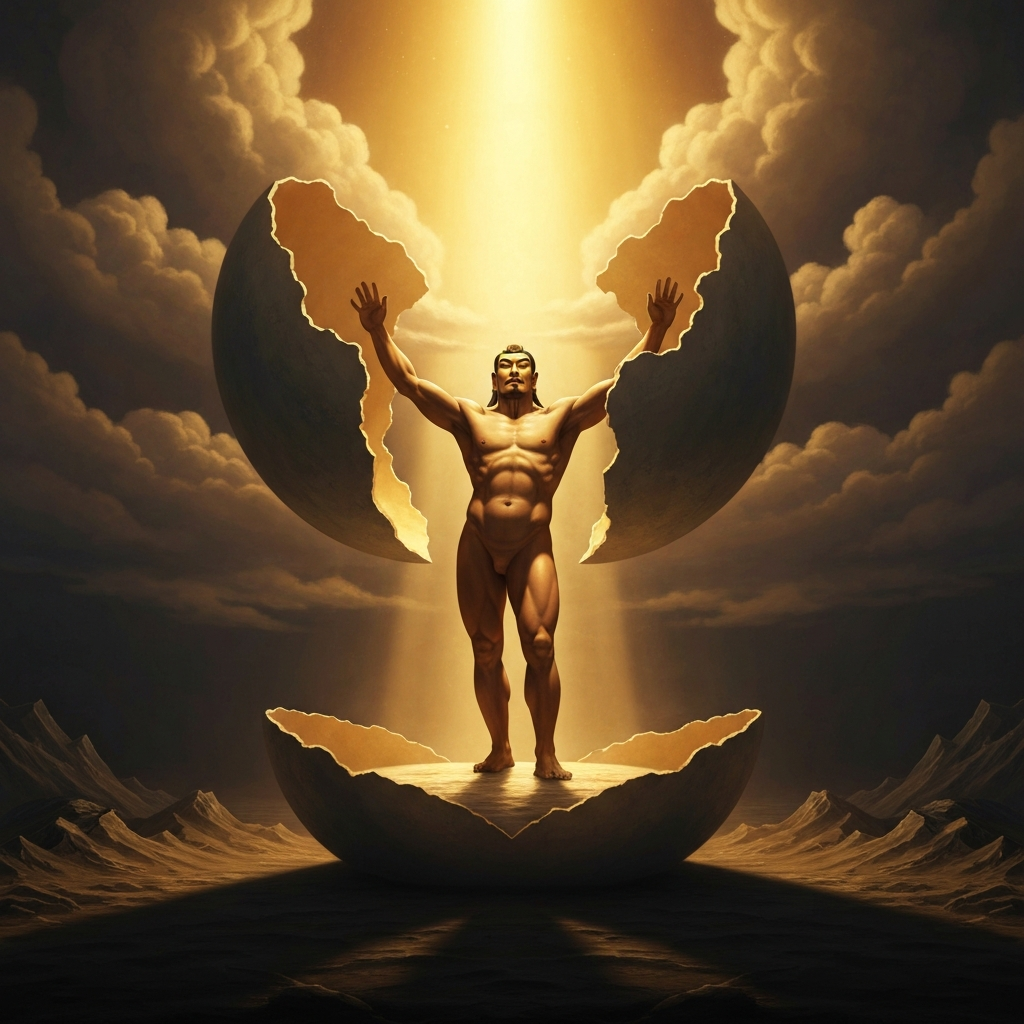
The Yellow Emperor’s palace at Kūnlún is the model for the Forbidden City. The Forbidden City is the model for every government building in China. The bureaucracy of heaven is the model for the bureaucracy of earth. The mountain at the center holds the whole system up, the way Pángǔ held heaven and earth apart — not through force but through being the structural requirement that everything else is organized around.
Remove the mountain and the organization fails. The rivers stop knowing which direction is down. The immortals have nowhere to alight between heaven and earth. The Yellow Emperor has no earthly palace. The Queen Mother’s garden has no location.
The mountain stays. The rivers run east. The peach trees flower every three thousand years. King Mu’s name is on the summit stone in characters that the wind has been erasing for a very long time.
Echoes Across Traditions
Entities
- Queen Mother of the West
- Yellow Emperor (Huangdi)
- Kūnlún Mountain
- the Yellow River source
- King Mu of Zhou
Sources
- Shanhaijing (山海經), multiple chapters on Kūnlún
- Mu Tianzi Zhuan (穆天子傳), c. 4th century BCE — King Mu's journey to Kūnlún
- Suzanne Cahill, *Transcendence and Divine Passion: The Queen Mother of the West in Medieval China* (Stanford, 1993)
- Lihui Yang & Deming An, *Handbook of Chinese Mythology* (Oxford, 2008)