Contents
The high god travels to the well at the foot of the world-tree where the head of Mimir keeps watch. He asks for a drink of the water, which knows everything that has ever happened and everything that will. Mimir names the price. Odin pays it without bargaining.
- When
- c. 900 CE (mythic time, oral tradition recorded 13th century)
- Where
- Beneath Yggdrasil, the world-ash, at one of its three roots — Mimir's Well in the world of the giants
The world-tree, the Norse said, was an ash. Its name was Yggdrasil, which means the steed of the dread one — Odin’s gallows, because the high god had once hung there for nine days and nights to win the runes — and its three roots ran down into three different worlds.
One root went to Asgard, the world of the gods, where the well of Urd lay and the three Norns drew water to keep the tree alive. The Norns were Urd, Verdandi, and Skuld — past, present, future — the women who carved the fates of all beings into the bark of the tree.
Another root ran to Niflheim, the world of cold mist, where the dragon Nidhogg gnawed at the root from beneath, slowly trying to bring the world-tree down.
The third root ran to Jotunheim, the world of the giants. There, beneath the root, was Mimir’s Well. The well was the source of all wisdom. The water in it knew every event that had occurred since the world began and every event that would occur until Ragnarok. To drink from it was to gain access to the entire stream of time. The well was guarded by a being named Mimir.
Mimir had once been a god — counselor of the Aesir, sent by them as a hostage to the rival Vanir at the end of the war between the two pantheons. The Vanir had cut off his head. The Aesir, retrieving the head, had embalmed it with herbs to preserve it from decay. Odin had given it the power of speech. The head, alive in a way nothing else in the cosmos was alive, was placed at the well it had always guarded. Mimir, with his single severed head and his deathless eyes, sat at the rim and listened to what the water said. The water spoke to him constantly. He was, by long association, the wisest being in the cosmos. The water flowed past him without ceasing, and he drank from it, and what he learned he kept.
He did not give the water away.
There were rules. Anyone who came to the well could ask. The price was set by Mimir, and the price was always something the seeker did not want to give. Most seekers, finding out the price, turned around and left.
Odin came to the well.
The high god of Asgard, the All-Father, the husband of Frigg, the father of Thor and Baldr — Odin had everything he wanted in the cosmos except a single thing. He did not have certainty about what was coming. The Norns were carving Ragnarok into the bark of the tree. Odin knew, in a general way, that Ragnarok was coming — the wolf swallowing the sun, the Midgard serpent rising from the sea, his own death in Fenrir’s jaws — but he did not know the details. He did not know how it would unfold. He did not know if the gods could prevent it. He did not know, if they could not prevent it, what they could do to prepare.
He needed to know.
He left Asgard. He came down through the layers of the world. He came to the root of the tree on the giants’ side. He walked to the well. The water was very still. The dropped leaves of Yggdrasil floated on it. At the rim sat Mimir.
Odin greeted him. Mimir, old friend.
Mimir, watching him from the well-rim, replied without surprise. Odin. You have come for a drink.
Yes.
The price is high. You will not like it.
Name it.
Mimir looked at him for a long time. Mimir, the wisest being in the cosmos, knew exactly what Odin most valued and exactly what would be most useful to lose. He named the price.
He said: One of your eyes.
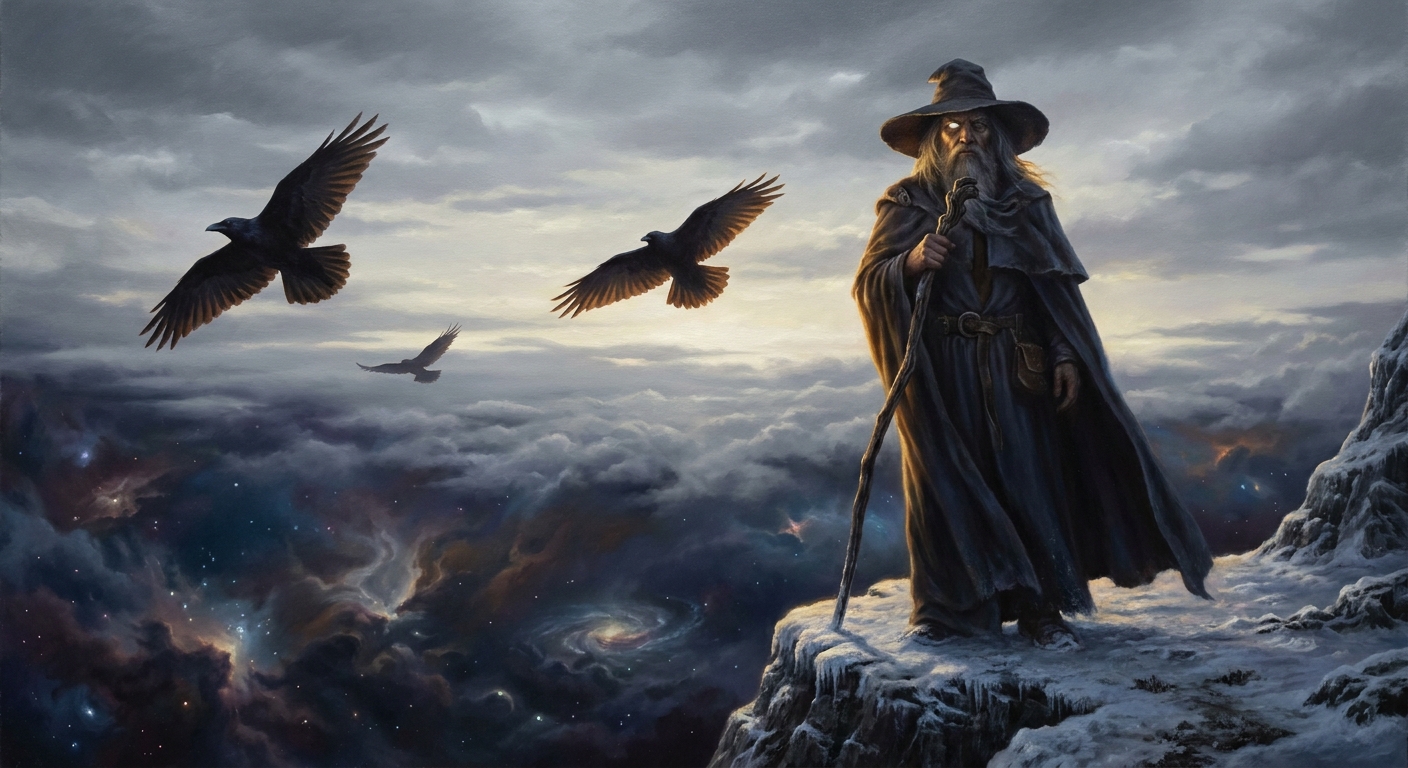
He had known what to ask for. Odin was the god who watched. He was the god of the wide-seeing perspective, the god whose ravens — Hugin and Munin, Thought and Memory — flew across the worlds every day and brought back reports. He was the god whose gaze took in everything. To take an eye was to take the very seat of his function. It was to halve the field of his sight forever. The price was not symbolic. The price was the actual reduction of the high god’s perceptive power, in exchange for one drink of water from one well.
Odin did not bargain. The texts emphasize this. He did not negotiate. He did not ask if there was an alternative. He had come knowing the price would be high. He had decided in advance that he would pay whatever was asked.
He took out a knife.
The Eddic texts are matter-of-fact about the procedure. He cut out one of his own eyes. He did it with his own hand. He did not flinch. He did not call for assistance. He cut the eye from its socket. He held it in his palm.
He looked at Mimir. He held the eye out. He let it fall into the well.
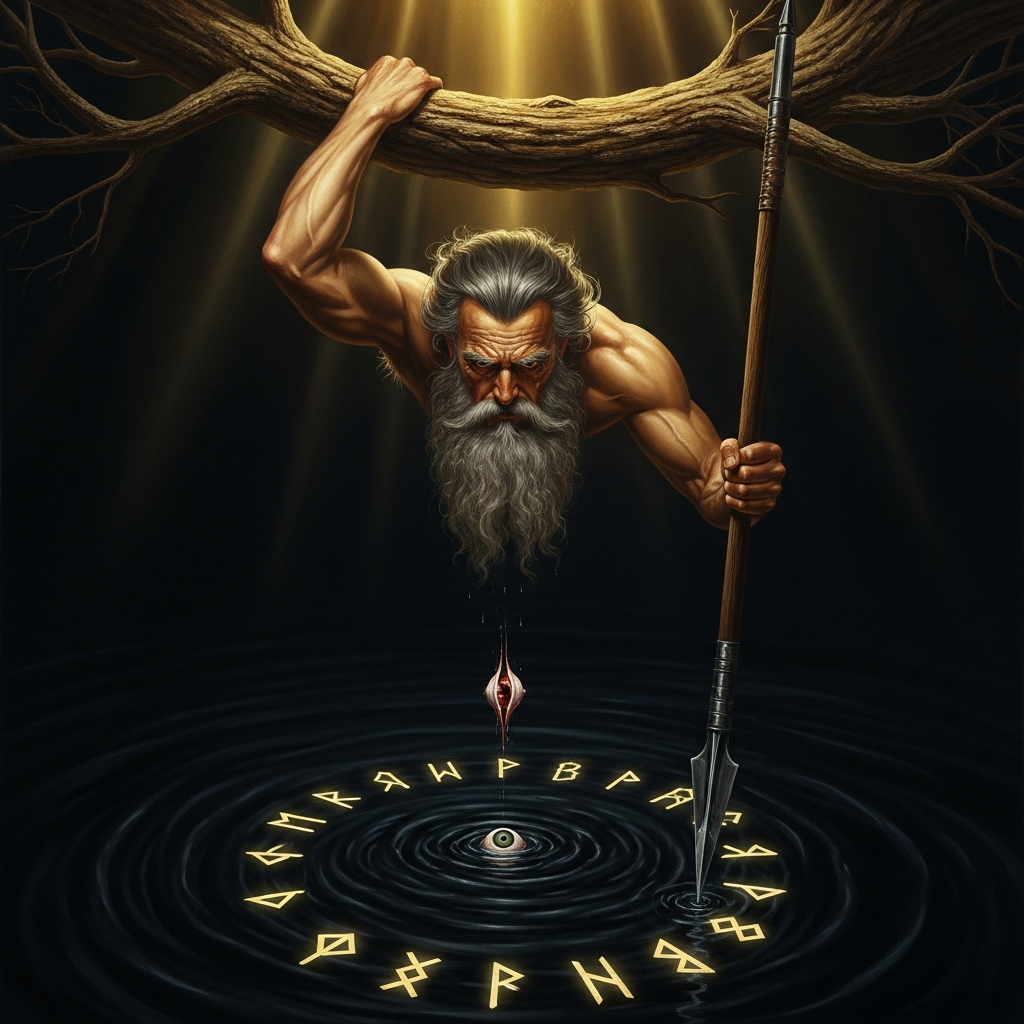
The water received the eye. The eye sank, slowly. It went down into the depths of the well. The texts say it remains there to this day — that anyone who looks down into the deepest part of Mimir’s Well will see Odin’s eye still floating, still preserved by the water that knows all things, watching the cosmos from beneath.
Mimir picked up the drinking horn from beside the well. He filled it. He handed it to Odin.
Odin drank.
The Eddic texts do not narrate what he saw. They do not have to. What he learned in that moment shaped every subsequent action of his existence. He saw Ragnarok. He saw the order of the events. He saw the wolf Fenrir breaking his chain. He saw the Midgard serpent rising from the sea. He saw the ship Naglfar sailing from the east with the dead. He saw Surt coming with his sword of fire. He saw himself fighting Fenrir. He saw himself losing.
He learned, in other words, that he was going to die in a specific way at a specific time and that no maneuver of his — and Odin was the most maneuvering of gods — would change the outcome.
He learned this and accepted it, the way he had just accepted the loss of his eye. He gave the horn back to Mimir. He turned. He climbed up out of the giants’ world, leaving his eye behind in the water and carrying his new knowledge under his hat.
From that day onward Odin had only one eye. The remaining socket — sometimes shown closed, sometimes empty — became part of his iconography. Vikings carving Odin’s image, sailors dreaming of him on long passages, skalds reciting his deeds — they all knew the high god was half-blind in the ordinary sense and, because of that loss, far more clear-sighted than any other being in the cosmos.
This is the central pattern of Odin’s mythology. He gives away pieces of himself for knowledge. He had hung himself, before this, on Yggdrasil — pierced with a spear, hanging head-down, no food, no water, for nine days and nine nights — to learn the runes. I gave myself to myself, he says in the Hávamál, a self to a self, on that tree of which no man knows from what roots it springs. The runes came up from beneath the tree to him on the ninth night, and he seized them, and he fell. He came back to Asgard knowing how to write. The previous payment had been days of suspended pain. The current payment was an eye. There would be other payments later — he would steal the mead of poetry from the giant Suttung at considerable cost, he would seek out the seeress in the world of the dead and trouble her sleep. He would do whatever was required.
The Norse imagination understood that this was the proper portrait of a god. Not a god who gave wisdom away to those who asked nicely. Not a god who knew the runes and dispensed them like loaves and fishes. A god who had stood on the giant’s side of the world-tree, alone, with a knife in his hand, and had cut out his own eye to pay for one drink of water — and who had, that same day, learned that the water did not promise survival, only foreknowledge.
Odin paid the price for the foreknowledge anyway.
This is the difficult center of the myth. The water did not save him. The water told him he could not be saved. Knowing that, he had still given his eye for the chance to know it. The Norse implication: real wisdom is not the kind that helps you escape your fate. Real wisdom is the kind that lets you see your fate clearly enough to walk into it knowingly. There is no wisdom that buys exemption. There is wisdom that buys clarity. The clarity costs an eye.
Every Viking sailing into a storm knew this. Every farmer planting in a season that might fail knew this. The high god knew it best of all, because he had paid for it directly. He had come back from the giant’s well with one eye in his head, the other in the water, and the gait of a man who had seen the end and was returning to fill the time before it came with as much courage and as much company as could be arranged.
Scenes
Odin descends through the roots of Yggdrasil
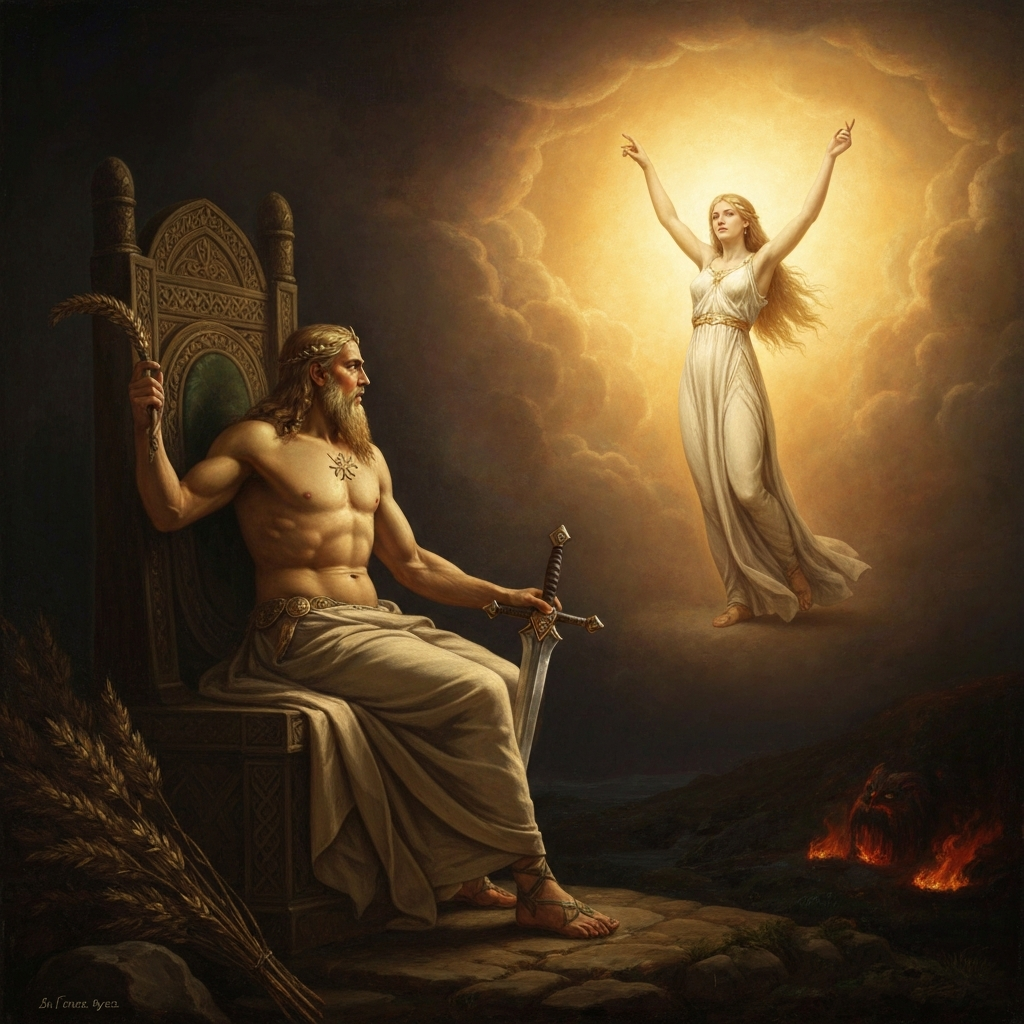
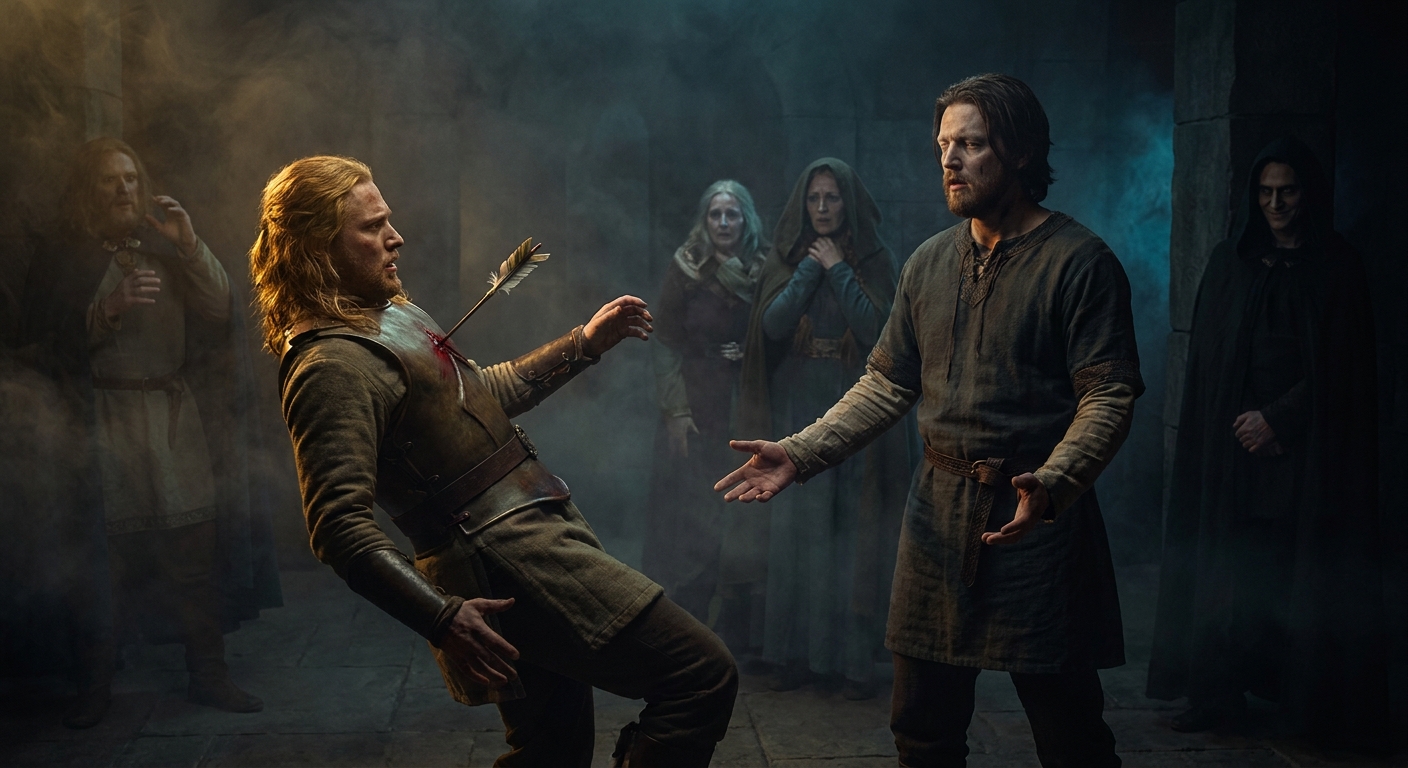
At the well's stone rim, Odin and Mimir face each other
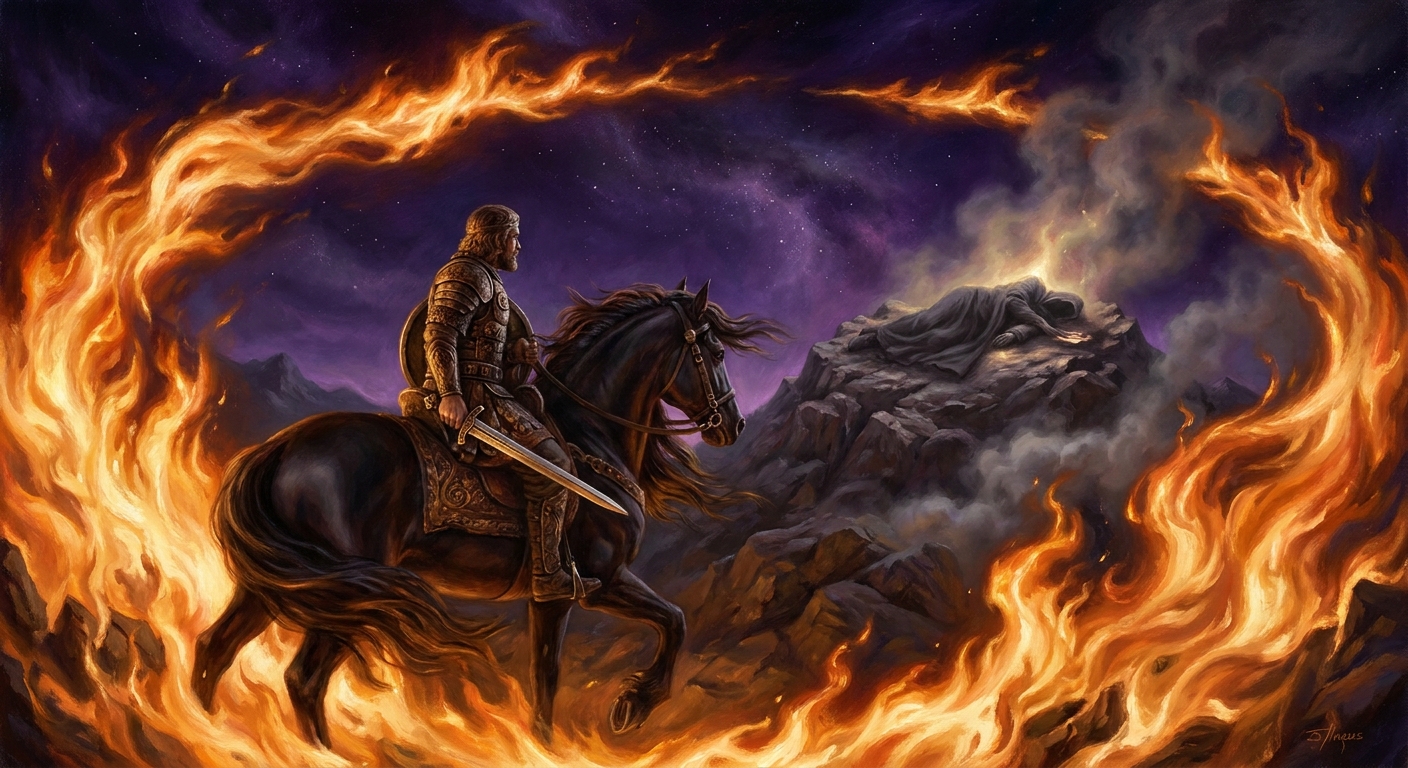
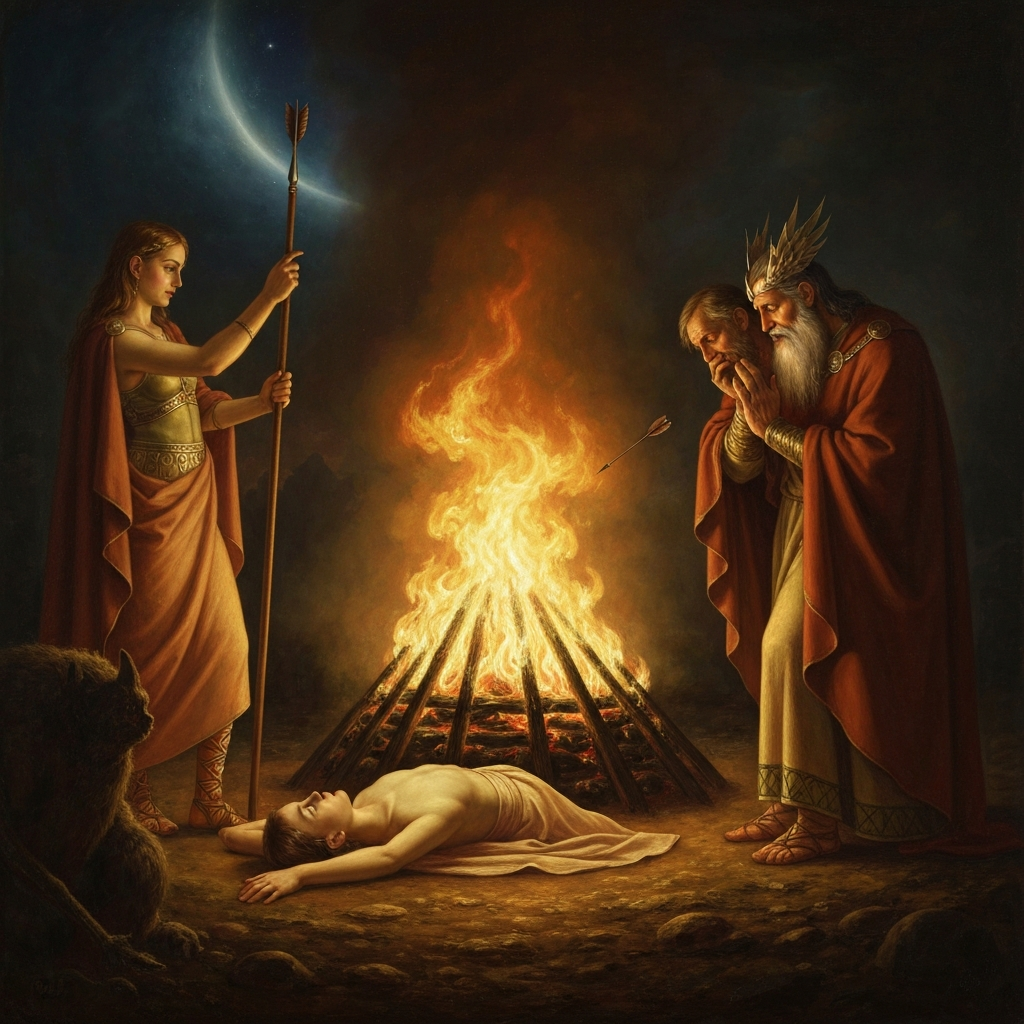
Odin at the rim, his hands cupped to his face, the eye in his palm and the drinking-horn beside him
Echoes Across Traditions
Entities
- Odin
- Mimir
- Yggdrasil
- The Norns

Sources
- Snorri Sturluson, *Prose Edda* — *Gylfaginning* 15
- *Voluspa* (Poetic Edda), stanzas 27-28
- *Hávamál* (Poetic Edda), stanzas 138-145 — Odin on the tree
- *Sigrdrífumál* — runes from the well