Pygmalion's Ivory Prayer
Mythic age, undatable; Ovid composes the *Metamorphoses* version c. 8 CE; the story is set on Cyprus, the island sacred to Aphrodite · The island of Cyprus, especially the city of Amathus or Paphos — the great cult sites of Aphrodite, where the goddess was said to have first risen from the sea
Contents
Pygmalion was a sculptor on Cyprus, disgusted by the women he saw around him. He carved a woman out of ivory — pale, perfect, motionless — and fell in love with her. He brought her gifts. He spoke to her. He laid her on a couch with cushions under her head. At the festival of Aphrodite, too embarrassed to ask for the statue herself, he prayed only for *one like her*. Aphrodite understood the prayer he could not finish. He went home and kissed the ivory mouth, and the mouth was warm.
- When
- Mythic age, undatable; Ovid composes the *Metamorphoses* version c. 8 CE; the story is set on Cyprus, the island sacred to Aphrodite
- Where
- The island of Cyprus, especially the city of Amathus or Paphos — the great cult sites of Aphrodite, where the goddess was said to have first risen from the sea
Pygmalion is a sculptor on Cyprus.
He is good at his work — exceptionally good, even by the standards of an island that produces sculptors. He works in marble; he works in bronze; he works, occasionally, when he can afford it, in ivory. His workshop is on the slope above the harbour of Amathus or of Paphos — Ovid is not specific, but the geography matters: Cyprus is Aphrodite’s island, the place where the goddess of love rose from the sea, the place where her cult is most ancient and most central. Whatever Pygmalion does on Cyprus is done in her sight.
He has no wife.
This is unusual. He is at the age when Cypriot men are married. He has the means; he has the standing in the community. But Pygmalion has decided, at some point in his early manhood, that the women available on Cyprus are not worth marrying — and the reason for his decision is the Propoetides.
The Propoetides were a small group of women in Amathus who refused to acknowledge Aphrodite as a goddess. The goddess punished them for it: she filled them with shame and then with shamelessness, and they became the first prostitutes — selling their bodies in the streets of the city, indifferent to who used them. Eventually Aphrodite turned them into stone where they stood, and the statues of the Propoetides remained in the city as a warning.
Pygmalion saw them. He saw them when they were women selling themselves. He saw them when they had been turned to stone. The whole spectacle disgusted him. He concluded — in the way young men sometimes do — that all women were like this; that the female body was, by some fundamental defect, vulnerable to a corruption he wanted nothing to do with; that he would be better off alone.
He went into his workshop. He shut the door behind him. He stayed there.
He works for a long time.
What he is making is a woman. He is making her from ivory — the most expensive material he can buy on Cyprus, the white tusk-bone shipped over from Africa, the substance from which the most precious cult-statues are carved. The work takes months. Possibly years. Ovid does not give a timeline; what he gives is the patience.
Pygmalion carves the body in pieces. He fits them together. He carves the face last. The face is — the line is famous in Ovid — beyond what nature could produce in a real woman. She is not based on anyone. She is not a portrait. She is the form Pygmalion has been carrying in his head, refined by years of looking at every female form he has ever seen and selecting only what he wanted to keep.
When he is done, she is finished and life-sized and standing in his workshop on a low platform, and Pygmalion looks at her and forgets that she is ivory.
He starts to talk to her.
This is the first stage. He talks to her the way one might talk to a model who is sitting still: little remarks, comments on the weather, requests not to move. She does not move. He moves around her instead, adjusting the cushions on the platform, draping a cloth across her shoulders so she will not be cold (the workshop is unheated; it is a workman’s superstition; he knows she is ivory and will not feel the cold; he drapes the cloth anyway).
The second stage is the gifts.
He brings her flowers. He brings her shells from the beach. He brings her small birds in cages — cyprus warblers and finches — and sets them at her feet. He brings her amber beads, which he hangs around her neck. He brings her perfume. He brings her a ring, small and gold, which he slides onto her finger. He buys her a couch — a proper couch, with linens — and lifts her onto it and arranges her there as though she were sleeping.
He kisses her sometimes.
He is aware — Ovid is careful about this — that she is ivory. He is aware that the ivory is cold, that the ivory does not respond, that he is, in the strictest material sense, embracing a piece of carved bone. But he is also aware, in another part of himself, that the body he has been working on for months is the only female body he has wanted to be near in years. He calls her his wife. He addresses her as such. The workshop has become, by stages, a small household with two inhabitants of which one is made of ivory and the other has stopped going out.
This goes on for a long time.
The festival of Aphrodite arrives.
On Cyprus the festival of Aphrodite is the largest event of the year. The whole island participates. Animals are sacrificed at the altars in Paphos and Amathus and the smaller cult sites along the coast. The streets fill with worshippers; the temples are full of smoke; everyone, in some form, brings something to the goddess and asks her for something.
Pygmalion goes too.
He goes — Ovid does not say, but the implication is clear — partly out of obligation; the entire male population of Cyprus is at the festival; not to be there would be conspicuous; he comes out of his workshop for the first time in weeks, washed and shaved, in his good cloak, and he walks with the rest of his city up to the temple precinct.
He stands at the altar. He has brought a heifer to sacrifice — a white one, with gilded horns, the appropriate offering for a man of his standing. The heifer is sacrificed. The smoke goes up. The priests recite the formula. Then it is the worshipper’s turn to pray.
Pygmalion stands in front of the altar. He has come prepared with a prayer.
The prayer he wants to make is: Aphrodite, give me the ivory woman. Make her real. Let me marry her.
He cannot say it.
This is the part of the story Ovid lingers over with the most precision. Pygmalion, in front of the altar, in front of the priests, in front of the goddess, cannot bring himself to ask for what he actually wants. The ask is too embarrassing. To say the words make my statue real in the open air of the festival, to admit in public that he has been talking to a piece of ivory in his workshop and now wants Aphrodite herself to participate in the delusion, is more than he can do.
So he amends the prayer.
He says: Aphrodite, grant that my wife may be — like — the ivory woman.
He does not say the ivory woman herself. He says like the ivory woman. He prays for an image of his image, a real woman who would resemble the statue he has made. He says it with his eyes on the floor.
He cannot finish the sentence properly. He trails off. He turns away from the altar.
Aphrodite knows.
This is the deepest piece of the story. The goddess of love is not deceived by Pygmalion’s circumlocution. She knows exactly what he wants. She knows exactly what he could not bring himself to ask for. She also knows — and this is the goddess’s particular wisdom, the thing the Greek tradition keeps insisting on — that what he has not been able to say is the thing she has the authority to grant.
She sends a sign.
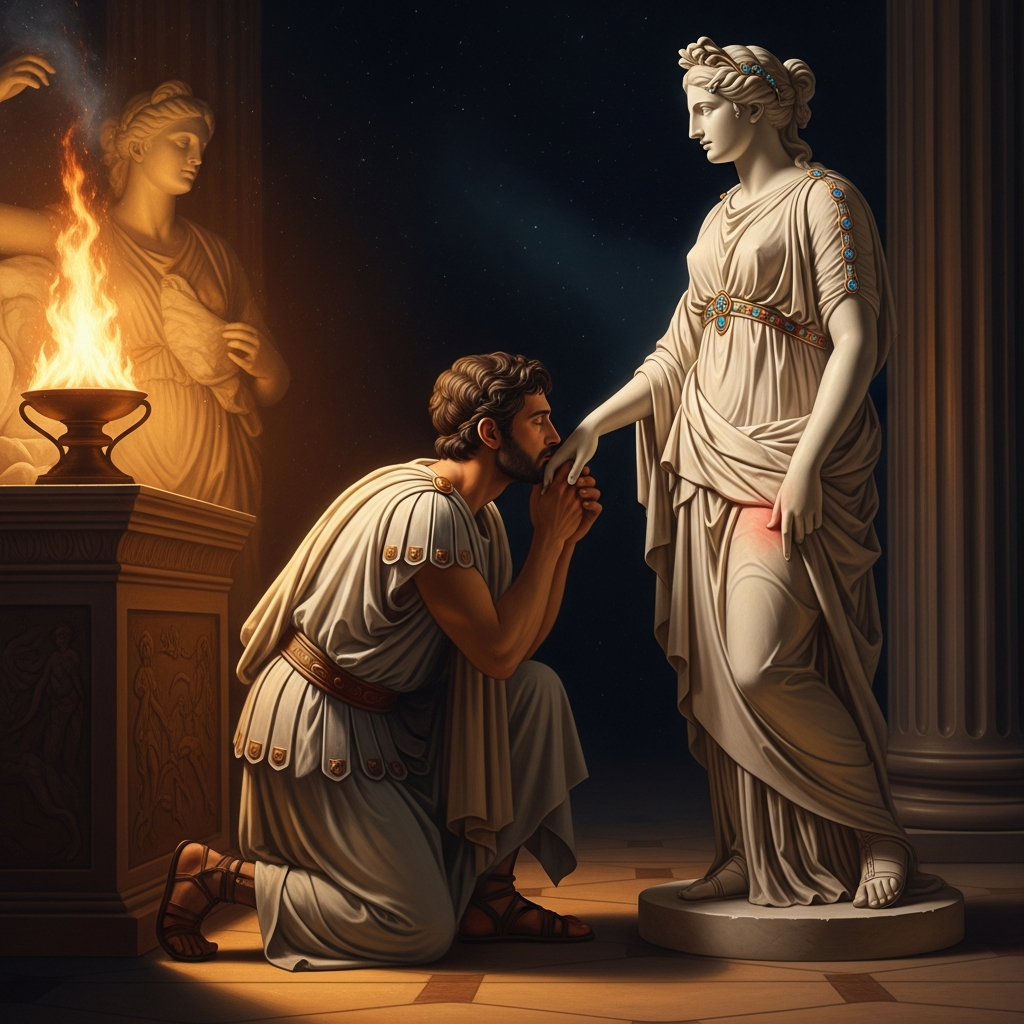
Ovid records it as a small detail at the altar: the flame on Aphrodite’s altar leaps up three times into the air — a tongue of fire that rises higher than the priests have set the wood for — and then settles. The sign is the answer. The goddess has heard the unfinished prayer and has accepted it in the form she chose to understand.
Pygmalion does not see the sign clearly — or he sees it and does not let himself believe what it means — but he leaves the temple in a different state than he entered it. He walks home through the festival crowds. He climbs the steps to his workshop. He opens the door.
The ivory woman is on her couch, where he left her, in the same position. The flowers he set at her feet that morning are still in their vase. The birds in the cage are still sleeping.
He goes to her. He puts down his cloak. He sits on the edge of the couch beside her. He bends over and kisses her on the mouth, the way he has kissed her every evening for months.
The mouth is warm.
He pulls back. He looks at her.
The change is happening slowly, in front of him, in the way a sunrise happens — not a flash, but a gradual shift of state, every moment more advanced than the last. The ivory of her cheeks is warming to flesh-colour. The ivory of her arms is softening; he can feel it under his hand. He puts his palm against her chest and, after a moment that is longer than any moment he has ever experienced, feels a heartbeat begin under his palm — small at first, then steady, then unmistakable.
She breathes.
Her eyes open.
She is looking at him. She is the woman he has been making for months — every line of her face is the line he carved — but she is also, now, somebody. She is looking at him with the attention of a person, not the blank stare of a sculpture. She is recognizing him, perhaps. She is seeing the workshop for the first time. She is seeing the cloak draped over her shoulders, and the flowers at her feet, and the man kneeling beside her on the couch she has been lying on for months.
She does not know his name.
He tells her. She tells him hers — or he gives her one; the sources are inconsistent. The classical tradition does not name her; the post-classical tradition gives her the name Galatea — milk-white, after the milky colour of the ivory she was carved from. The name does not appear in Ovid. Ovid simply calls her the woman who had been ivory.
They marry. Aphrodite herself attends the wedding — Ovid is explicit about this — descending from her temple to bless the union. The goddess who heard the unfinished prayer presides over the ceremony in which the prayer is granted in full.
A daughter is born to them. They name her Paphos.
The city of Paphos on Cyprus — the great cult site of Aphrodite, the place pilgrims came to from across the Greek-speaking world for a thousand years — is named for the daughter of Pygmalion and the ivory woman. The whole sacred geography of Cypriot Aphrodite-worship traces back, in the local genealogy, to one workshop and one half-finished prayer.
Ovid places the Pygmalion story in Book 10 of the Metamorphoses — the book of love-stories, sung by the bereaved Orpheus after Eurydice’s second loss. Orpheus tells the story in a sequence that includes Hyacinthus, Adonis, and Atalanta — figures whose loves end badly, are foreshortened, or transform into something that survives them. Pygmalion is the exception. His love-story is the only one in Orpheus’s catalogue that ends in unambiguous joy: the statue becomes a woman, the woman bears a child, the child gives her name to a city. Ovid places the happy ending in the middle of the surrounding griefs to make it shine more — and possibly to remind his audience that, in the Greek imagination, the gods will sometimes do exactly what is asked, and even what is not quite asked, when the asker is sincere.
The shape of the prayer is the deep teaching. Pygmalion does not pray for what he wants; he prays for something like it. He cannot bring himself to ask. Aphrodite — the goddess who specializes in what cannot be said directly — grants the unsaid request rather than the said one. This is one of the recurring patterns of Greek religion. The gods read the unfinished prayer. They grant what was meant rather than what was articulated. The piety is not in the saying; the piety is in the wanting.
The Greek tradition does not name the woman. Ovid does not name her. The name Galatea enters the story through the post-classical reception — through medieval adaptations, through Rousseau’s Pygmalion (1772), through Schiller, through the long line of operas and ballets and finally through George Bernard Shaw’s Pygmalion (1913) and the musical My Fair Lady (1956). Shaw turned the myth into a class parable about a phonetics professor and a flower girl, but the structure is the same: the maker who tries to fashion the perfect woman out of his materials, and the question of what becomes of her once she is made.
Shaw’s instinct, importantly, was to refuse the happy ending. His Eliza walks away from Higgins; the play ends with her not coming back. Shaw was reading the Greek myth against itself, asking what the ivory woman would actually have wanted once she became aware enough to want anything. The Greek tradition is silent on this. Ovid does not tell us what the woman thought when her eyes opened. He tells us only that Pygmalion was happy. The asymmetry is, in some sense, the deepest moral question the myth raises, and the moral question Greek myth itself leaves open.
The smallest detail is the most precise. Aphrodite’s flame leapt up three times at the altar. Pygmalion did not see it clearly. The sign that he had been heard was given before he could finish asking. He came home not knowing yet that the prayer had been answered, and the answer was waiting for him on the couch in the workshop with the cloak around her shoulders. The kiss was not, strictly speaking, the moment the miracle happened. The miracle had already happened. The kiss was just the moment Pygmalion noticed.
Echoes Across Traditions
Entities
- Pygmalion
- Aphrodite
- Galatea
- Paphos
Sources
- Ovid, *Metamorphoses* 10.243-297 (c. 8 CE)
- Apollodorus, *Bibliotheca* 3.14.3 (a different Pygmalion, but related)
- Clement of Alexandria, *Protrepticus* 4 (Christian summary)
- George Bernard Shaw, *Pygmalion* (1913)
- *My Fair Lady* (1956); the long modern reception