The Door You Must Not Open: The Sacred Taboo Across World Mythology
Orpheus myth in extant form from c. 6th century BCE; Genesis 2-3 compiled c. 6th-5th century BCE; Ark of the Covenant narrative from 1 Samuel 6 (compiled c. 7th-6th century BCE); 'Bluebeard' type story first collected in Perrault's 1697 version but type is much older · The underworld (Orpheus), the Garden of Eden (Adam and Eve), the road from Sodom (Lot's wife), the threshing floor of Nacon (Uzzah and the Ark), Bluebeard's castle, Pandora's jar — the forbidden is always in the most intimate proximity to the sacred
Contents
Orpheus looking back. Bluebeard's chamber. The pomegranate. The Ark of the Covenant. Every mythology is built on a forbidden thing. The taboo is the most powerful structure in religion.
- When
- Orpheus myth in extant form from c. 6th century BCE; Genesis 2-3 compiled c. 6th-5th century BCE; Ark of the Covenant narrative from 1 Samuel 6 (compiled c. 7th-6th century BCE); 'Bluebeard' type story first collected in Perrault's 1697 version but type is much older
- Where
- The underworld (Orpheus), the Garden of Eden (Adam and Eve), the road from Sodom (Lot's wife), the threshing floor of Nacon (Uzzah and the Ark), Bluebeard's castle, Pandora's jar — the forbidden is always in the most intimate proximity to the sacred
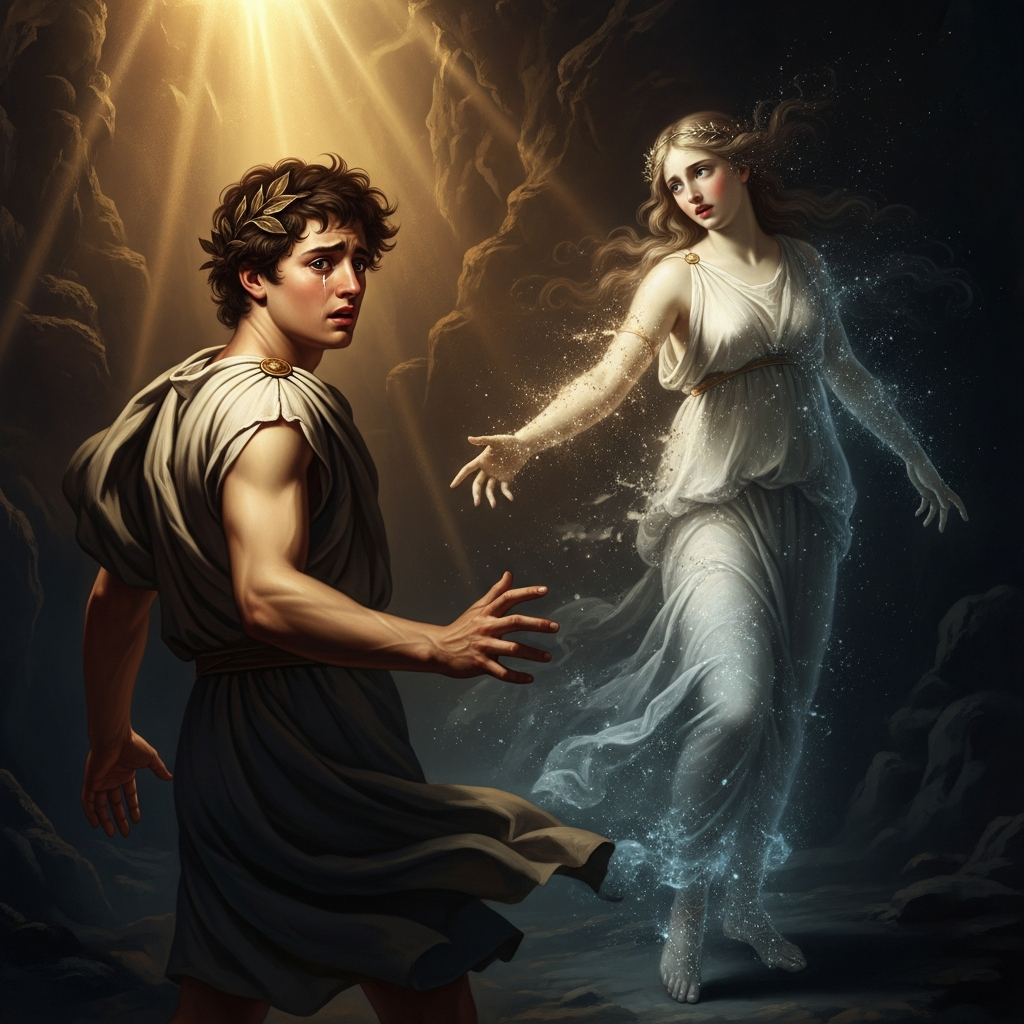
Orpheus has crossed the Styx. He has played his lyre and charmed Cerberus, charmed the Furies, charmed Persephone herself — who wept iron tears — and charmed Hades, who never weeps at all. He has been given back his wife Eurydice, killed by a snakebite on their wedding day. He is leading her up out of the underworld by the sound of his lyre, and he has been given one condition.
He must not look back.
He must not look back until they are in the upper world. Until then, Eurydice follows him through the dark, and she follows in silence because the dead have no voice, and he has no way to confirm she is there except by faith in the promise.
At the very edge of the upper world — at the moment where the light of the living world is becoming visible — he looks back.
Virgil describes it in seven Latin words that have been translated and retranslated for two thousand years: “iam luce sub ipsa, / immemor heu!” — “now, under the very light, unmindful — ah!” The exclamation of heu is untranslatable: it is the sound of catastrophe that was also a choice. He forgets. Or he cannot help it. Or he does not trust. The line does not say which. It does not need to.
Eurydice is pulled back into the dark.
The Structure of the Taboo
The anthropologist Mary Douglas, in Purity and Danger (1966), argued that the taboo is not fundamentally about morality. It is about category. The things that are taboo are, typically, things that violate the categorical structures a culture uses to make the world intelligible. Dirt is not inherently evil; it is matter out of place. The pig in Leviticus is not evil; it violates the categorical scheme of proper animals (it has split hooves but does not chew cud — it fits one category but not the other). The taboo marks the category boundary.
This framework illuminates the mythological taboos. Orpheus’s prohibition is a category boundary: the living and the dead are separated, and the passage between them requires that you leave the dead in the dead world rather than carrying your attachment with you. Looking back is the physical embodiment of that attachment. The taboo against looking back is the taboo against blurring the living/dead boundary by failing to let go.
Uzzah’s death makes the same kind of sense. The Ark is in the category of the most holy — the physical habitation of divine presence, the object on which the divine power most concentrated in the Israelite world. Ordinary humans are in the category of ordinary. The taboo against touching the Ark is the maintenance of the categorical boundary between the ordinary and the absolutely holy. Uzzah’s well-intentioned touch violates the category, and the category violation is fatal not because God is cruel but because the power concentrated in the Ark is genuinely incompatible with ordinary human materiality.
Eden: The Taboo That Made Morality Possible
The Genesis 2-3 narrative is among the most discussed passages in the entire Western tradition precisely because its theological implications are recursive to the point of paradox. The taboo is against eating from the tree of the knowledge of good and evil. Violating the taboo — eating the fruit — produces the capacity for moral judgment. Which means: before the violation, there was no moral capacity to understand that the violation was wrong.
This is the theological puzzle at the heart of the Fall narrative: how can Adam and Eve be blamed for a transgression they committed before they had the moral capacity to understand it as transgression? Augustine resolved this by emphasizing the clarity of the command (the prohibition was explicit and unambiguous) and the role of pride in overriding obedience. But the paradox remains visible in the text, and most theologians have found it does not fully dissolve.
What the story is doing that is not purely moral is cosmological: it is describing the conditions of human existence. Humans are moral beings — beings who know good and evil — and the myth is explaining how they came to be that way. The tree is not a moral lesson about disobedience. It is the etiological narrative of moral consciousness itself.
The most theologically radical reading (developed in the Jewish Kabbalistic tradition and in some Gnostic texts) is that the serpent was right: eating the fruit did make humans like gods, knowing good and evil. The divine prohibition was a limitation, and the transgression was the price of human dignity — the capacity to choose, which requires knowledge, which requires the fruit. In this reading, the Fall is not a fall but an ascent: the catastrophic cost of becoming fully human.
Uzzah’s Death and the Terror of Holiness
The Uzzah narrative in 2 Samuel 6 is, for many modern readers, the most disturbing single event in the Hebrew Bible. The man reaches out to steady a sacred object from falling. He is instantaneously killed. David is angry and afraid and refuses to continue the Ark’s journey to Jerusalem.
The theological tradition has handled this in various ways. Some commentators argue that Uzzah violated a specific Levitical law (Numbers 4:15 prohibits Kohathites from touching the sacred objects, only from carrying them). Others argue that the error was in using an ox-cart rather than the prescribed poles — the stumbling should not have been possible if the Ark had been carried properly. In this reading, Uzzah is collateral damage from David’s logistical error.
But the most honest reading is the simplest: the holiness is real. The divine power concentrated in the Ark is genuinely incompatible with casual human contact. The taboo is not arbitrary. It is the formal marker of a real danger — not the danger of a morally offended God but the danger of incompatible categories in direct contact.
Rudolf Otto, in The Idea of the Holy (1917), described the fundamental religious experience as mysterium tremendum et fascinans — the overwhelming mystery that is simultaneously terrifying and compelling. The sacred is not just good; it is powerful in a way that is dangerous to ordinary existence. The Uzzah story is the narrative expression of this experience: the most holy thing in the world is in the world, and ordinary humans cannot handle it without mediation.
The Room You Must Not Open
The Bluebeard story — whose distribution across Europe, the Middle East, and beyond marks it as genuinely ancient — encodes the taboo differently from the others. Here the forbidden room does not contain something holy. It contains something terrible: the bodies of the previous wives, the evidence of who the husband really is.
The transgression in Bluebeard is epistemological rather than religious. The taboo protects a secret, not a sanctity. But the structural logic is the same: a prohibition, a violation, a catastrophic revelation. And crucially: the woman is saved. The taboo had to be violated. Without the violation, she would have been the next body in the room, never knowing the danger she was in. The forbidden thing, when it is evil rather than holy, must be transgressed rather than honored.
This is the taboo-story’s other face. Some prohibitions protect the sacred from contamination by the ordinary. Some protect the ordinary from contamination by evil. The difficulty — which every tradition that takes taboos seriously must navigate — is telling which is which before you have violated it.
Pandora opens the jar and releases suffering into the world. But Hope remains inside, which is why Hope has always been in the world too, and always available. The transgression was necessary for Hope to have its meaning. The violation was the price.
The door you must not open is always in the most important room.
Echoes Across Traditions
Entities
- Orpheus
- Eurydice
- Persephone
- Hades
- Uzzah
- Lot's Wife
- Pandora
- Adam
- Eve


Sources
- Ovid, *Metamorphoses* X.1-85 (Orpheus and Eurydice)
- Virgil, *Georgics* IV.454-527 (Orpheus)
- Genesis 2:15-17, 3:1-24 (Eden taboo and transgression)
- 2 Samuel 6:1-7 (Uzzah and the Ark)
- Numbers 4:15, 20 (Levitical rules for handling the Ark)
- Genesis 19:17, 26 (Lot's wife)
- Hesiod, *Works and Days* 60-105 (Pandora)
- Charles Perrault, 'La Barbe Bleue,' *Histoires ou contes du temps passé* (1697)
- Walter Burkert, *Structure and History in Greek Mythology and Ritual* (1979)
- Mary Douglas, *Purity and Danger* (1966)