Contents
When the warrior Sām abandons his albino newborn on a mountain, the great cosmic bird Sīmorgh descends from her nest on Alborz and carries the child home — raising him in her nest at the summit of the world for twenty years.
- When
- The heroic age of the Shahnameh — before Rostam's birth
- Where
- The summit of Mount Alborz — the cosmic mountain at the roof of the world
The child is white.
Not pale — white, as white as the snow that blankets the mountain passes in winter, as white as milk from the first milking. His hair is white from birth. His eyes, later described as bright as gems, are not the dark eyes of his father Sām’s family. He is healthy, clearly robust, crying with good strong lungs. He is, by every measure except color, a perfectly ordinary and excellent infant.
Sām, the greatest warrior of his generation, looks at his firstborn son and is ashamed.
The shame belongs to him, not to the child, and the Shahnameh records it without mitigating it: Sām instructs his servants to take the infant to the Alborz mountains and leave him there. He cannot explain this son. The interpretations the court will offer — demon-born, cursed, monstrous — are wrong, but Sām does not know they are wrong, and he prefers to be rid of the evidence rather than live with the uncertainty.
The servants take the infant to Alborz.
They leave him on the high slope, above the tree line, where the wind from the summit carries the cold that kills in hours. They go back down to the valley.
The Sīmorgh is watching from her nest.
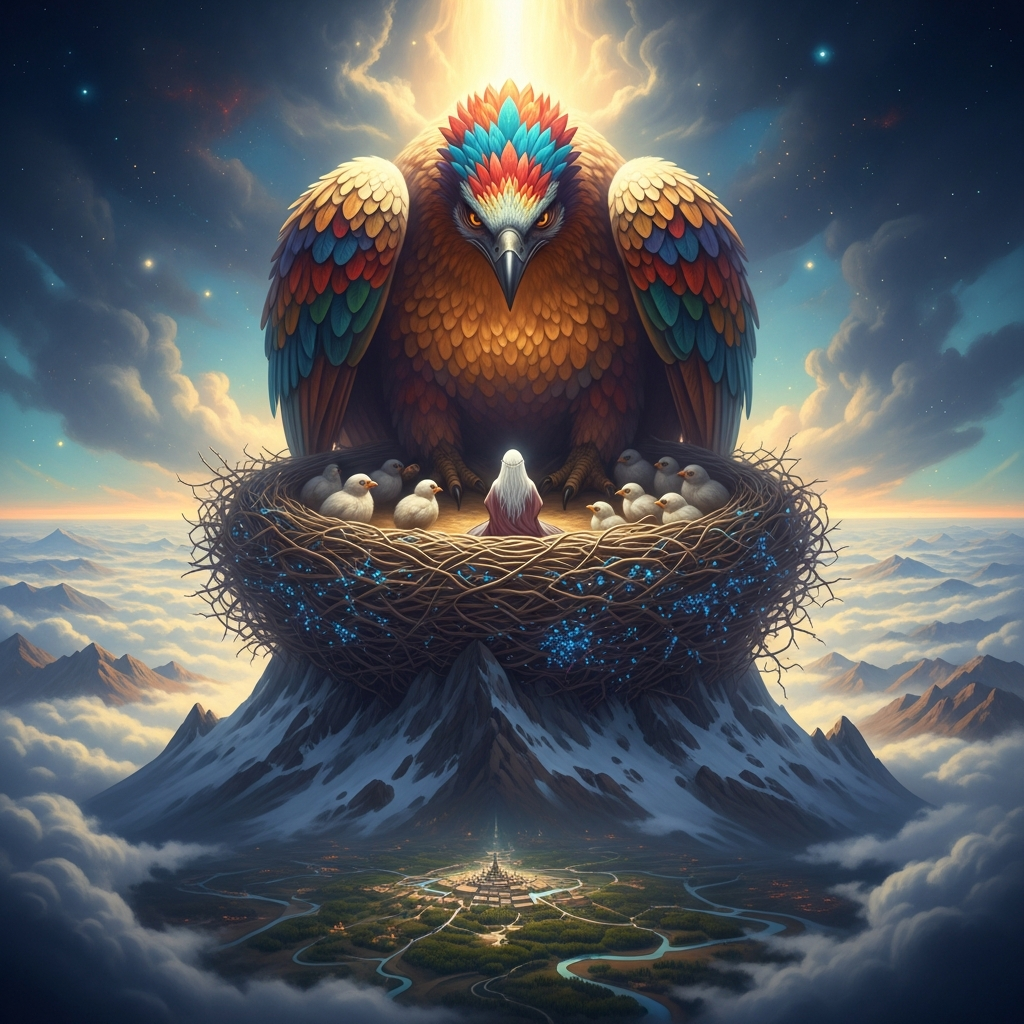
She has sat on the summit of Alborz since before memory — the Shahnameh says she has lived seven times the life of the world, which places her existence in an era before human reckoning. She has seen kings rise and fall from her height. She has watched the whole sweep of Iranian history from the vantage of the cosmic mountain, and she is not usually involved in it. She is vast and ancient and has the accumulated knowledge of everything she has observed.
She sees the infant.
The Shahnameh does not explain this in terms of duty or divine instruction. The Sīmorgh descends because she wants to. She circles the infant once and then takes him in her enormous claws — gently, with the precision of a creature who has lifted things that needed not to be broken — and carries him up to her nest.
The nest on the Alborz summit is enormous, built from trees she has carried up over the centuries. Her own chicks are there. She places the human child among them and brings him food and tends to him as she tends to her own offspring, and when he grows past the stage where she brings food to him, she teaches him to hunt and climb and observe.
He grows up knowing only the mountain.
He knows the nest, which is his home. He knows the Sīmorgh’s chicks, who are his siblings in the only sense the word means anything to him. He knows the view from the summit — the whole of the Iranian world spread out below, visible in its entirety. He knows the Sīmorgh herself: her smell of sandalwood and ancient feathers, her intelligence, her patience, the way she explains things he asks about by showing rather than telling.
He does not know his name. She gives him one.
Twenty years pass.
Sām, in the valley, has been dreaming. The dreams are of his white-haired son, and in the dreams there is reproach. He is told by the dreams and by a priest who interprets them: go to the mountain. Go to the mountain, and what you threw away is still there, and if you do not go now you will be shown in the history of the world as the man who abandoned a son who became the father of the greatest hero Iran has ever had.
Sām goes to the mountain.
The Sīmorgh sees him coming. She has always known this moment would arrive — she is older than memory and has seen how human stories go. She calls Zāl to her and she says: your father is coming. He is coming because he was wrong and he knows he was wrong. You were born for a human life, not a bird’s life, and the time has come for you to go down.
She gives him three feathers.
She tells him: when you need me — when you are in a crisis that no human wisdom can resolve — burn one of these feathers, and I will come.
Zāl descends. He embraces his father, who weeps with a shame that is almost appropriate but is still, in some measure, less than what the situation requires. Zāl goes to the court of Iran. He becomes famous. He marries Rūdāba and burns the first feather when she cannot deliver the child who will be Rostam.
The Sīmorgh comes down.
She always comes.
Echoes Across Traditions
Entities
- Sīmorgh
- Zāl
- Sām
- Alborz Mountain
Sources
- Ferdowsi, *Shahnameh*, 'The Story of Zāl,' translated by Dick Davis
- A.Sh. Shahbazi, 'Sīmorḡ,' *Encyclopædia Iranica* (2002)
- Olga Davidson, *Poet and Hero in the Persian Book of Kings* (Cornell, 1994)
- Minoo Southgate, 'The Uses of Fantastic Literature in the Persian Court,' *Iranian Studies* (1984)