Contents
Thor wakes up to find his hammer missing. The giant Thrym has stolen it and demands the goddess Freyja as his bride in exchange. Freyja refuses. Loki proposes a substitution: dress Thor in the bridal gown and send him to the wedding instead. Thor agrees, with extreme reluctance. The reception goes badly for everyone but Thor.
- When
- c. 900 CE (mythic time, oral tradition recorded 13th century)
- Where
- Asgard, the road to Jotunheim, the great hall of the giant Thrym
Thor woke up one morning and his hammer was gone.
This was not an ordinary loss. Mjölnir was the most important weapon in the cosmos. The dwarves had forged it; Loki had nearly ruined the forging, but it had come out at the end with a slightly short handle and otherwise perfect. It was the weapon that kept the giants of Jotunheim out of Asgard. Without it, the gods were vulnerable. With it, Thor was the unstoppable force of the pantheon. He slept with his hand on the haft.
He sat up in bed and felt the empty pillow. He felt the floor beside the bed. He felt every cubic foot of the bedroom. Mjölnir was nowhere.
He shook his beard. He raised his voice. He went to find Loki.
The poem makes a point of this — that the first being Thor goes to in a crisis is Loki. Thor distrusts Loki on principle. But Loki, the trickster, is the one who can find out what no one else can find out. Thor explained the situation. Loki, stroking his lips, said: Hidden it has been from gods and men. We will need to make inquiries.
Loki borrowed Freyja’s falcon-feather cloak. He flew, in falcon-form, across the worlds. He flew north, to Jotunheim, the giants’ country. He landed at the hall of a giant called Thrym. Thrym was sitting on a mound, plaiting golden collars for his hounds, in the way of giant kings.
Thrym, seeing Loki, asked: How fares it with the gods? How fares it with the elves? Why come you alone to Jotunheim?
Loki said: Ill it fares with the gods. Ill it fares with the elves. Have you hidden Thor’s hammer?
Thrym laughed. He admitted it readily. I have hidden the hammer of Thor, he said, eight miles deep beneath the earth. None shall fetch it back unless he brings me Freyja for my wife.
Loki returned to Asgard. He flew, in his falcon-shape, all the way back. He landed in the courtyard. Thor was waiting. Loki told him what Thrym had said.
The pair of them went to Freyja’s hall.
Freyja was the most beautiful goddess in the pantheon. She was the goddess of love, of war, of fertility, of seid-magic. She wore the Brisingamen, the necklace of fire, which was the great treasure of the Vanir. She was the bride of Odr, who had wandered away on a long journey, and she wept tears of red gold for him every night.
Thor came in. He said, brusquely: Freyja. Put on your bridal veil. We are going to Jotunheim. You are marrying the giant Thrym. He has my hammer.
Freyja’s reaction is the funniest moment in the poem. She is so angry she breaks her own necklace.
The Brisingamen — the gold-and-fire collar that even the gods rarely saw her without — snaps off her throat as she draws breath to refuse. Most man-mad of the gods I would be called, she shouts at Thor, if I were to ride to Jotunheim with you on this errand!
She refuses absolutely. The gods, gathered now in a council, see that she will not be moved.
The All-Father Odin convenes the assembly. The question is debated. The hammer is essential. The bride cannot be sent. What is to be done?
Heimdall — the watchman of the gods, who can see by daylight and by night, who hears grass growing on the earth and wool growing on the back of sheep — speaks. Heimdall speaks rarely. When he does, the gods listen. He has a proposal.
He says: Let us bind on Thor a bridal veil. Let him wear the Brisingamen. Let keys clatter at his belt and women’s clothes fall about his knees. Let him have stones on his breast. Let his head be tied with a bride’s headdress. He will go in disguise as Freyja, and Loki will go with him as the bridesmaid.
There is a long silence.
Thor objects.
The poem renders his objection with concentrated force. The gods will call me a woman, he says, if I let myself be wrapped in a bridal veil.
Loki — quick, smiling, with the tone of someone who has been waiting his whole career for this moment — answers: Be quiet, Thor. The giants will live in Asgard if your hammer is not recovered.
The argument is unanswerable. The hammer must come back. Asgard’s defense is at stake. The world-order rests on the hammer. Thor’s dignity is the only currency available. He pays.
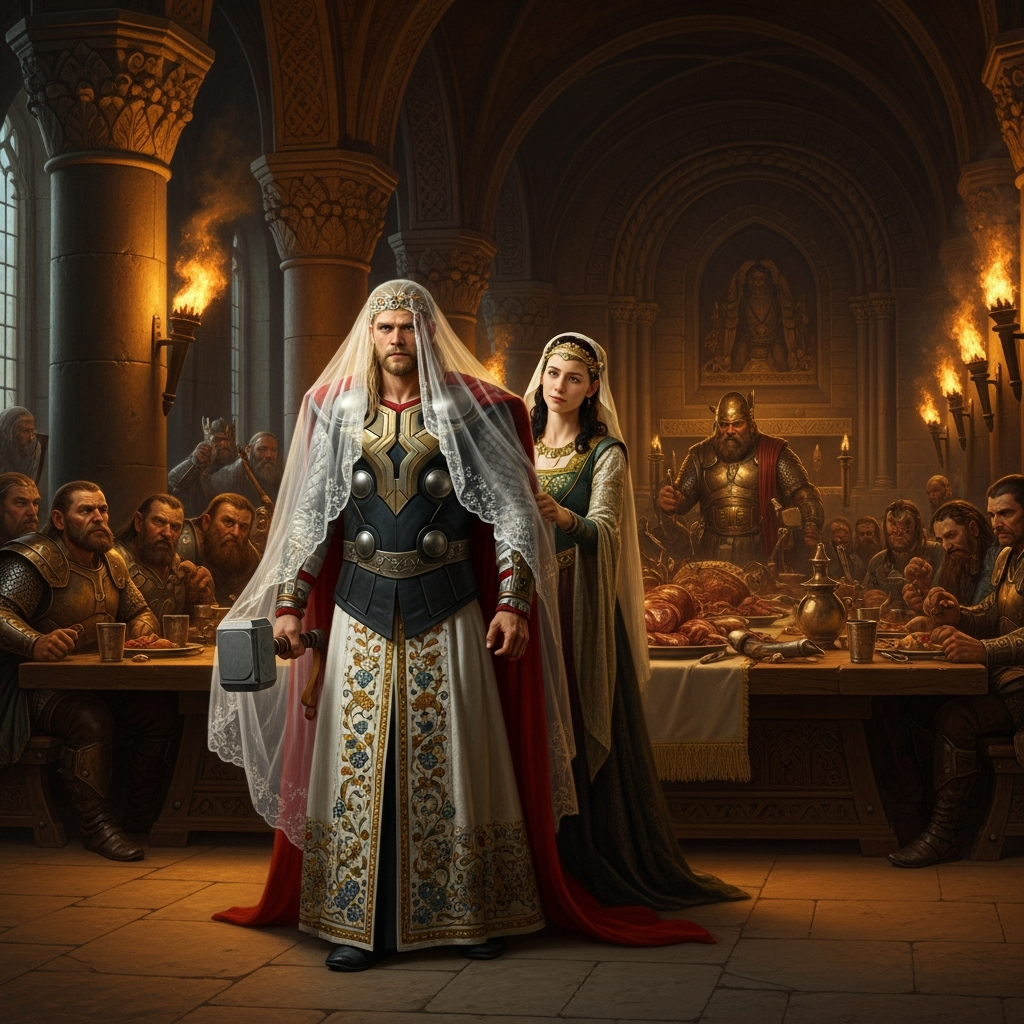
The dressing scene takes its time. The poem describes each item being put on him. The bridal linen. The keys at his belt — keys are women’s articles, the keys to the household stores. The stones to fill out the bodice. The Brisingamen. The headdress. The veil drawn down over his eyes — a generous veil, because Thor’s beard would otherwise give the game away in the first second.
He stands in the courtyard. The bridal goats — Tanngnjostr and Tanngrisnir, the gnashing-toothed and the gritting-toothed, who pull his chariot — are harnessed. Thor and Loki get into the wagon. They drive off for Jotunheim.
When they arrive at Thrym’s hall, the giants have been preparing. There is a wedding feast laid out. Thrym, beside himself, has been telling his retainers all day that his bride is coming. He runs out to greet the wagon. He helps the bride down — she is very tall, and very bulky, but he attributes this to her being a goddess of formidable power — and leads her into the hall.
The wedding feast begins.
This is the comic centerpiece. The bride sits at the high table. The giants sit around the hall. The food is brought out. The bride begins to eat.
She eats an entire ox.
She eats eight salmon.
She eats every dainty pastry that has been baked for the women’s portion of the meal.
She drinks three barrels of mead.
Thrym, watching from beside her, grows nervous. He leans over to the maid-of-honor sitting beside the bride. He says: I have never seen a bride eat so much. I have never seen a maiden drink so much mead.
Loki — quick, sharp, never at a loss for an explanation — leans toward the giant and says, conspiratorially: Freyja has not eaten for eight days. She was so eager for the wedding that she fasted with longing.
Thrym is delighted with this answer. He nods. He smiles. He is excited.
He leans in further. He lifts the veil — only the corner, only an inch, only enough to see the bride’s face — to give her a wedding kiss.
He sees her eyes.
The eyes are red. The eyes are burning. The eyes have an expression no bride has ever had — an expression of barely-suppressed homicidal fury.
Thrym leaps back. Why are Freyja’s eyes so terrible? They burn like fire!
Loki — quick, sharp, never at a loss — says: Freyja has not slept for eight nights. She was so eager for the wedding that she lay awake longing.
Thrym sits back down. He is reassured.
The feast goes on for some time. The bride eats more. The giants drink more. Thrym, growing impatient for the consummation, calls for the consecration of the marriage.
In Norse wedding custom, the marriage was consecrated by laying the hammer of Thor in the bride’s lap. The hammer was the sign of fertility. The hammer blessed the union. Thrym had Mjölnir — that was the entire point of the wedding — and he ordered it to be brought out.
The giants brought it. They laid it across the lap of the seated bride.
The bride’s hand closed on the haft.
Thor came up off the bench like a thunderstorm.
He swung Mjölnir into the giant Thrym’s skull. Thrym died on the spot. Thor swung again. The giant’s old mother, who had come out for the wedding, died in the second swing. Thor swung again, and again, and again. Every giant in the hall died. The hall itself, by the end, was a charnel house. Loki — possibly still in his bridesmaid’s dress, the texts do not say when he changed — picked his way through the bodies behind Thor. They walked out of the hall. They got back into the wagon. They drove home to Asgard.
The hammer was back. The defense of Asgard was restored. The cosmos was as it should be.
Thor put on his ordinary clothes. He gave back the bridal items. He never spoke of the incident, the texts imply, except when very drunk and even then unwillingly. The skalds, however, never let him forget. The Lay of Thrym was sung in halls across Scandinavia for centuries afterward. Children at fires laughed at it. Old warriors told it to their grandchildren. It was funny because Thor was funny. It was funny because the strongest god in the cosmos had been put in a wedding dress and made to eat an ox.
But the poem holds something serious under its comedy. It holds the recognition that no defense is so well-secured that it cannot be lost in a single night. The hammer was at Thor’s pillow; he woke up and it was eight miles deep in Jotunheim. It holds the recognition that recovery sometimes requires the strong to abandon their pride. It holds the recognition that the trickster — the despised, untrusted, sideways-talking Loki — is sometimes the only ally available when the orthodox tools fail.
And it holds, finally, the recognition that the giants do not always come at the gods with armies. Sometimes they come with proposals of marriage. Sometimes the threat to the cosmos arrives in the form of a wedding feast laid out, with mead barrels and pastries and a giant in his best clothes waiting to lift the veil. The gods of the Norse imagination knew this. They knew the price of the hammer’s return was a ridiculous afternoon. They paid it. They got the hammer back. They never spoke of it again, except in song, where the song made everyone laugh, and then made them slightly uncomfortable, and then made them laugh again.
Scenes
Thor in his bedchamber at dawn, hand groping the pillow where Mjölnir should be, finding only empty bedclothes
On the road to Jotunheim, Thor in a long bridal gown and Brisingamen necklace and full bridal veil, riding in a wagon
In Thrym's hall the wedding feast is in full swing
Echoes Across Traditions
Entities


Sources
- *Þrymskviða* (Poetic Edda) — the Lay of Thrym
- Snorri Sturluson, *Prose Edda* — *Skáldskaparmál*
- Henry Adams Bellows (trans.), *The Poetic Edda* (1923)
- Carolyne Larrington (trans.), *The Poetic Edda* (1996, rev. 2014)