Combat Profile
Cargo Ascension
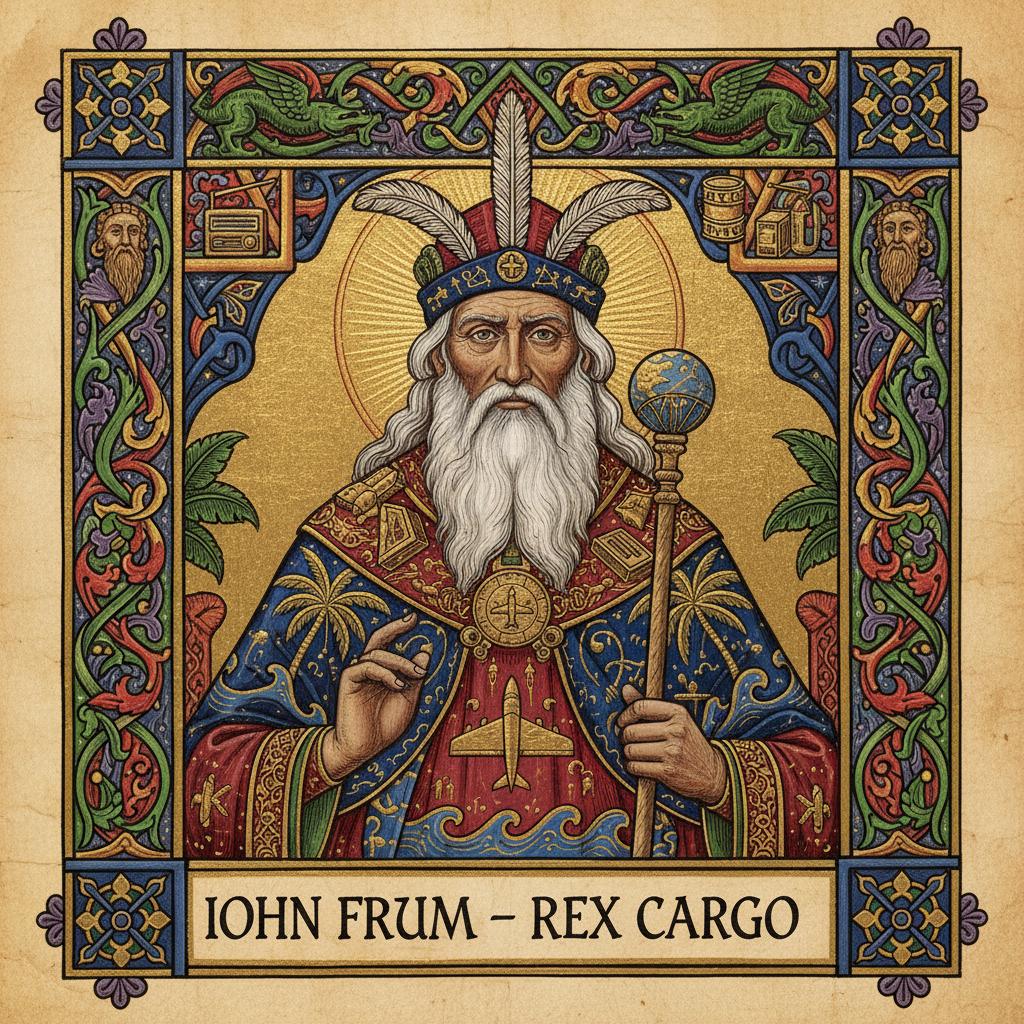
John Frum manifests material abundance and advanced technology from the void, materializing provisions and military goods to his followers as proof of divine return.
Messianic Beacon
All who witness John Frum's presence gain unwavering faith and hope in a prophesied future of prosperity, rendering them immune to despair and spiritual corruption.
He has not returned. Decades have passed. The cargo has not come. And yet the faith persists -- which is either the weakness or the strength, depending on where you stand
“You Christians have been waiting 2,000 years for Jesus to come back. We have been waiting less than 80. Why is our faith the strange one?”
Lore: John Frum is a figure — possibly historical, possibly mythical, probably both — at the center of the most famous cargo cult in the world, based on the island of Tanna in Vanuatu (formerly the New Hebrides) (Lindstrom, Cargo Cult; Tabani, John Frum: He Will Come). The movement began in the late 1930s when a mysterious figure reportedly appeared to villagers, called himself “John Frum” (or “John from America,” though the etymology is disputed), and urged them to reject the European missionaries, return to traditional custom (kastom), abandon Christianity and European money, and wait for his return. When he came back, he would bring cargo — an abundance of manufactured goods — and a new era of prosperity.
The timing was critical (Worsley, The Trumpet Shall Sound). World War II arrived in the Pacific shortly after. Tanna was flooded with American military personnel — including, crucially, African American soldiers, whose presence astonished Tannese villagers who had been told by white missionaries that Europeans were inherently superior. The Americans built airstrips. They spoke into radios. They wore matching uniforms. They performed coordinated drills. And from the sky, cargo arrived — food, medicine, vehicles, technology. When the war ended and the Americans left, taking their cargo with them, the John Frum movement intensified. If the rituals (airstrips, uniforms, radio-like devices, marching) had summoned cargo before, they could summon it again. The followers built symbolic airstrips from cleared ground. They constructed radio masts from bamboo. They carved headphones from wood. They marched with “USA” painted on their chests. They waited.
They are still waiting. John Frum Day is celebrated every February 15 on Tanna with flag-raisings, military-style parades, and chanting (Tabani, John Frum: He Will Come; Rice, John Frum He Come). The movement has survived over eight decades without the prophesied return. This persistence is typically cited as evidence of irrational belief. But consider: Christianity has maintained faith in Christ’s return for 2,000 years. Islam awaits the Mahdi. Judaism awaits the Messiah. Shia Islam awaits the Hidden Imam. Arthurian legend promises the return of the once and future king. The cargo cult is not structurally different. It is simply newer, and therefore easier to condescend to.
Parallel: John Frum is the modern incarnation of the returning savior archetype found in virtually every tradition: Christ’s Second Coming (Acts 1:11), the Kalki avatar (the tenth and final incarnation of Vishnu, who will appear on a white horse to end the Kali Yuga), King Arthur (who will return from Avalon when Britain needs him most), the Twelfth Imam in Shia Islam (who went into occultation and will return as the Mahdi), and Quetzalcoatl (who departed eastward and promised to return). The structure is identical in every case: a powerful figure departs, promises to return, and the faithful maintain rituals and readiness for the return. The only variable is the date of the founding promise and the technology of the expected cargo.
2 min read
Time. Every year that passes without John Frum's return is a test of faith. Every year, the faith survives the test
Lindstrom, *Cargo Cult: Strange Stories of Desire from Melanesia and Beyond*; Worsley, *The Trumpet Shall Sound*; Tabani, *John Frum: He Will Come*; Rice, *John Frum He Come*