Where the Good Go: Visions of Paradise Across Six Traditions
Ancient, across all periods — Greek archaic period through classical Islamic and Chinese traditions · The Elysian Fields, Valhalla, Svarga-loka, Jannah, Tian, the Happy Hunting Ground
Contents
Paradise is what a civilization prizes, made eternal. Elysium rewards heroes. Valhalla rewards warriors. Svarga rewards the ritually correct. Jannah rewards the faithful. Tian rewards the virtuous. Each afterlife is a self-portrait of the culture that imagined it.
- When
- Ancient, across all periods — Greek archaic period through classical Islamic and Chinese traditions
- Where
- The Elysian Fields, Valhalla, Svarga-loka, Jannah, Tian, the Happy Hunting Ground
Every culture that has asked the question “what happens to good people after they die?” has had to answer a prior question: what makes a person good?
The answer is embedded in the paradise. You cannot describe what the afterlife rewards without describing what the living culture valued. Valhalla rewards warriors because Norse civilization valued combat courage above all other virtues. Jannah rewards the faithful because Islam understood the highest human achievement as the proper orientation of the will toward God. The Elysian Fields reward heroes and the exceptionally virtuous because Greece’s highest concept of the human was arete — excellence, the fullest actualization of human potential.
Reading the paradises of world mythology backward — asking what each heaven is for rather than simply describing its features — produces an anthropology of value, a survey of what different civilizations believed made life worth living.
Elysium: Paradise as Excellence Rewarded
The Greek afterlife is not organized around religion or ritual but around quality of life.
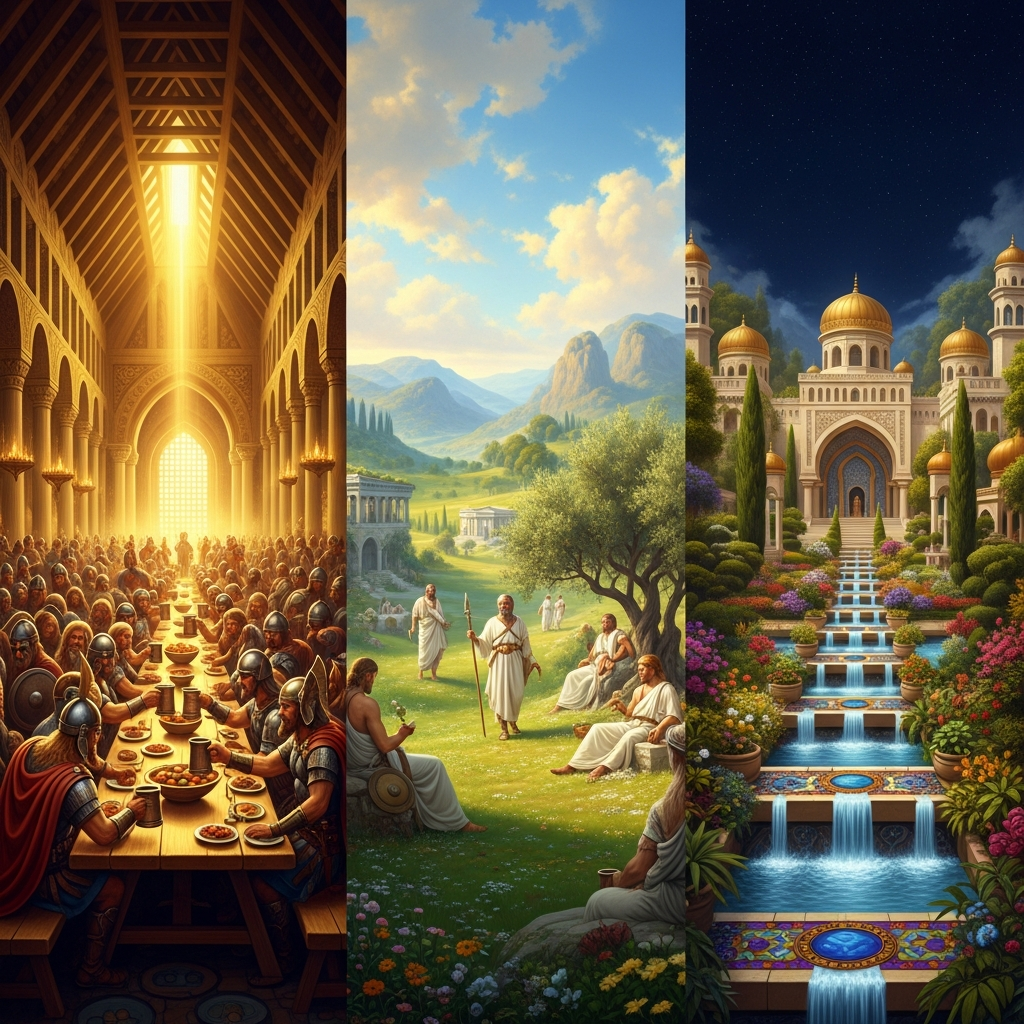
The ordinary dead go to the Asphodel Meadows — not punishment but grey anonymity, a shadowy continuation of ordinary existence without the vividness of living. The unjust go to Tartarus. But the heroes and the exceptionally virtuous go to Elysium — the Elysian Fields — where the climate is perfect, there is no labor, and existence is pleasant forever.
In Pindar and Plato, the standard is raised: the Isles of the Blessed receive those who have been judged righteous in three separate lives. This is excellence across multiple incarnations — moral achievement so consistent that it has survived the test of repeated return. The reward is permanent paradise; the requirement is sustained virtue.
The Greek paradise reveals Greek values: excellence, arete, demonstrated achievement rather than faith or ritual conformity. The Elysian Fields are not for those who believed the right things or sacrificed correctly. They are for those who lived well — which meant, in Greek understanding, achieving the fullest expression of their human potential. Homer’s heroes go there. Philosophers might go there. Ordinary believers in the Olympian gods do not necessarily go there.
This is the most demanding of the paradise theologies: it does not offer salvation to everyone who joins the right group. It offers reward to those who have genuinely earned it, across the span of a life or multiple lives.
Valhalla: Paradise as Training Ground
The Norse Valhalla is the most functional of all the paradises in this survey, because it is not an endpoint but a preparation.
Odin’s hall in Asgard receives those who die in battle — specifically, those chosen by the Valkyries (literally “choosers of the slain”). The Einherjar (the “army of one”) feast on the boar Saehrimnir, which is slaughtered each evening and revived each morning. They drink mead from Heidrun, the goat who grazes on Yggdrasil. They fight from sunrise to sunset each day, their wounds healing by evening. Then they feast again.
This is paradise designed for a specific purpose: they are training for Ragnarok. The world will end, and Odin needs an army. Every warrior who dies in battle and comes to Valhalla is a recruit in the eschatological force that will fight alongside the Aesir at the world’s final battle — and lose that battle, but lose it well.
The Valhalla theology is unique in that the warriors in paradise will ultimately die there, too. Ragnarok consumes gods and Einherjar alike. The paradise is real — the feasting, the camaraderie, the endless combat that never permanently harms — but it ends. The Norse refused to make paradise final. Even the best afterlife has a horizon.
What this reveals about Norse values: the highest good is not rest but meaningful combat in the company of worthy companions, in service of something larger than yourself, against odds that cannot ultimately be beaten but that can be faced with courage. Valhalla is the idealized version of the warrior’s life — not eternity but the warrior life perfected and extended as long as it can be.
Svarga: Paradise as Dividend
The Hindu Svarga — the heaven of Indra, the Vedic paradise — is beautiful, pleasurable, and temporary.
The souls of the righteous dead ascend to Svarga and experience its pleasures: the divine gardens, the company of the gods, the music of the Gandharvas, the dancing of the Apsaras. It is described in the texts as luminous, abundant, and utterly unlike the difficulties of earthly life. The dead who have fulfilled their dharma and performed their ritual obligations correctly enjoy Svarga for a period proportional to their accumulated merit.
Then the merit runs out. When the karmic credit is exhausted, the soul returns to earth for another life, another accumulation of merit, another opportunity to progress toward ultimate liberation (moksha). Svarga is not the goal of the Hindu spiritual life. Moksha — liberation from the cycle of rebirth entirely, the extinction of individual identity in union with Brahman — is the goal. Svarga is the rest stop.
This makes the Hindu paradise theologically distinct from most of the others in this survey: it is explicitly penultimate. It is better than ordinary life, it is a reward for virtue, but it is not the end of the journey. The tradition that takes rebirth and karma most seriously is also the tradition that is most reluctant to call any afterlife state permanent or final.
Jannah: Paradise as the Restoration of the Good
The Quranic Jannah (from the Arabic for garden, cognate with the Hebrew Gan Eden) is described in remarkable physical specificity: gardens with rivers flowing beneath, shade and coolness, abundant fruit, fine garments, golden vessels, and companionship. The Quran returns to Jannah repeatedly, in different suras, building a picture of the afterlife through accumulated detail.
The physicality of Jannah is theologically deliberate. Islamic theology resists the Neoplatonic deprecation of the body and the physical world that entered some strands of Christian thought. The world is not a prison for the soul; it is God’s creation, and creation is good. The afterlife that rewards the faithful is therefore not an escape from the physical but a purified, perfected version of it — the pleasures of the world freed from the suffering, injustice, and finitude that corrupt them here.
Jannah rewards the faithful — those who submitted to God (Islam = submission), who believed in the Oneness of God, who acted rightly. The criteria are both theological (correct belief) and ethical (correct action), and Islamic jurisprudence has debated the relative weight of these for fourteen centuries. But the paradise itself does not vary: it is the restoration of everything good that this world promises but cannot fully deliver.
What Paradise Reveals
Each paradise is a mirror. What it shows you is not the afterlife but the culture that imagined it.
Elysium says: the highest human achievement is excellence. Valhalla says: the highest human good is meaningful combat with worthy companions. Svarga says: pleasure is real but temporary and not the ultimate goal. Jannah says: the physical world is genuinely good and the faithful deserve to have it perfected. Tian says: virtue is its own deepest reward, and the virtuous need no more elaborate description of their destination than that they will be with the principle of goodness itself.
The Native American traditions, in their diversity, say: the afterlife should be continuous with the relationships and activities that made this life meaningful — not an escape from this world but a continuation of what was best about it.
None of these paradises is irrational. Each is the considered answer of a civilization that thought carefully about what made life worth living and then imagined what it would look like if death could not end it.
Echoes Across Traditions
Entities


Sources
- Walter Burkert, *Greek Religion* (1985)
- H.R. Ellis Davidson, *Gods and Myths of Northern Europe* (1964)
- Wendy Doniger, *The Hindus: An Alternative History* (2009)
- Sachiko Murata and William Chittick, *The Vision of Islam* (1994)
- Michael Loewe, *Chinese Ideas of Life and Death* (1982)
- Raymond Fogelson, 'The Ethnohistory of Events and Nonevents,' *Ethnohistory* 36 (1989)