Hecate at the Crossroads
Pre-Olympian — Hesiod gives her central place in the *Theogony* (c. 700 BCE) as a Titaness who keeps her honors under Zeus; cult continues through the Roman imperial period and into Christian Greece · The crossroads — *trihodos* — wherever three roads met; the doorway of the house; the threshold of the underworld; especially the small wayside shrines (*hekataia*) at every Greek country crossroad
Contents
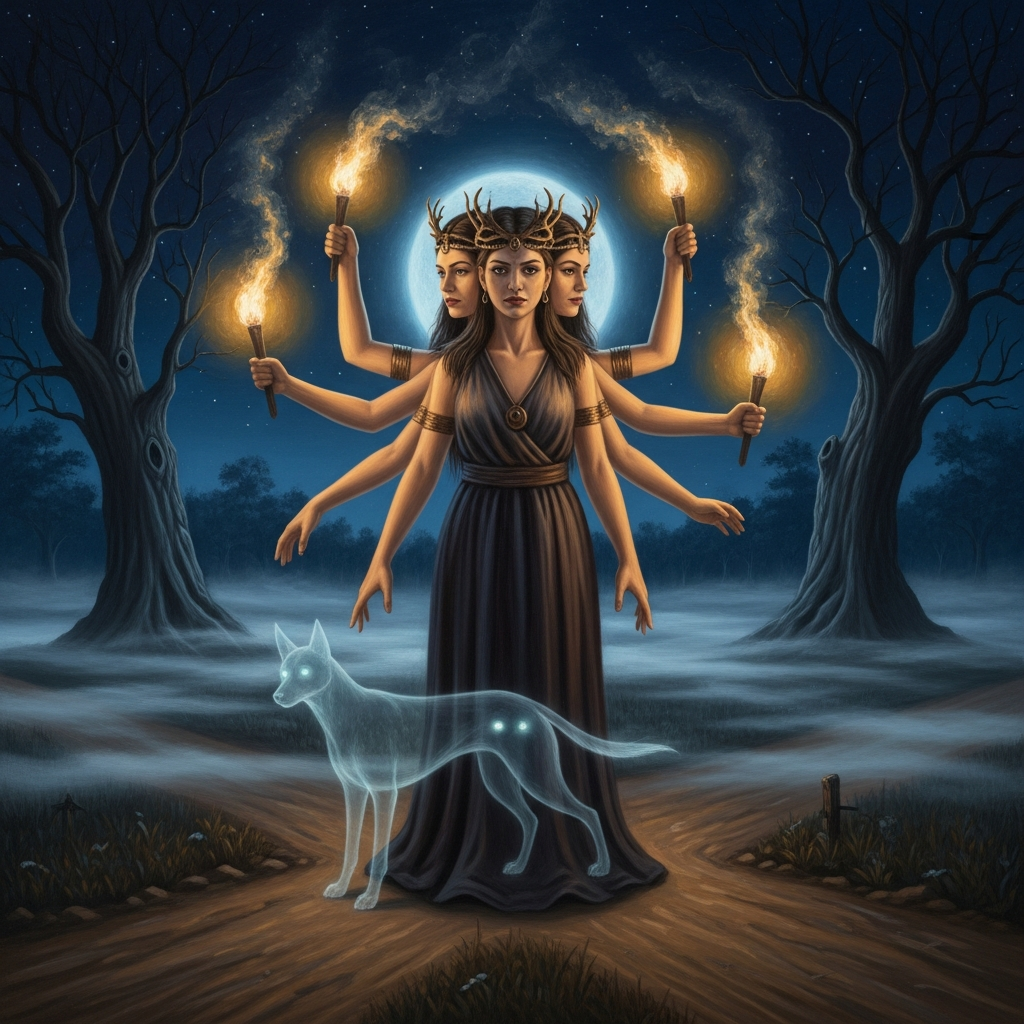
She stood where three roads met — three-faced, holding two torches, dogs at her ankles. She was present at every threshold: birth, marriage, death, the doorway, the moment of decision. Offerings to her were left on the ground at midnight at three-way crossroads — a small cake, a fish, an egg — and were not eaten by mortals afterward, because the goddess had touched them. She was not the goddess you prayed to for victory. She was the goddess you prayed to for safe passage through what you could not see.
- When
- Pre-Olympian — Hesiod gives her central place in the *Theogony* (c. 700 BCE) as a Titaness who keeps her honors under Zeus; cult continues through the Roman imperial period and into Christian Greece
- Where
- The crossroads — *trihodos* — wherever three roads met; the doorway of the house; the threshold of the underworld; especially the small wayside shrines (*hekataia*) at every Greek country crossroad
The crossroads is in the country.
It is a place where two cart-tracks meet a third — three roads converging, the trihodos the Greeks named her after — and there is a small shrine at the meeting point. The shrine is a stone pillar with three faces carved on it: a young woman looking down one road, a middle-aged woman looking down the second, an older woman looking down the third. There is a low offering-table in front of the pillar. The grass around the table is darker than the grass around the rest of the crossroads, fed by the milk and the oil that have been poured there for generations.
This is a hekataion. There is one of these at most country crossroads in Greece for a thousand years.
A traveller passes at midnight. He has been on the road since before dark. He does not know which of the three turnings is the right one — the moonlight is not strong enough to read the local landmarks, the road has forked in a way he did not expect, and he is at the moment in any night journey when the way home stops being obvious.
He stops at the shrine. He puts down a small cake — amphiphon, a flat round cake with candles around the edge — on the offering-table. He pours a little wine on the ground at the foot of the pillar. He says her name three times, once down each road.
Hekate Soteira, he says. Hecate the Saviour. Show me the way.
He waits. He listens.
The dogs of Hecate are heard before she is seen. He hears them — far off, then close, then everywhere — the howling that the Greek tradition describes as the unmistakable announcement of her presence. The dogs are her companions and her warning. Where the dogs are, she is. Where she is, the threshold has opened.
He looks up.
He sees, or feels, the goddess at the centre of the crossroad — three-faced, holding two torches one in each hand, the dogs at her feet, her cloak the colour of a moonless sky. She does not speak. She turns her central face toward one of the three roads, slightly, just enough that he can see which way to go.
He takes that road. He gets home.
The cake on the offering-table is still there at dawn the next morning. The neighbours, walking past, do not touch it. It belongs to the goddess. It has been left for her, and after she has touched it — in whatever way the goddess touches an offering — no mortal mouth eats from it. The dogs, perhaps, eat the cake. Or it rots into the ground beside her shrine and feeds the next year’s grass. Either way, it is hers.
This is what Hecate does. This is what she is for.
She is older than Olympus.
Hesiod, in the Theogony, gives her a passage of striking respect — striking because Hesiod is generally dismissive of the older Titanic generation, which was overthrown by Zeus, but Hecate is the Titaness Zeus chose to honor. She is the daughter of Perses and Asteria — both of them children of Titans — and when Zeus distributed honors after his victory over Cronus, he confirmed Hecate’s ancient prerogatives instead of stripping them.
Hesiod lists her domains. She has a share in the sky; she has a share in the earth; she has a share in the sea. She presides over the assemblies of warriors, over the contests of athletes, over the work of fishermen, over the herds of farmers. She is the goddess invoked by men who go to war and by women who give birth. She nurses the young. She receives the dying. Her honors run, Hesiod says, throughout every domain of human activity — and yet she is not Olympian, not at the table on the mountain, not in the council of the twelve. She is everywhere and on the side.
This is the unique position. She is a major goddess of the Greek pantheon who is structurally outside the Olympian system. She belongs to the older order. The Olympians admit her, defer to her, leave her domains alone. She comes when called and goes away again. She does not live with the others.
Where she lives is more difficult to say. The texts place her, variously, in the underworld (where she escorts Persephone back and forth between Hades and Demeter), at the crossroads (where she meets travellers), at the threshold of houses (where her statue is set in the doorway as protection), and on the moon. She is, in the later tradition, identified with Selene — the moon herself — and with Artemis — the hunter — to form a kind of triple-goddess of the moon and the wild.
But the threefold figure precedes that identification. She is three before she is three with anyone else.
The Homeric Hymn to Demeter places her at one of the great threshold-moments of Greek myth.
Persephone has been taken. Hades has carried her down into the underworld. Demeter is searching the world for her daughter, walking the earth in mourning, and the only being who has heard the cry of the abducted girl is Hecate.
Hecate was in her cave when it happened. She heard the scream from the meadow at Eleusis. She did not see who took the girl — only Helios, the sun, saw that — but she heard. She comes to Demeter, holding her two torches in the dark, and tells the grieving mother what she heard.
This is the role she will keep through the rest of the myth. After Persephone is restored — after Demeter has shut down the harvest and forced Zeus to negotiate — Hecate becomes Persephone’s propolos, her attendant, the one who escorts the queen of the underworld between her two homes. Six months below with Hades; six months above with her mother. Hecate walks beside her both ways.
She is the figure who knows the road in both directions. She has been to the underworld and back. She does not live there, but she travels there, and the dead who pass through her crossroads are her concern in a way they are not the concern of any of the Olympians.
This is why Greeks pray to her at the moment of dying. This is why Greek tombstones are sometimes inscribed with her name. This is why, in the Greek Magical Papyri a thousand years after Hesiod, the great spell of Hecate is the spell summoned for help in the moments of greatest need — birth, death, marriage, the choosing of a road.
She is the goddess of what happens at the threshold.
She has a particular relationship to magic.
This is the part of her that the later Greek tradition emphasized and the modern imagination has inherited. By the Hellenistic period — the centuries after Alexander — Hecate has become the patron deity of Greek witches. The witch Medea calls on her in Apollonius’s Argonautica (Medea is a priestess of Hecate). The witch Simaitha calls on her in Theocritus’s Pharmakeutria. The witch Erichtho calls on her in Lucan. By the Roman imperial period, the Greek Magical Papyri preserve elaborate spells in which Hecate is summoned by name, by epithet, by every form of address the spell-writer can think of, to come at midnight and grant a request.
This connection makes sense. The witch’s work is at the threshold. The witch operates at the seams of things — between sleeping and waking, between living and dead, between this house and the next, between what is named and what is hidden. The witch is, in a sense, a human who tries to do for clients what Hecate does for everyone. The patron goddess is the structural logical patron.
But the witchcraft layer is later. In the older tradition — Hesiod’s, the Homeric Hymn’s, the country shrines’ — Hecate is not the goddess of magic. She is the goddess of the threshold. The magic comes because the threshold is where the visible and invisible touch, and the goddess of the threshold is the natural address for any operation that wants to move between them.
She is the country grandmother’s goddess before she is the witch’s.
The dogs are the constant.
Black dogs. They appear in every description of her — howling at her arrival, accompanying her through the underworld, leading her train through the night. The dog was the animal Greeks associated with Hecate the way the eagle was associated with Zeus and the owl with Athena. Dogs were sacrificed to her — black ones, at the crossroads, at midnight, on the deipnon Hekates, the monthly Dinner of Hecate at the dark of the moon.
The dinner was a meal left at the crossroads or at the doorway of the house — bread, eggs, cheese, fish — for Hecate and for the daimones she travelled with. The daimones were the unhappy dead, the souls of those who had died badly, the ghosts who could not rest. Hecate was, among everything else, their shepherd. She walked them through the world at night, and once a month the houses left out food so that the unhappy ghosts would have what they needed and not enter.
The food was not eaten by mortals afterward. To eat the deipnon Hekates was a serious offense; it would draw the unhappy dead onto you. The food belonged to the goddess and to her train, and it was left out and never taken back.
This was monthly. This was ordinary. This was happening in tens of thousands of Greek households, every dark of the moon, for centuries. Hecate was not exotic. She was domestic. She was the goddess to whom you owed a small dinner once a month for keeping the unhappy spirits of the world off your doorstep.
She kept being prayed to.
Long after Olympus had become a literary device — long after the temples of Zeus and Hera had been converted into churches — the rural Greeks were still leaving cakes at the crossroads. The hekataia, the three-faced shrines at country crossroads, persisted into the Byzantine period. The Eastern church spent centuries trying to suppress the practice. The practice did not entirely stop.
The figure was too useful. The threshold of the night, the moment of decision at the crossroad, the door of the house at the dark of the moon — these moments did not stop happening, and the goddess who had presided over them for two thousand years did not have an easy substitute. The Christian saints absorbed some of her functions (St. Brigid of Kildare, in the western tradition, and various local Madonnas in the eastern); the village magic absorbed others.
But the basic gesture — pour a little wine at the meeting of three roads, leave a small cake at the threshold, ask for safe passage through what you cannot see — is older than Greek religion and outlasted Greek religion. It is what people do when the road forks at midnight.
The shrine is a stone pillar with three faces.
The torches are two because the dark has more than one direction.
The dogs are heard before she is seen.
Hesiod’s hymn to Hecate in the Theogony is unusual in its tone. He is generally a poet of order and hierarchy — the Theogony is a poem about how Zeus achieved kingship over the cosmos and which of the older powers were subordinated and which were destroyed. But when he gets to Hecate he stops the cataloguing and writes a passage of unmistakable reverence: and to her Zeus the son of Cronos gave splendid gifts, that she might have a share of the earth and the unfruitful sea. The list of her domains goes on for forty lines. Hesiod, who is not normally generous, is generous here. Modern scholars have wondered whether he himself was attached to a Hecate cult — whether his village in Boeotia kept a hekataion at its crossroads — and whether the long passage represents something personal in the otherwise impersonal poem.
The Homeric Hymn to Demeter places her in a more specific role: the figure who hears Persephone’s scream and brings the news to Demeter. From that moment on she becomes Persephone’s escort — the goddess who walks the queen of the underworld between her two homes. This makes Hecate the only Olympian-era figure who travels regularly between the world above and the world below. She is the goddess of the katabasis and the anabasis, the descent and the return. The dead who pass through her crossroads are not strangers to her; she has been on the road they are taking, in both directions, more than once.
By the Hellenistic period the iconography has standardized. The three-faced statue (the triformis, in Roman writers) becomes the image. The two torches become the image. The dogs become the image. By the Roman imperial period she has been syncretized with Diana and Selene to form a tripartite goddess — Diana on earth, Selene in heaven, Hecate in the underworld — and this Renaissance-era reading of her (visible in Shakespeare’s Macbeth, where Hecate appears as the queen of witches) is what the modern imagination has inherited.
But beneath the literary Hecate is the rural Hecate — the country goddess of the threshold, with a hekataion at every village crossroad and a small cake set out at the door at the dark of every moon. She is the goddess your grandmother prayed to. She is the goddess of what happens when you cannot see the way home. She is what the Greek tradition put in the place where another tradition might have put an angel.
The torches are still lit.
Echoes Across Traditions
Entities
- Hecate
- Persephone
- Demeter
- Asteria
- Perses

Sources
- Hesiod, *Theogony* 411-452 (c. 700 BCE)
- Homeric Hymn to Demeter 24-25, 51-62 (c. 7th century BCE)
- Apollonius Rhodius, *Argonautica* 3.1207-1224
- Theocritus, *Idyll* 2 (the *Pharmakeutria*)
- Sarah Iles Johnston, *Hekate Soteira* (1990)
- *Greek Magical Papyri* (PGM IV.2785-2890, the great spell of Hecate)