Contents
A boy is given to Death by his angry father — a sacrifice spoken in temper. The boy goes anyway. He arrives at Yama's house when Yama is out and waits three days without food. When Yama returns and apologizes by offering three boons, the boy uses the third to ask the question even gods do not ask: what happens after we die?
- When
- c. 500 BCE (composition of Katha Upanishad)
- Where
- First a sacrificial enclosure where the boy's father is giving away his cattle; then the threshold of Yama's house in the southern direction of the dead
His father is sacrificing.
Vajashravas is performing the vishvajit — the all-conquering sacrifice — and the rules say that to do it correctly, he must give away everything he owns. Every animal, every coin, every jewel, every bolt of cloth. He has done the bare minimum. He has gathered his cattle in the sacrificial enclosure. He is giving them to the priests as gifts.
But the cattle he is giving away are old.
Some of them are sick. Some of them have lost their teeth. Some of them have given their last calf years ago. They are cattle that would soon die anyway, and Vajashravas is performing the ritual of total renunciation by handing over animals he was about to lose.
His son Nachiketa, who is perhaps twelve years old, watches.
He understands, with the particular clarity of clever children, that his father is cheating. The ritual demands true generosity. His father is faking it. The gods, who see everything, will not be fooled.
He approaches his father. He says, Father, to whom will you give me?
Vajashravas waves him away. He is busy.
Nachiketa asks again. Father, to whom will you give me? You are giving away everything else. I am yours. To whom will you give me?
Vajashravas, not yet looking up, says nothing.
Nachiketa, with the calm patience that will define him, asks a third time. Father — to whom will you give me?
Vajashravas — distracted, pressed, irritated, already in the wrong about his cattle — looks up at his son and snaps:
To Death. I give you to Death.
He does not mean it. He means go away, you are bothering me. But the words have left his mouth at a sacrifice. They are spoken aloud, in front of priests, in the moment of a vow. They are real now.
Vajashravas, realizing what he has said, opens his mouth to take it back.
It is too late. Nachiketa has already bowed.
—
The boy says, gently — and there is no anger in him, this is one of the most striking features of the Katha Upanishad — Then I will go to Death, Father. The rite must be honored. I will go.
He walks out of the sacrificial enclosure. He turns south — south is the direction of Yama, the god of death, in Hindu cosmology — and he walks.
The text does not describe the journey. It does not need to. The boy walks until he arrives at the gate of a great house. The gate is shut. The boy sits down on the threshold and waits.
Yama is not home.
Yama is — the text implies — out collecting souls. The work of death does not pause for visitors. The boy waits.
He waits one day. The servants come out and offer him food and water; he refuses. He has come to Death, and one does not eat at Death’s house unless Death himself sets the table. They withdraw, troubled.
He waits a second day. The servants beg him to come inside. He shakes his head. He sits at the threshold.
He waits a third day.
—
Yama returns on the third night.
He comes back from his rounds — green-skinned, riding his black buffalo, the noose of death coiled at his belt — and he sees a small boy sitting at his gate. The servants run to him in alarm. Lord, this Brahmin boy has been on our threshold three days. He has refused food. He has refused drink. We did not know what to do.
Yama is, by all accounts, deeply alarmed. To leave a guest unattended at one’s gate is a serious sin in Vedic society; to leave a Brahmin boy unattended for three days, fasting on one’s threshold, is something a god can be punished for. Yama himself, even Yama, must make this right.
He kneels in front of Nachiketa. He apologizes. He bows. Forgive me, Brahmin boy. I have wronged you. I will atone. For each of the three nights you have spent at my gate, I will grant you one boon. Anything. Ask, and the boon is yours.
Nachiketa nods. He has been thinking, on the threshold, about what to ask.
He asks, for his first boon: Let my father, when he sees me again, recognize me, embrace me, no longer be angry. Let his anger toward me be gone, and let him not fear that I have died. When I return, let him welcome me as his son.
Yama smiles. Granted.
For his second boon, Nachiketa asks: Teach me the fire-sacrifice that leads to the heavenly worlds — the rite that secures the realm of the gods, where there is no fear, no hunger, no death.
Yama is more pleased. Granted. He teaches the boy the fire-sacrifice, in detail, with all the technical precision the Upanishad spells out — and tells him, generously, that this fire-sacrifice will from now on be called Nachiketa-fire in his honor. People will use your name when they perform it. You will be remembered by the rite.
The boy bows.
Then Nachiketa asks his third boon.
—
He says, quietly:
When a man dies, there is doubt. Some say he still exists. Some say he does not. I want to know the truth. Teach me what happens after death.
Yama goes still.
He has been waiting for this. He has known, perhaps, since the boy first sat at the gate that this was the question coming. And he does not want to answer it.
He says, Boy, do not ask me this. This is the one question I am not eager to answer. Even the gods of old were uncertain of this. The matter is subtle. It cannot be easily understood. Choose another boon. Ask for sons who will live a hundred years, ask for cattle, elephants, gold, kingdoms larger than the earth. Ask for any pleasure that exists in any world. I will give you whatever your imagination can conjure. But not this question. Choose something else.
Nachiketa shakes his head.
All those things, Yama, are temporary. Cattle die. Kingdoms fall. Even a hundred years is a short fire. I have seen them. I do not want them. I want the question I asked for. Teach me what happens after death.
Yama tries again. He elaborates the offers — celestial nymphs, music, the daughters of gods, lifetimes longer than anyone has lived. He paints the picture in increasing detail, the way one paints to a child to distract him.
Nachiketa listens patiently. When Yama is done, the boy says only:
All of that wears out. I want to know what does not wear out. Teach me the deathless.
Yama looks at him for a long time.
Then Yama bows.
You are, he says, the student that teachers wait their lives for. The boy who refuses the cattle and asks for the question. Very well, Nachiketa. I will teach you.
—
What Yama teaches him, the Katha Upanishad spends the rest of itself recording. It is one of the foundational metaphysical doctrines of Hinduism.
Yama teaches him about the atman — the inner self — which is not the body, not the mind, not the personality. The atman is what watches all of these. The atman is not born and does not die. When the body falls, the atman does not fall. It moves to another body, or it is recognized, finally, as identical with brahman — the cosmic ground — and is freed from the cycle of birth altogether.
Yama teaches him the chariot metaphor that will travel from the Upanishad into Greek philosophy through the Phaedrus: the body is the chariot, the senses are the horses, the mind is the reins, the intellect is the driver, and the atman is the rider — the rider does not move with the chariot. When the chariot stops, the rider steps off.
Yama teaches him the great line: naayam atma pravachanena labhya na medhaya na bahuna shrutena — this self is not gained by speech, by intellect, by much hearing of texts. It is gained only by the seeker who, like Nachiketa himself, sits at the threshold and refuses to leave.
He teaches him for a long time.
Finally, the teaching is done. Nachiketa has the answer. He turns and walks home.
He arrives back at his father’s enclosure. Vajashravas, still in the middle of the long sacrifice, sees his son walking up the path — the son he sent to Death — and runs to him and embraces him. The first boon takes effect: there is no anger left in him, only relief.
Nachiketa returns to ordinary life. He does not become a famous teacher. He does not start a sect. The Upanishad is content to leave him as a boy who went to the house of Death, asked the question that mattered, and came back with the answer that has been the secret of the Vedic tradition ever since.
The text closes with what Nachiketa took back — the secret formula given by Death himself: that the self is greater than the body, that the deathless dwells in the heart of the deathful, that the sage who knows this is freed.
And, as the text concludes, whoever hears this story, told as the boy heard it, becomes free as the boy became free.
Even reading it, the Upanishad says, is a kind of arrival at the threshold. You sit there now, on the gate of Yama’s house, with the question on your lips. The boy is your model. Wait. Refuse the cattle. Ask the third boon.
Scenes
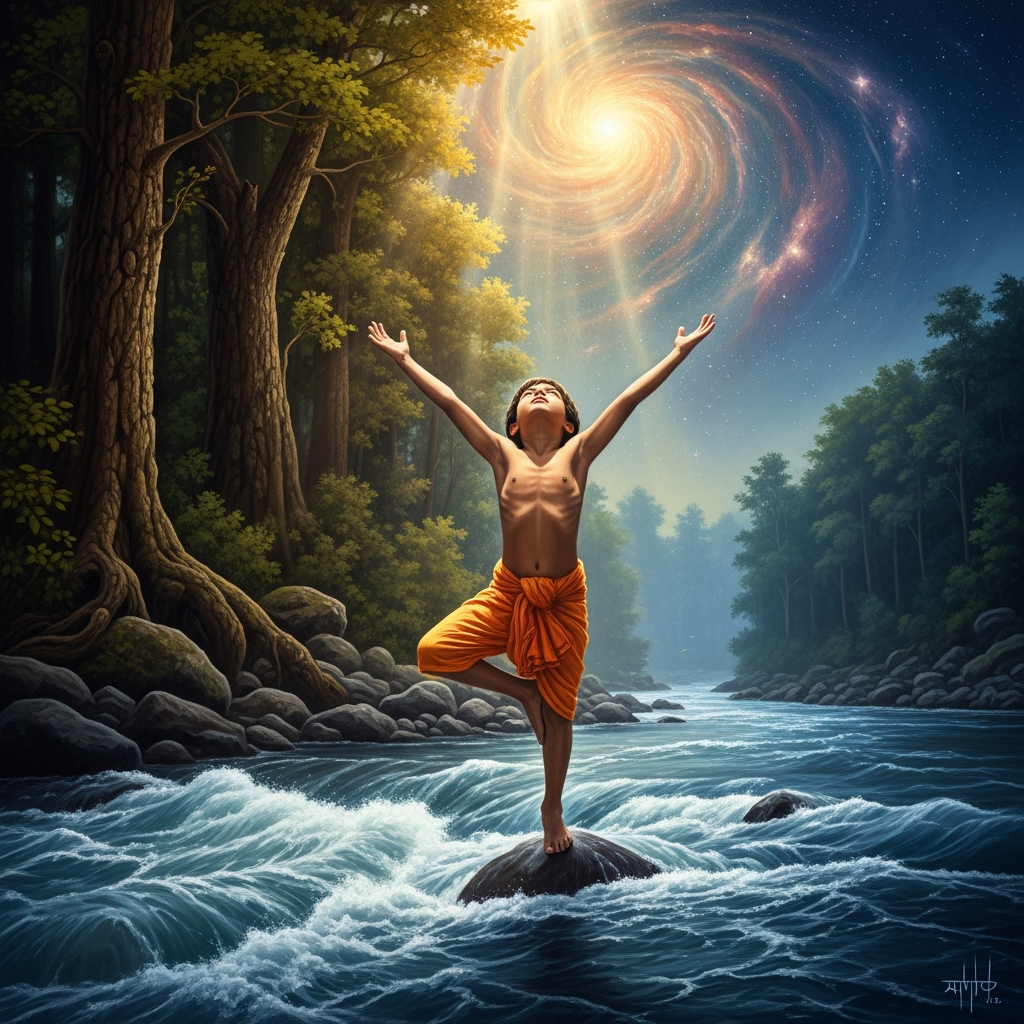
A young boy in a white dhoti stands in the sacrificial enclosure, watching his father give away aged, dying cattle
At the gate of Yama's mansion in the southern realm, the boy Nachiketa sits cross-legged on the threshold
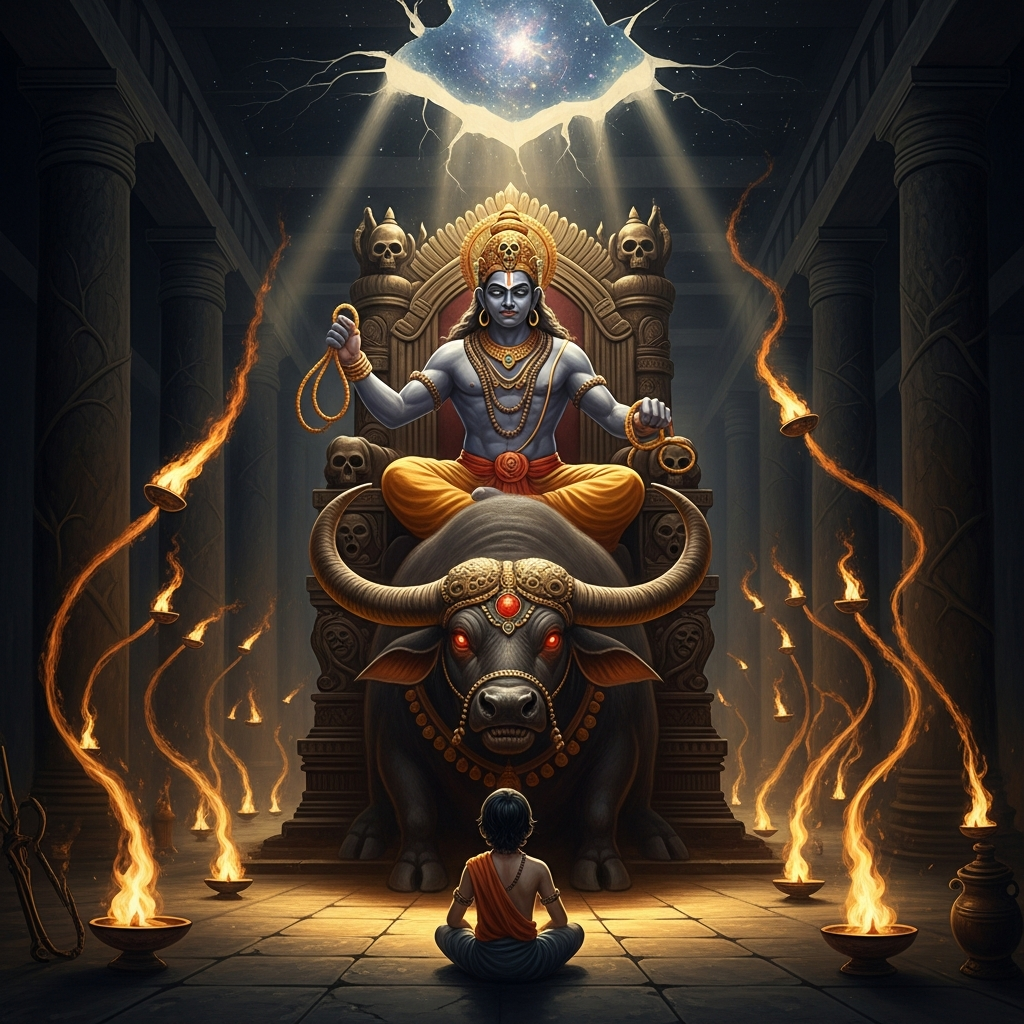
Inside the dim hall, Yama — green-skinned, mounted on a buffalo, holding a noose — leans forward from his throne, eyes wide
Echoes Across Traditions
Entities
- Nachiketa
- Yama
- Vajashravas
- Death

Sources
- *Katha Upanishad* (c. 500 BCE)
- Eknath Easwaran (trans.), *The Upanishads* (1987)
- Patrick Olivelle (trans.), *The Early Upanishads* (1998)
- T. S. Eliot, *The Waste Land* (notes), drawing on Upanishadic material