Phaethon and the Chariot of the Sun
c. 700 BCE (mythic time) · The palace of the sun at the eastern edge of the world, the path of the sun across the heavens, the river Eridanus
Contents
A boy mocked for not knowing his father climbs to the palace of the sun and demands proof. Helios swears by the Styx to grant him any wish. The boy asks to drive the chariot of the sun across the sky for one day. The horses bolt. The world begins to burn.
- When
- c. 700 BCE (mythic time)
- Where
- The palace of the sun at the eastern edge of the world, the path of the sun across the heavens, the river Eridanus
The boy’s mother had told him, all his life, who his father was.
His name was Phaethon. His mother was Clymene, an Oceanid, married now to the king Merops of the Ethiopians but mother of this boy by the sun god himself — by Helios, who drove the chariot of the sun across the sky every day from east to west, beginning in the palace at the world’s edge.
Phaethon believed her. He believed her completely until one day, in a quarrel, his playmate Epaphus — son of Io and Zeus, and therefore noble in his own right — said: You cannot prove anything. Your mother could be lying. You think you are the son of the sun? You are the son of any man your mother chooses to name.
Phaethon went home humiliated. He found Clymene. He told her what had been said. He begged her to give him some sign — some token, some proof — that what she had told him about his father was true.
Clymene grew angry on his behalf. She held up her hands to the sun. She swore by his father’s light that what she had said was true. If you doubt me, she said, go to him yourself. The palace of Helios is not far. Go east. Ask him.
The boy went.
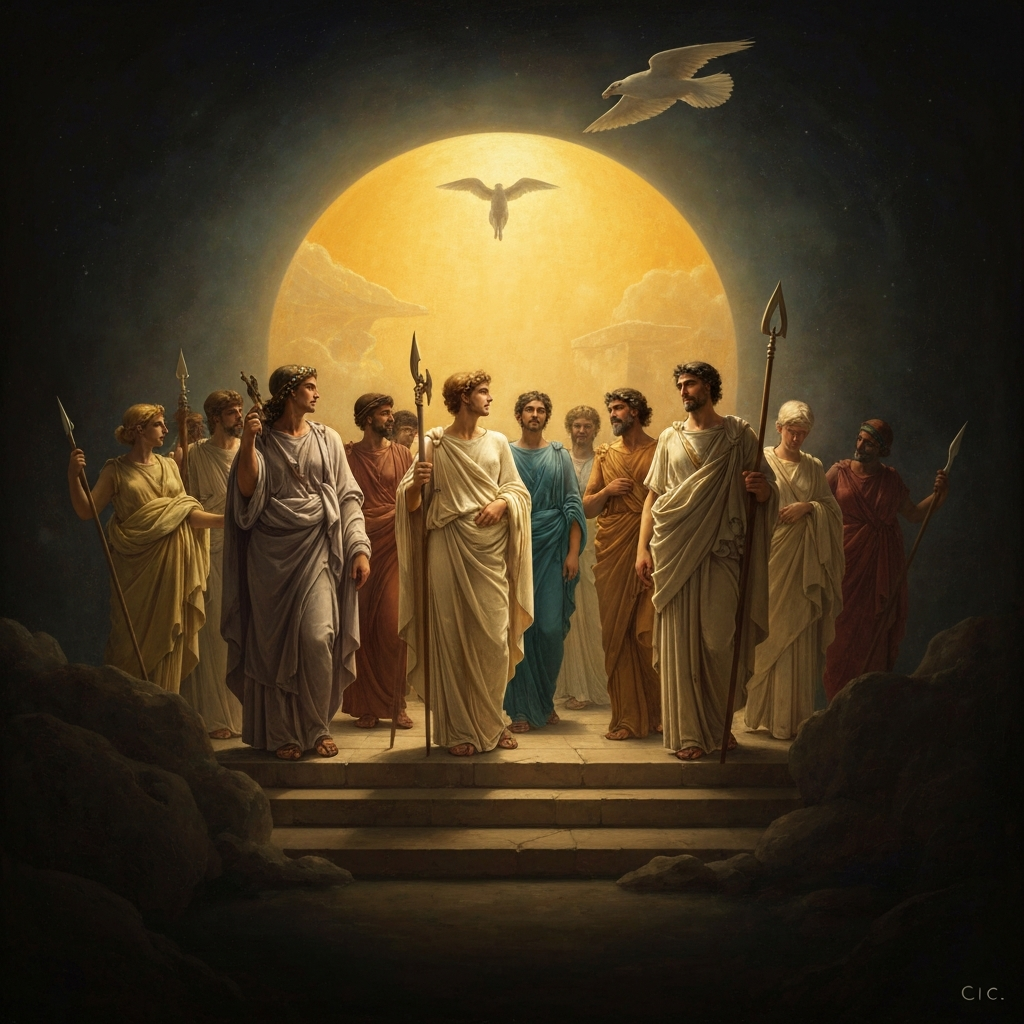
He traveled through Ethiopia and through India and through the lands beyond, until he came to the eastern edge of the world. There, on the slope of a great mountain, stood the palace of the sun — a palace built by Vulcan of doors of beaten silver, columns of gold, walls inlaid with chrysolite and ivory, the throne itself set with emeralds and burning at the center of a hall too bright for any mortal eye.
Phaethon shielded his face. He came forward. The Hours, the Days, the Months, the Years stood in attendance. On the throne, Helios — radiant, crowned with light, dimming his rays for the boy — looked down. He recognized his son.
He came down from the throne. He embraced him. You are my son, he said. I deny nothing. Your mother spoke truth. What is it you want?
Phaethon hesitated. He had imagined this moment all his life and had no plan for what to do once it arrived. Then, perhaps without quite meaning to, he said: Swear to me, by the Styx, that you will give me any gift I ask. I want proof, not in word but in deed.
Helios laughed. He swore.
The Styx is the river by which the gods swear and which no god can perjure. The oath was binding the moment it was spoken.
Phaethon said: Let me drive your chariot across the sky tomorrow. One day. Just one day. So everyone may know what gift the sun has given his son.
Helios’s face fell.
He shook his head. He said: Anything but this. You do not know what you ask. The chariot is mine alone. Even Zeus does not drive it. The path begins straight uphill — so steep the horses can barely manage it in the cool of morning. The middle of the journey is the highest point of heaven; from there I myself look down and grow afraid. The descent is so steep that even the goddess Tethys, waiting at the western shore to receive me, fears I will plunge headlong into the sea. The horses are wild. They breathe fire. They have known no driver but me, and even I struggle with them. Ask anything else. I have sworn by the Styx; I cannot revoke. But for your own sake — choose another gift.
Phaethon would not.
He had come for proof, and proof was the chariot, and the chariot was now his by oath.
Helios, weeping, gave the instructions. He led the boy to the chariot. Stay between the five great zones. Do not go too far north — the bears are there, and they will be afraid. Do not go too far south. Keep to the wheel-tracks worn into the sky. Use the whip sparingly. Hold the reins tight. Do not, under any circumstance, lose your grip on them.
Aurora opened the eastern gates. The horses were harnessed. The boy climbed into the chariot. He took the reins. The four horses — Pyrois, Eous, Aethon, Phlegon — felt at once that the hand on the reins was not their master’s. The weight in the chariot was lighter than usual. The voice was not the voice. They snorted, reared, and broke into a wild gallop.
The chariot left the path immediately.
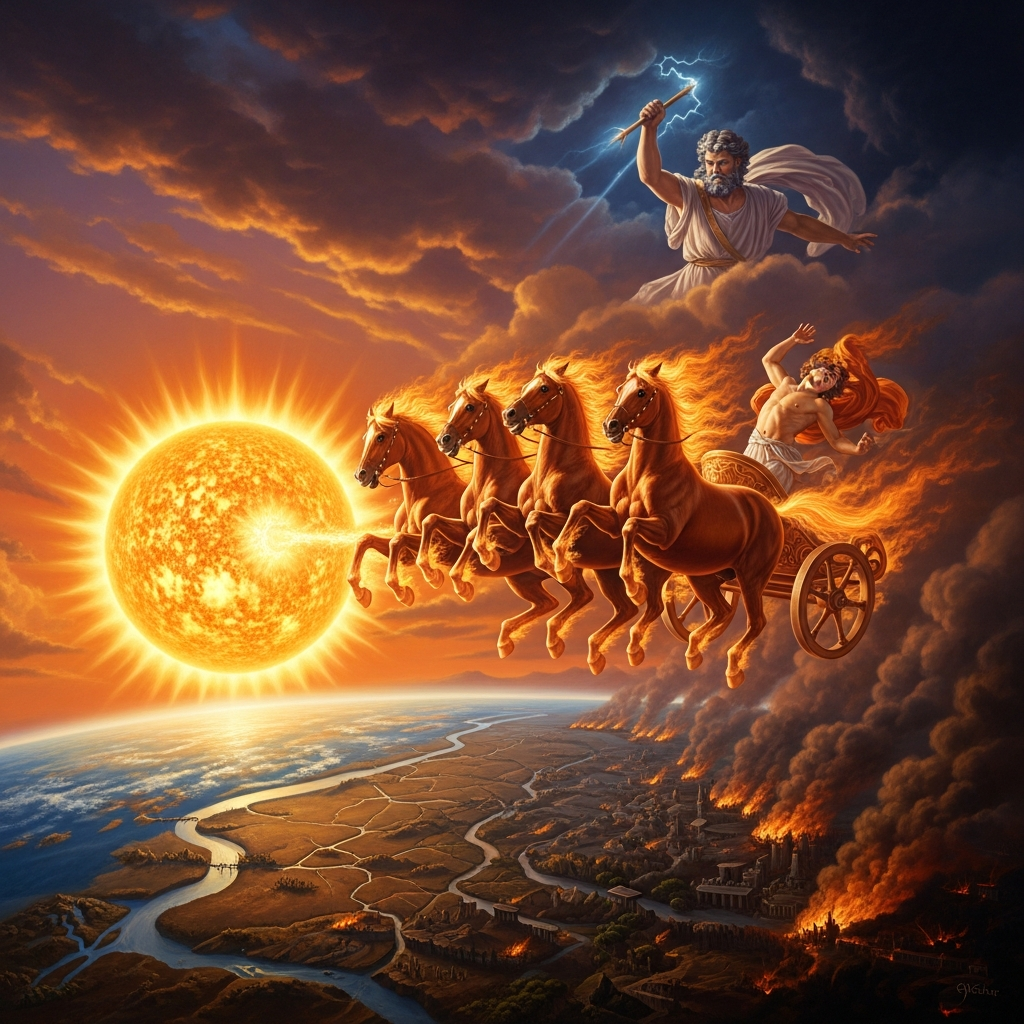
It plunged upward, far above the usual track. The constellations, which had grown used to the regular morning passing, found themselves scorched. The Great Bear smoked. Scorpio stretched its claws toward the unfamiliar fire. The boy looked down. He saw, at a height no one had ever seen the world from, the entire earth laid out below — and his nerve broke.
The horses, sensing fear, ran where they liked. They plunged downward toward the earth.
The earth was too close.
Forests caught fire. Mountains caught fire. The Ethiopians’ skin was burned dark in the inferno (Ovid offers this etymology). The Nile fled in fear and hid its source. The Don and the Rhine and the Po boiled. The Sahara was created in an afternoon. Atlas, holding up the sky, found the sky too hot to touch. The cities of men burned. The seas began to shrink.
Earth, the goddess herself, raised her scorched face out of the smoke and prayed to Zeus: If this is what you meant the world to be, then end it cleanly. But if you mean for it to continue, do something about your grandson in that chariot.
Zeus had no time for due process. He took up a thunderbolt. He stood on Olympus and aimed.
The bolt struck the chariot. The boy was thrown out — burning, hair on fire, falling like a comet across half the sky. He fell toward the river Eridanus, in the far west, and the waters of the river caught his smoking body and drew him down.
The horses, freed of the bolt-shattered chariot, were rounded up by the gods and returned, eventually, to Helios.
For a day Helios refused to drive. He sat in his palace and wept. The world was without sun. The other gods had to plead with him. Drive, they said, or the world ends. He drove. He drove for the rest of time, and never again did he loan the chariot.
On the banks of the Eridanus, the Heliades — Phaethon’s three sisters — found his body. They wept over him for months. They could not stop weeping. Their feet rooted into the bank. Bark grew up their legs. Their bodies became poplars; their tears, dropping into the water, hardened in the slow cold and became amber. To this day, Greek and Roman poets said, amber on the riverbed is the tears of his sisters; and the poplar shivers when the wind comes from the west, where their brother fell.
Phaethon’s tomb was on the bank. The inscription, the way Ovid writes it: Here lies Phaethon, charioteer of his father’s chariot. He could not control it. He died in the great attempt.
The line is generous. It does not say foolish. It does not say vain. It says he tried something beyond his strength, and failed greatly, and burned the world doing it. The Greeks were not above admiring the attempt, even as they mourned the cost.
But the chariot is back in the hands of its proper driver. The reins, every morning at dawn, are held by someone old enough to know what fire is. The horses know the difference. So do we, when we are honest.
Scenes
The crystalline palace of Helios at the world's edge
The chariot is a streak of fire across a wrong piece of sky
Mountains burn
Echoes Across Traditions
Entities
- Phaethon
- Helios
- Clymene
- The Heliades
- Zeus
Sources
- Ovid, Metamorphoses I.747-II.400
- Euripides, Phaethon (fragments)
- Hyginus, Fabulae 152A, 154
- Plato, Timaeus 22c