Contents
Brahma has just made the world and it is silent — colors, shapes, motion, but no sound. He looks at his consort Saraswati and asks for something to fill the air. She lifts a vina from nowhere, places her fingers on the strings, and sound enters the universe for the first time. The first note is so clean the gods stop in mid-breath, and the river that bears her name begins to flow.
- When
- c. 1500 BCE (Vedic) – 900 CE (Puranic; mythic time of creation)
- Where
- The newborn cosmos, just after Brahma's first creative breath; the bank of the river Saraswati where she first appears
When Brahma first opens his eyes on the new universe, the cosmos is full of things and empty of one thing.
The things are everywhere. Stars have already been hung. The first oceans roll. Mountains have lifted out of the ocean floor. Trees stand on their first soils. Animals — half-formed, in their first generations — graze on grass that has not yet been named. Brahma is pleased with what he has made; the form is correct.
But the cosmos has no sound.
He notices this slowly. He is, after all, in the first hour of creation; he has not yet learned what the absences are. He lifts a hand and a tree branch moves and there is no rustle. A mountain stream falls and the water lands without splashing. The wind stirs grass and the grass moves silently. Birds open their beaks and nothing emerges.
The world is a beautiful pantomime.
Brahma does not have the word sound yet. He has only the lack of it — a strange thinness in everything, as if the world were a painted backdrop without the orchestra below. He turns to find someone to tell. He looks for his consort.
She is already there.
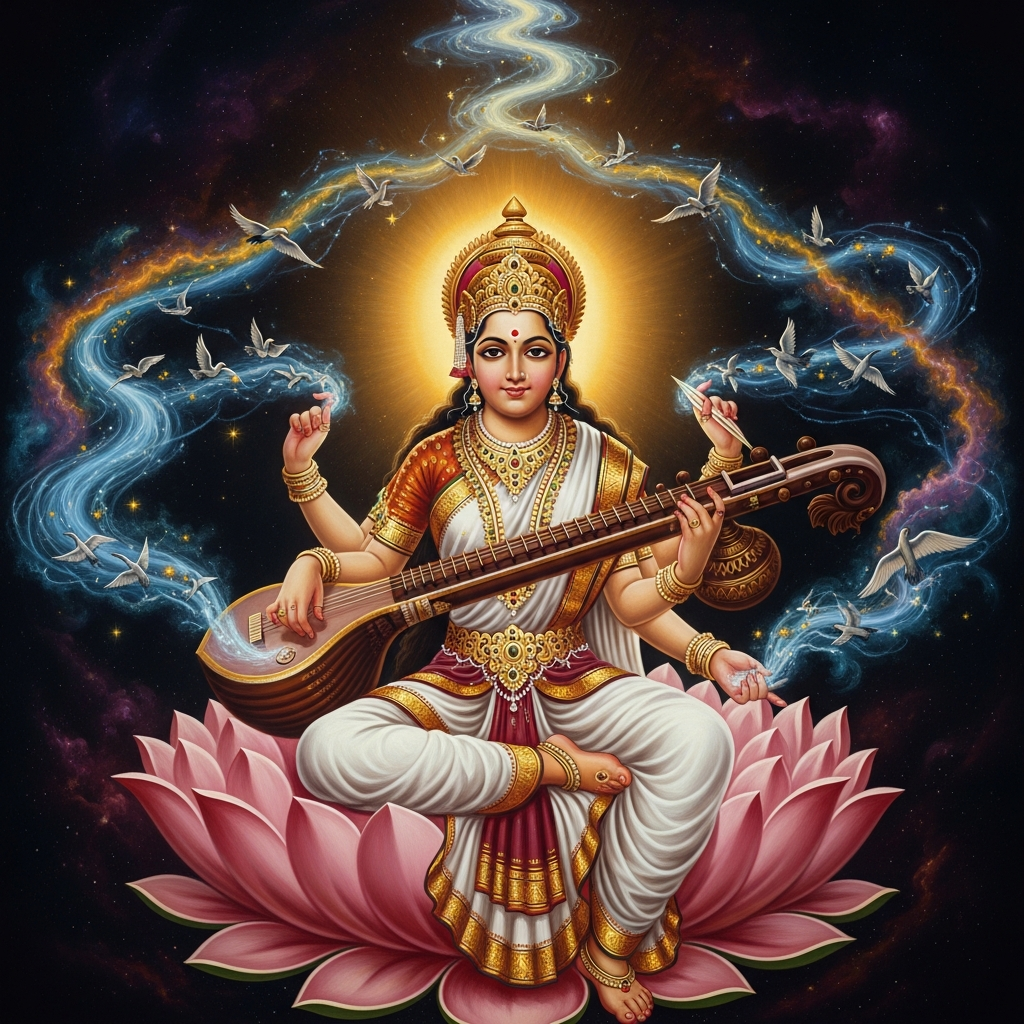
Saraswati has come into existence beside him without announcement, as the goddesses of the Vedas do. She wears white. She is seated on a white lotus that has just opened on the surface of an unnamed river. Her hair is dark and unbound. Her face is calm with a quality Brahma cannot yet identify but later traditions will call intelligence — the goddess of all understanding, of speech, of knowledge, of the inner ordering of things.
Brahma turns to her and says — and it is itself the first speech of creation, but the world has no sound to make it audible — something is missing.
She nods. She has been waiting for him to notice.
—
She lifts her hands.
They are empty. Then they are not empty. A vina — the long-necked Indian lute, four strings stretched over two gourds — rests across her lap. Where it came from, the texts do not say. It is hers. It has always been hers. It was waiting in the same nowhere she was waiting in, and now she has called it forth.
She tunes it.
The tuning itself is the first sound — small, plucked, exploratory notes that find their pitches against each other. The new universe trembles. Trees, which had been still, lean infinitesimally toward the lotus. Animals, which had been moving silently, freeze. A stag at the edge of a clearing turns its head.
Brahma watches her hands.
He does not yet understand what is happening. He understands only that something is changing in the air. There is a thickness to it now. The thinness is leaving.
She finishes tuning. She places her fingers on the strings.
She plays.
—
The first chord enters the universe.
The Puranas do not specify what note it is. Indian musical tradition will, eventually, identify the seven primary notes — sa, re, ga, ma, pa, dha, ni — and identify Saraswati as the source of all of them; but in the moment of first sound, there is only one note. One pure note, struck on a string, opening outward through the air.
It travels.
It travels at a speed faster than light, the texts say, because it is not bound by the rules that bind light — it is a finer substance. It reaches the trees before it reaches the ground. The trees that were leaning in stand fully attentive now. It reaches the animals; the stag’s head comes fully around, ears forward. It reaches the gods, who have been milling at the edge of the new creation; they go still. It reaches the unborn rivers, the still-forming clouds, the horizon. It reaches the boundaries of the cosmos and bounces back, and the cosmos hears itself for the first time.
When the note fades, the silence that follows is not the same silence as before. The silence before was empty. The silence now is the silence after a sound — the silence that knows what sound is.
Brahma exhales. He has been holding his breath.
Saraswati plays a second note. Then a third. She begins to construct the first raga — the first scale, the first melody, the first organized progression of pitches.
The cosmos begins to come alive.
—
What Saraswati’s music does, in the Puranic accounts, is finish creation.
Brahma had built the form of the world — geography, biology, geometry. But form without sound is a body without breath. Saraswati’s music is the breath. Once the music begins, the world’s silent parts wake into voice.
The wind learns to whistle. It has been moving silently across grass; now it discovers it has a sound, and the sound is the soft sustained tone of breath through reeds. It begins to whistle continuously across the new continents.
The rivers learn to gurgle. They have been flowing without splash; now their voices come to them, and they begin the chorus that they will keep, river by river, for the rest of cosmic time.
The birds, who had been opening their beaks uselessly, are given their songs. Each bird species, the texts say, was given a different fragment of Saraswati’s vina-melody to carry forward — that is why the dawn chorus, listened to with attention, has the structure of a half-remembered raga.
The animals find their voices. The stag bellows. The lion roars. The peacock screams. The frog croaks. The cricket chirrs. The whale, in the deep, sings the long structured songs that, even now, scientists discover have grammar to them — the relics of the vina’s first transmission.
Most importantly, the gods speak.
Until this moment, even the gods have communicated only by shape and intent. Now they have voices. They begin to speak — first in single words, then in the great chants of the Vedas, which, in this telling, are simply the sounds the gods began to make once Saraswati gave them tongues.
—
Saraswati continues to play. As she plays, she walks.
She walks barefoot away from Brahma — gently, as one walks not to disrupt a music — out across the new earth, holding the vina, plucking softly. Her footsteps on the bare ground are themselves the foundation of a river. Wherever her foot lifts, water has welled up; wherever the next foot falls, the water deepens.
By the time she has walked a long course, a river has formed behind her — broad, running, sun-flashed, fed by her steps.
This is the river Saraswati. The Vedas know it as one of the seven sacred rivers of India, the one along whose banks the Vedic civilization first crystallized — the river of poets, of Brahmin scholars, of memorized scripture. The Rigveda’s hymns refer to her constantly: Best of mothers, best of rivers, best of goddesses. By the time the Puranas are composed, the geographic Saraswati has dried up — the geological river vanished into the desert sometime in the second millennium BCE — but the goddess remains, and the river is said to flow now invisibly, underground, surfacing only at the great confluence at Prayag (modern Allahabad) where the Ganga and Yamuna meet.
Pilgrims still go there to bathe in three rivers, two visible and one not. Saraswati’s river is the one you cannot see. You feel it.
—
The music never stops.
Saraswati has not, in any text, set the vina down. She is depicted, in every painting and sculpture from the temple-friezes of the Gupta period to the bedroom shrines of contemporary college students, with the instrument across her lap. Her fingers are always on the strings.
This is doctrinally important. Hindu philosophy does not believe music started and then continued from human imitation; it believes music is ongoing, that Saraswati is still playing, that every musician on earth — every sitar player, every singer of dhrupad, every woman humming to a baby, every street-corner flautist — is borrowing from her continuous melody. The instrument changes. The melody is one melody, distributed.
Indian classical training begins, traditionally, with a prayer to Saraswati. Every concert opens with a brief invocation. Schoolchildren on the first day of the academic year — the festival of Vasant Panchami, in late January — write the syllable Om on a fresh page in honor of her. They do this because she is the goddess of vidya, of knowledge, and because every act of learning, in Hindu reckoning, is an act of receiving sound from the goddess who first gave the universe its voice.
Brahma’s creation gave the cosmos its body. Saraswati gave it its breath, and it has been singing ever since.
Scenes
Brahma stands in the newly created cosmos — stars overhead, rivers below, the first trees half-formed — and the air is silent
Saraswati seated on a white lotus, the vina across her lap
On a riverbank where the goddess walks barefoot, water rises behind her footsteps; the Saraswati river is born and flows toward the dawn, scholars and poets along its banks bowing as she passes
Echoes Across Traditions
Entities


Sources
- *Rigveda* (hymns to Saraswati, c. 1500 BCE)
- *Markandeya Purana* (c. 300 CE)
- *Devi Bhagavata Purana* (c. 900 CE)
- Tracy Pintchman, *The Rise of the Goddess in the Hindu Tradition* (1994)