The Divine Twins: Castor and Pollux, the Ashvins, Romulus and Remus, Hunahpu and Xbalanque
Ancient, across all periods — Vedic Bronze Age through Maya Classic period · Sparta, the Vedic heaven, Rome, the Maya underworld Xibalba
Contents
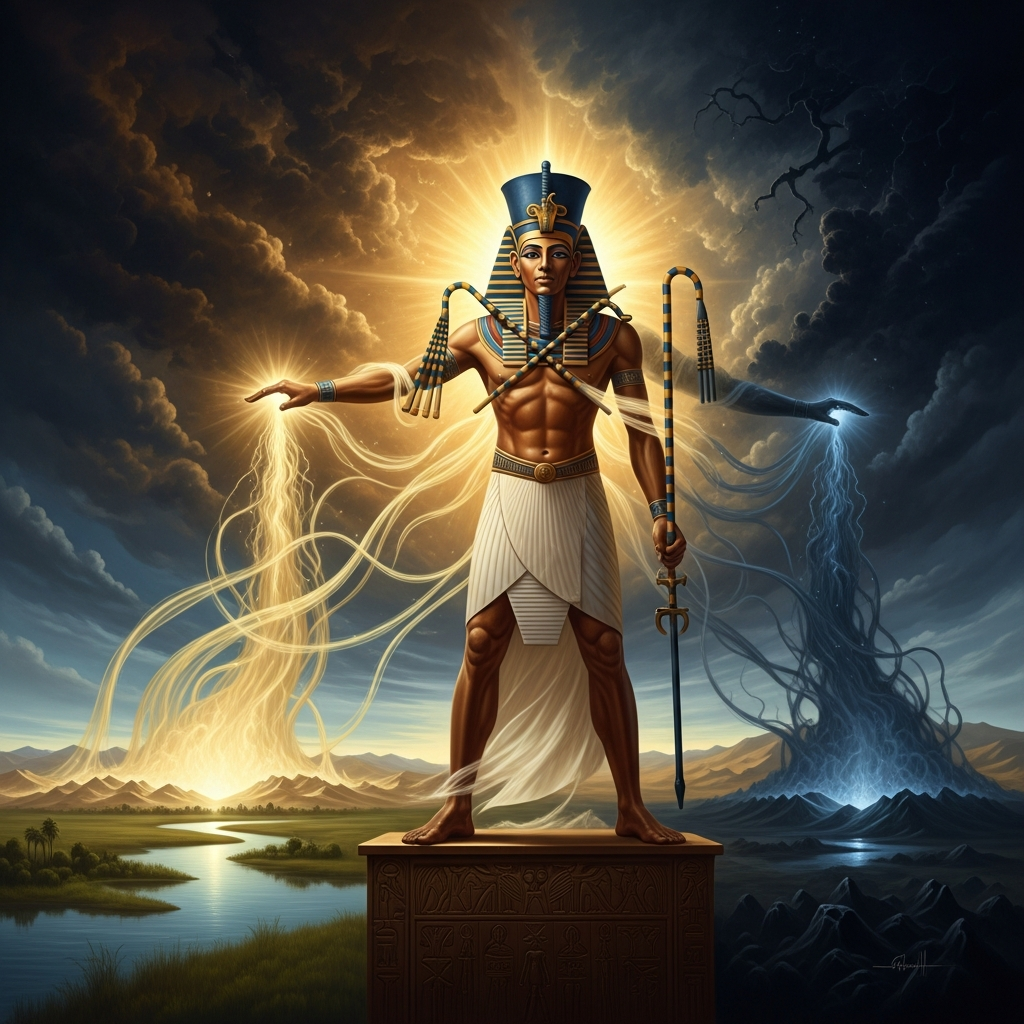
Divine twins appear across every major mythology. The recurring structure — one mortal, one immortal, bound by love and rivalry — encodes humanity's oldest meditation on the tension between death and transcendence.
- When
- Ancient, across all periods — Vedic Bronze Age through Maya Classic period
- Where
- Sparta, the Vedic heaven, Rome, the Maya underworld Xibalba
Two children born from the same mother, at the same moment, raised together — yet divided by the most fundamental difference the world contains: one of them can die.
The divine twin mythology appears in Greek, Roman, Vedic, Norse, Maya, Yoruba, and dozens of other traditions. The specific details vary enormously, but the structural core recurs so consistently that comparative mythologists have identified it as one of the most ancient and widespread narrative patterns in world mythology. Jaan Puhvel traces the divine twin archetype back to Proto-Indo-European mythology — the twin horsemen who drive the sun’s chariot appear in Greek, Vedic, Germanic, and Baltic tradition, suggesting a common origin thousands of years before any surviving text.
What does the twin myth do that a single divine hero cannot?
It holds the two halves of the human condition in a relationship rather than a contradiction. Every human being contains both mortal and immortal impulses — the animal drive to survive, and the spiritual drive to transcend. The twin myth externalizes this tension into two beings who love each other perfectly and are separated by the condition of existence itself. The result is not resolution but something more honest: a myth about the cost of being human, encoded as the grief between two people who should be the same and are not.
Castor and Pollux: The Brothers Who Split Eternity
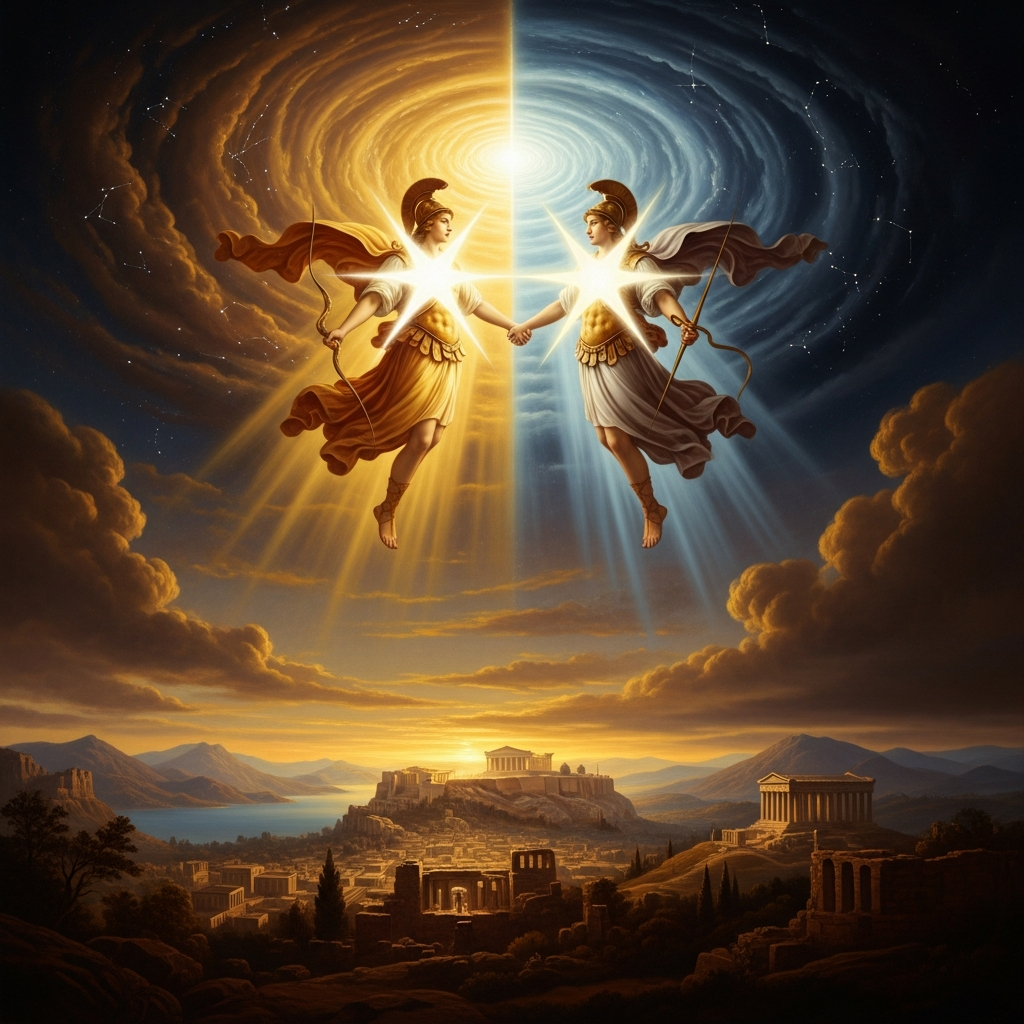
The Dioscuri are among the most widely worshipped divine figures in the ancient Mediterranean world. Their cult spread from Sparta across the Greek world and into Rome, where they appeared on horseback to lead the Roman army to victory in 499 BCE. Sailors prayed to them during storms — the phenomenon now called Saint Elmo’s fire was called the Dioscuri’s fire in antiquity.
Their birth myth requires two fathers. Leda, queen of Sparta, was visited by Zeus in the form of a swan, and on the same night slept with her husband Tyndareus. She laid two eggs. From one egg came Castor (mortal, son of Tyndareus) and Clytemnestra. From the other came Pollux (immortal, son of Zeus) and Helen. The split is immediate: two brothers from the same womb, one who will age and die and one who will not.
They are inseparable. When Castor is killed in a cattle raid, Pollux — the immortal — refuses to go to Olympus alone. He appeals to Zeus to share his immortality with his brother. Zeus cannot give Castor immortality; Castor is mortal and that cannot be undone. But he can divide the arrangement: Castor and Pollux will alternate between Olympus and the underworld, spending one day in each, never both alive at the same time, but always together in the cycle.
The myth insists on something that Greek tragedy would later explore in detail: that love across the mortal/immortal divide is the most fundamental human condition, and that the gods themselves sometimes find ways to honor it, even if those ways are heartbreaking. The Dioscuri are together, and they are eternally separated, and these are the same fact.
The Ashvins: The Gods Who Arrive Before the Sun
The Vedic Ashvins are not hero-twins in the narrative sense — they have no single defining story in the Rig Veda. Instead, they appear in dozens of hymns as the divine helpers, the twin horsemen who drive the sun’s chariot to the horizon each dawn.
Their character is therapeutic. They are the deities you invoke when you are drowning, when you are dying of age, when you are lost. They healed the blind sage Rijrasva. They restored youth to the sage Chyavana as payment for teaching them the secret of immortal drink. They retrieved Bhujyu when his ship was destroyed at sea. The Ashvins function as divine emergency responders — the twin forces of early light that arrive before the full illumination of day.
Their dual nature reflects something real about the dawn: there are, in fact, two distinct moments — the pale eastern light before sunrise and the moment the sun appears. The Vedic twin myth is grounded in this observational detail. The twins are the two kinds of dawn light, individuated and made divine, inseparable from each other but distinct.
This is the most naturalistic version of the divine twin mythology: the twins represent the two phases of a single phenomenon. Their partnership is not about the mortal/immortal split but about the two necessary parts of a transition — the before and the moment of.
Romulus and Remus: The City Built on a Death
The Roman twin myth refuses the comforting resolution that Greek myth sometimes permits.
Romulus and Remus are suckled by a she-wolf, raised by shepherds, discover their divine origin, overthrow their treacherous great-uncle, restore their grandfather to his throne, and then must found a city of their own. They disagree on which hill — the Aventine for Remus, the Palatine for Romulus. They resort to augury: Remus sees six vultures, Romulus sees twelve. Romulus wins. He begins building the wall of Rome.
Remus mocks the wall by jumping over it. Romulus kills him.
The accounts vary — some say a lieutenant killed Remus, some say Romulus struck the blow himself — but the outcome is consistent. The city of Rome requires the death of one founder. The political theology embedded in this myth is deliberately harsh: great things require sacrifices that cannot be undone, and the person who sacrifices a brother to build a city is not forgiven, exactly, but neither is he condemned. He builds Rome.
The fraternal twin myth here does something different from the Dioscuri. There is no loving compromise, no eternal alternation. There is a choice — city or brother — and the city was chosen. Rome told this story about its own origins and kept telling it. The civic consciousness that built the greatest empire of the ancient world was rooted in a founding murder that could not be explained away.
Hunahpu and Xbalanque: The Twins Who Defeated Death
The Maya Hero Twins from the Popol Vuh are the most cosmologically important of all the divine twin mythologies in this survey, because they succeed where their predecessors failed: they defeat the lords of death and ascend as celestial bodies.
Their father and uncle, the original Hero Twins (One Hunahpu and Seven Hunahpu), had descended to Xibalba — the Maya underworld — to play ball against the death lords. They lost, were killed, and One Hunahpu’s head was hung in a gourd tree. The head impregnated the daughter of a Xibalba lord, who fled to the upper world and gave birth to Hunahpu and Xbalanque.
The twins grow up to avenge their father. They descend to Xibalba, survive the twelve death houses through cleverness and sacrifice — including allowing themselves to be burned, reconstituted, and burned again in a feat of disguised magic that impresses even the death lords. They reveal their divine nature, defeat the lords of Xibalba, retrieve their father, and ascend. Hunahpu becomes the sun. Xbalanque becomes the moon (or, in some accounts, Venus).
The theological payload is explicit: the proper response to death is not to avoid it or to bargain with it, but to descend into it voluntarily, survive it through intelligence and sacrifice, and emerge transformed. The Hero Twins do not escape the underworld — they conquer it. The myth of celestial bodies as the result of a triumph over death is the Maya sky’s deepest theological statement.
The Split That Makes Us Human
What the divine twin mythology does, across all of these traditions, is give form to the condition that makes human experience uniquely difficult: we are beings who know about death while wanting desperately to transcend it. Every human being has some version of this split — the body that dies and the mind that cannot fully accept it.
The twin is the externalized version of that internal division. One of us will die; one of us wants to live forever; and these two parts love each other with the intensity of people who share everything except the one thing that matters most.
The myths that find solutions — Castor and Pollux alternating between heaven and death, Hunahpu and Xbalanque ascending as sun and moon — are not wishful thinking. They are descriptions of what the human imagination finds tolerable: not immortality for everyone, but a structure in which death and transcendence belong to each other, each making the other meaningful.
Echoes Across Traditions
Entities


Sources
- Jaan Puhvel, *Comparative Mythology* (1987)
- Walter Burkert, *Greek Religion* (1985)
- Dennis Tedlock, trans., *Popol Vuh* (1985)
- Wendy Doniger, *The Hindus: An Alternative History* (2009)
- David Leeming, *The Oxford Companion to World Mythology* (2005)