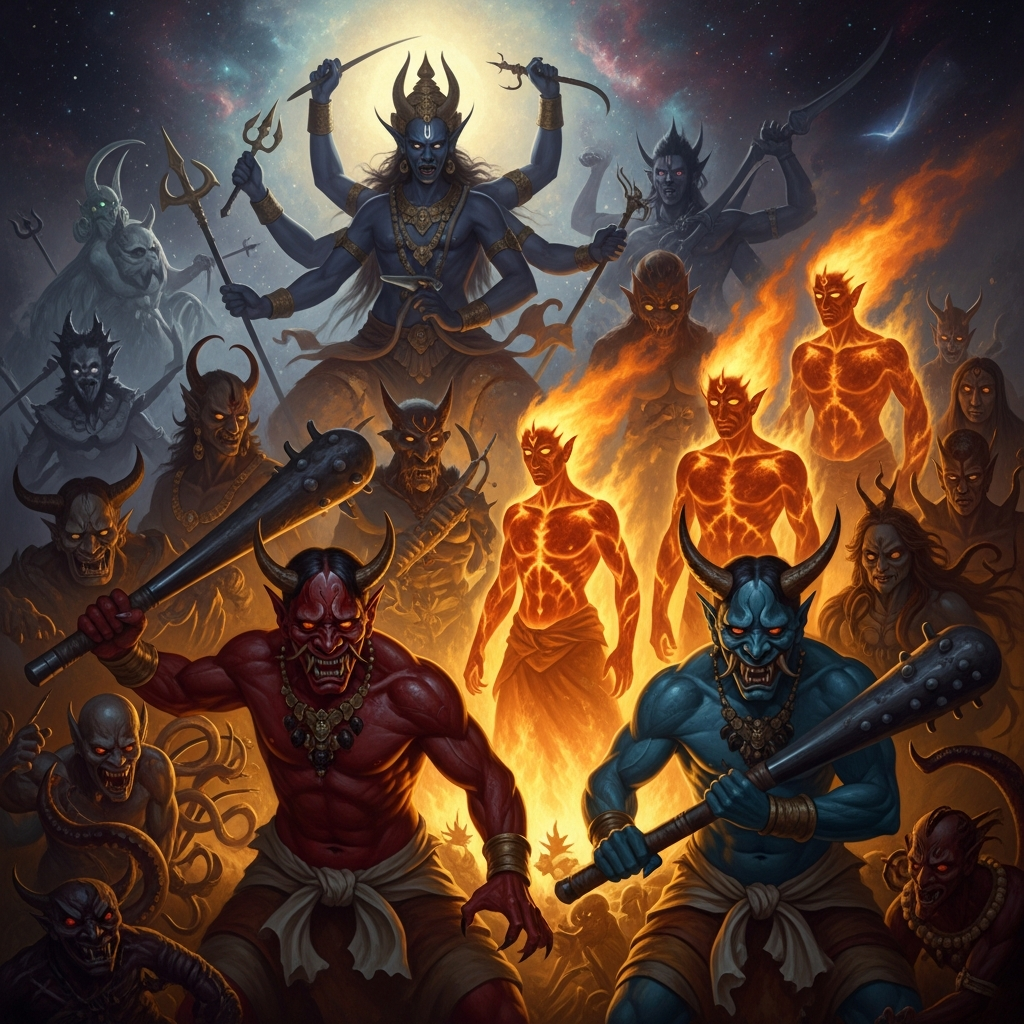
The Sympathy for Devils: Evil Spirits Across World Mythology
Asuras in the Rigveda (c. 1500-1200 BCE); Christian demonology systematized c. 3rd-5th century CE; jinn described in the Quran (c. 610-632 CE); Oni in Japanese texts from c. 720 CE; Rakshasas in the Ramayana (c. 500-400 BCE) · The celestial court (fallen from), the primordial chaos (risen from), the wilderness (dwelling in), the human heart (born within)
Contents
Asuras, demons, jinn, oni, rakshasas, shedim — evil spirits in world mythology are rarely simply evil. The closer you look, the more complicated they become.
- When
- Asuras in the Rigveda (c. 1500-1200 BCE); Christian demonology systematized c. 3rd-5th century CE; jinn described in the Quran (c. 610-632 CE); Oni in Japanese texts from c. 720 CE; Rakshasas in the Ramayana (c. 500-400 BCE)
- Where
- The celestial court (fallen from), the primordial chaos (risen from), the wilderness (dwelling in), the human heart (born within)
The king of Lanka is sitting in his palace reading. His name is Ravana, and he has ten heads and twenty arms, and he is the villain of the Ramayana, the most celebrated Sanskrit epic in Hindu tradition. He will kidnap the goddess Sita, and the hero Rama will raise an army of monkeys to rescue her, and Ravana will die in battle.
But before all of that, consider what the text tells us about this demon king. He is a Brahmin — the son of a sage, a member of the priestly class. He is a devoted worshipper of Shiva, having meditated for ten thousand years and cut off his own heads as offerings until Shiva granted him his boons. He is, by every religious standard, extraordinarily pious. His sin is not impiety but pride: the overreach that leads him to take what is not his.
The most interesting thing about evil spirits in world mythology is how often they turn out to be, in some crucial sense, right.
The Problem of Evil’s Origin
Every theological system that posits a good and powerful creator faces the same structural problem: if creation is good and the creator is good and powerful, where does harm come from? The evil spirit is the traditional answer — a category of being that exists outside or against the divine order and is responsible for suffering, temptation, disease, and death.
But the evil spirit immediately creates a second problem. If the good god created everything, did it create the evil spirit? And if so, what does that say about the god?
The traditions solve this problem in three fundamentally different ways, and understanding the three ways clarifies the entire landscape of demonology.
The fallen-god model (dominant in Jewish, Christian, and Islamic tradition) says that the evil spirit was originally a good being — an angel, a divine servant — who chose wrongly and was cast out. Evil is not primordial. It is a corruption of something that was originally good. Satan was Lucifer; the demons were angels. This model preserves divine goodness by making evil the result of creaturely choice.
The primordial-chaos model (dominant in Mesopotamian and many polytheistic traditions) says that evil is not a corruption but a remnant — the chaos that existed before the gods imposed order. The demons are not fallen angels but pre-cosmic beings who predate the divine order and have never accepted its authority. Tiamat’s descendants, the monsters before creation, the powers that the gods drove back but did not destroy.
The older-order model (dominant in Hindu and some Greek traditions) says that evil is the losing side in a divine civil war. The Asuras are not evil by nature — they are the beings who backed the wrong faction, or the faction that the gods needed to defeat in order to establish the current cosmic arrangement. Their “evil” is political, not metaphysical.
The Asuras: A Divine Civil War
The Rigveda, the oldest stratum of Hindu sacred literature (c. 1500-1200 BCE), does not treat “asura” as a term of condemnation. Varuna — one of the most morally elevated gods in the Vedic pantheon, associated with cosmic order, truth, and the punishment of human sin — is called asura. The great god Indra is called asura. The word means “lord of breath,” something closer to “vital lord” than to “demon.”
The semantic shift, tracked across centuries of Vedic and post-Vedic literature, reflects the outcome of the mythological civil war. As the Devas (the gods associated with light, sky, and the cosmic order that will become the basis of classical Hinduism) triumph over the Asuras in a series of cosmic battles, “asura” changes meaning. It comes to mean the beings who lost — the older, darker powers now dwelling in the lower realms.
But the Puranas remember the original ambiguity. King Bali — the greatest of the Asura kings — is repeatedly described as more righteous than Indra, more generous, more genuinely devoted to dharma. Vishnu himself takes human form as the dwarf Vamana and begs three paces of land from Bali, then expands to cosmic size and covers the entire universe in three steps, banishing Bali to the underworld. The myth does not disguise that this is a trick — a divine cheat — played on a virtuous king. Bali’s righteousness is explicitly the reason Vishnu had to resort to deception. There was no other way to remove him.
Some scholars read this as a cultural-political narrative: the Vedic traditions superseding older, local traditions. The Asuras may preserve the memory of religious traditions that were defeated and mythologized as demonic.
Iblis: The Proudest Refusal
The Quranic Iblis is a theological puzzle that Islamic scholars have wrestled with for fourteen centuries. When God commands all the angels to bow before the newly created Adam, Iblis alone refuses. His argument is coherent: “I am better than him; You created me from fire and him from clay.” (Quran 7:12)
God does not refute the argument on its merits. God simply states that Iblis had no right to be proud in “this place,” and casts him out. Iblis then makes a declaration that frames the entire subsequent history of humanity: “Because You have put me in error, I will sit in wait for them on Your straight path. Then I will come to them from before them and from behind them and on their right and on their left, and You will not find most of them grateful to You.” (Quran 7:16-17)
God’s response is to grant this request — to give Iblis his respite until the Day of Judgment, and to warn that Iblis and his followers will fill hell together. Iblis is not rogue. He is operating within a permission structure that God explicitly extends to him.
The Sufi tradition has produced the most radical reading of this passage. Several Sufi masters — most controversially al-Hallaj in the 9th century — argued that Iblis’s refusal to bow to Adam was not disobedience but the most extreme form of monotheism: Iblis refused to bow to anyone but God, and was punished for it. In this reading, Iblis is the tragic figure of pure devotion, undone by love for the one he served.
The Unexpected Compassion
Running through the demonology of multiple traditions is an unexpected current of sympathy that the traditions themselves do not always officially endorse but cannot seem to suppress.
Lilith in the medieval Kabbalistic text Alpha Bet of Ben Sira refuses to lie beneath Adam during intercourse, claiming equality. When she is refused, she speaks the Ineffable Name of God and flies away to the Red Sea, where she becomes a demon who kills infants. The text clearly disapproves. But the reason she leaves is legible — she wanted not to be subordinate — and the disapproval of the text cannot fully obscure the logic of her grievance.
Ravana, villain of the Ramayana, dies in battle after one of the most detailed villains-in-the-right speeches in ancient literature, addressing Rama at the gates of Lanka. His scholars have debated whether his death is straightforwardly a triumph of good over evil or a more complicated verdict on the costs of excess. Even Valmiki, who wrote the text that condemns him, cannot resist making him magnificent.
Pazuzu, the wind-demon of Mesopotamia whose face was used on amulets to ward off Lamashtu — a demon used as protection against other demons — occupies a structural role that collapses the clean boundary between evil spirit and protective spirit. The demons have their own hierarchy, their own enemies, their own uses. They are not a simple category.
Why Every Culture Needs Them
The evil spirit is a theological necessity. Without it, the divine order is responsible for everything that happens, including the death of children, the destruction of harvests, the collapse of the just and the triumph of the cruel. The evil spirit absorbs the unbearable surplus of suffering that cannot be reconciled with divine goodness.
But the evil spirit is also a psychological necessity. It provides a category for the aspects of the self — desire, rage, transgression, the impulse toward destruction — that cannot be acknowledged as self-generated. Projecting these forces outward into a being that attacks from outside rather than arising from within is a mechanism for preserving the coherent self-image of the individual and the community.
What is remarkable is that so many traditions, across their long history, have recognized the problem with this move. They have given their demons arguments. They have made them, in some versions, right. They have allowed the sympathy to creep into the text even when the official verdict is condemnation.
The most honest mythology acknowledges that the line between god and demon has always been contested, that the demons were not always on the wrong side of it, and that the victor in a cosmic war writes the definitions.
Echoes Across Traditions
Entities


Sources
- Rigveda (c. 1500-1200 BCE), hymns containing 'asura' as honorific
- Ramayana of Valmiki (c. 500-400 BCE), Books V-VI on Ravana
- Job 1-2, Hebrew Bible (Satan as prosecutor)
- Isaiah 14:12-15 (Lucifer passage)
- *Book of Enoch* I (Second Temple Jewish text, c. 300-100 BCE)
- Quran, Surah 2:34, 7:11-18, 15:26-44 (Iblis narrative)
- Quran, Surah 72 (*Al-Jinn*)
- *Nihon Shoki* (720 CE) and *Kojiki* (712 CE) — early Japanese supernatural taxonomy
- Jeffrey Burton Russell, *The Devil: Perceptions of Evil from Antiquity to Primitive Christianity* (1977)
- Wendy Doniger, *The Origins of Evil in Hindu Mythology* (1976)