The Night the God Spoke: Dreams as Divine Communication Across World Religion
Joseph's dreams in Genesis (compiled c. 6th-5th century BCE); Gilgamesh's dreams in Standard Babylonian version c. 1100 BCE; Asclepian dream-incubation documented from c. 5th century BCE through 4th century CE; Penelope's dreams in the Odyssey (c. 750 BCE); Aboriginal Dreamtime as ongoing cosmological category · Egypt, the Mesopotamian city of Uruk, Ithaca (Odysseus's island), the healing temples of Asclepius across the Greek world, the vast landscape of Aboriginal Australia in which Dreamtime and present time are not separate
Contents
Joseph's prophetic dreams, Gilgamesh's visions, Penelope's eagles, Aboriginal Dreamtime: across every tradition, the dream is the channel where the divine speaks most directly to the human.
- When
- Joseph's dreams in Genesis (compiled c. 6th-5th century BCE); Gilgamesh's dreams in Standard Babylonian version c. 1100 BCE; Asclepian dream-incubation documented from c. 5th century BCE through 4th century CE; Penelope's dreams in the Odyssey (c. 750 BCE); Aboriginal Dreamtime as ongoing cosmological category
- Where
- Egypt, the Mesopotamian city of Uruk, Ithaca (Odysseus's island), the healing temples of Asclepius across the Greek world, the vast landscape of Aboriginal Australia in which Dreamtime and present time are not separate
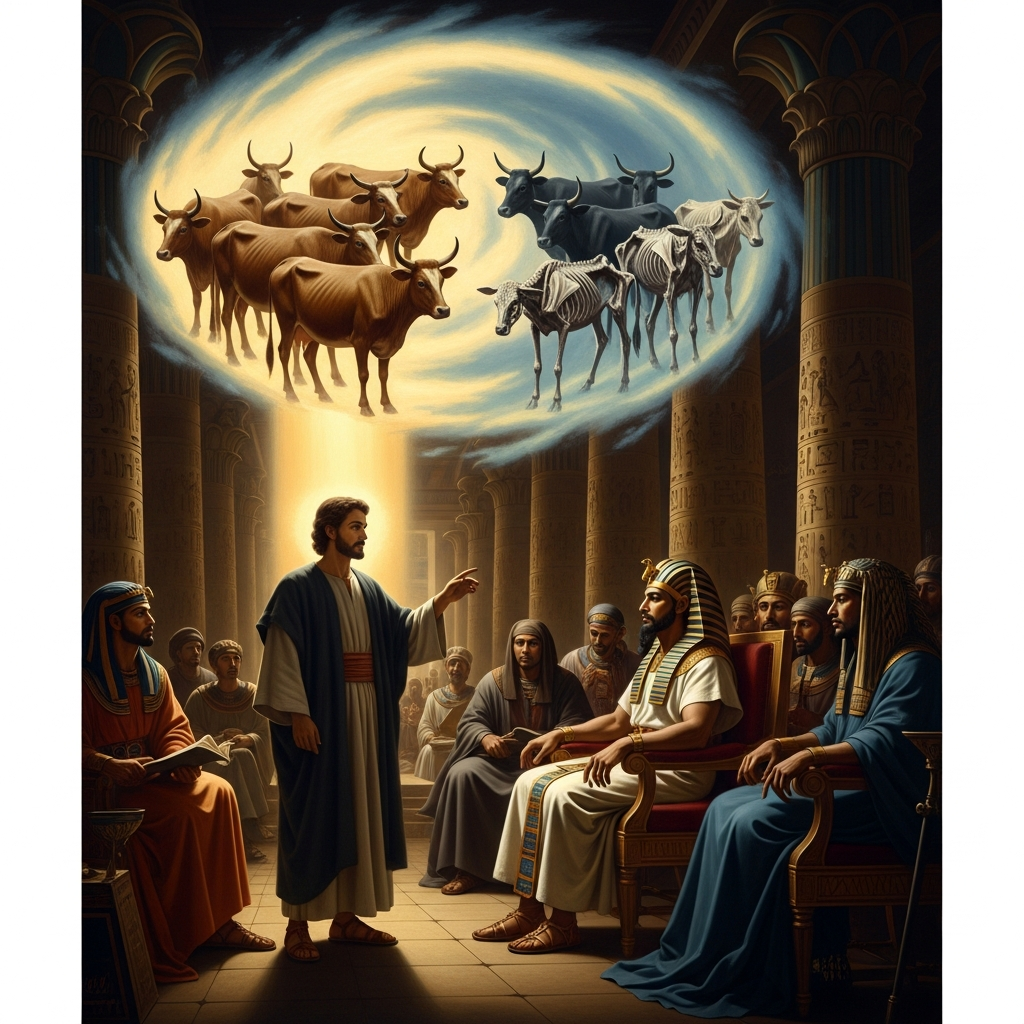
Pharaoh was standing by the Nile, and seven fat cows came up out of the river and grazed in the reed-grass. Then seven thin cows came up after them — gaunt, ugly, the worst-looking cattle anyone in Egypt had ever seen — and the thin cows ate the fat cows. And Pharaoh woke up.
He went back to sleep and dreamed again: seven full ears of grain on a single stalk, then seven withered ears scorched by the east wind, and the withered ears swallowed the full ears. He woke up again. It was morning. He was troubled.
None of his magicians could interpret the dreams. The cupbearer remembered a young Hebrew prisoner who had correctly interpreted two dreams in the jail. The prisoner was brought, cleaned up, and brought before Pharaoh.
“I am not able to interpret dreams,” Joseph said, which was the most important thing he said. “It is God who will give Pharaoh a favorable answer.”
The dreams meant seven years of plenty followed by seven years of famine. The interpretation came true. It changed the history of Egypt and Israel simultaneously.
This is the dream-interpreter’s position in the mythology of every tradition: not a person of technical skill but a person of spiritual receptivity, someone who can hear what the dream is saying because they have learned to listen to a frequency that ordinary social life drowns out.
The Dream as the Original Revelation
The earliest writing systems in the world — Sumerian cuneiform and Egyptian hieroglyphics — contain among their oldest legible texts accounts of significant dreams. The Sumerian king Gudea of Lagash recorded dreams in which the god Ningirsu commissioned him to build a temple. The Egyptian pharaoh Thutmose IV recorded the dream in which the Sphinx spoke to him, promising him the kingship if he cleared the sand that buried it. The Gilgamesh epic — the oldest extended narrative we possess — uses dreams as structural pivots throughout the action.
Dreams were not a supplementary religious phenomenon. They were, in the most ancient attested religious practice, the primary channel of divine communication. The god appeared in the dream, spoke, gave instructions, warned, prophesied, healed. The waking world was where you acted on what the dream had revealed.
This makes a certain cognitive sense. The dream is the only experience in which the mind is simultaneously generating rich, emotionally compelling, apparently objective experience while being unable to direct it. You cannot choose what you dream. The dream arrives. Its imagery is not assembled from your intentions but from some other organizing principle. It is the most natural candidate for the experience of receiving a message from outside the self — which is what religious revelation is.
Incubation: Sleeping as Religious Practice
The Greek practice of incubation — sleeping in a sacred space to receive a healing dream — was one of the most methodologically systematic religious practices in the ancient world. The sanctuary at Epidaurus was not simply a temple; it was a medical institution organized around the therapeutic power of sleep and dream.
The procedure was documented in the inscriptions on stone stelae at Epidaurus, which recorded (and promoted) successful cases. Before entering the abaton (the sleeping hall), the patient underwent purification: bathing, abstaining from certain foods, offering sacrifices. The preparation was designed to make the patient receptive — to thin the membrane, as it were, between ordinary consciousness and the divine communication that the sacred space made possible.
Aelius Aristides, a hypochondriac rhetorician of the 2nd century CE, kept a dream diary of thirteen years of Asclepian consultations and published it as the Sacred Tales — one of the most detailed records of personal religious experience in antiquity. He records hundreds of dreams in which Asclepius prescribed treatments, performed operations, gave philosophical advice, and maintained an ongoing personal relationship with his patient. Aristides’ health was, by his own account, continuously precarious. But his engagement with the divine through dreams was the central organizing experience of his life.
The sacred space of incubation was architecturally designed to produce the right kind of sleep. Low light. Sacred images. The knowledge that the god was present and watchful. The boundary between waking and sleeping was made porous — not because the ancients could not tell the difference, but because they understood that the boundary is always somewhat porous, and that certain conditions make it more porous.
Penelope and the Problem of Interpretation
Homer’s Odyssey contains not just Penelope’s dream but an articulation — perhaps the first in world literature — of the epistemological problem that attends all dream interpretation: how do you know if the dream is true?
The theory of the two gates (Book 19, lines 560-569) is one of the most elegant passages in ancient literature. True dreams come through the gate of horn (horn is transparent; the dream shows clearly what it means). False dreams come through the ivory gate (ivory is beautiful and opaque; the dream seems clear but deceives). Penelope tells the disguised Odysseus that she does not know which gate her dream of the eagle and the geese came through — and therefore does not know whether to trust it.
This is extraordinary. She is sitting in a room with Odysseus, who is disguised as a beggar and who is the eagle in her dream. He has not identified himself. She has dreamed, accurately, that he has returned and killed the suitors. And she does not trust the dream.
The epistemological problem is real: most people’s experience of prophetic dreams is that they are indistinguishable, before the event, from meaningless ones. The gate of horn and the gate of ivory look the same from inside the dream. The knowledge that the dream was true only comes afterward. Penelope’s caution is not failure of faith; it is an honest account of the limitations of dream-knowledge.
Dreamtime: The Dimension That Made the World
The Aboriginal Australian concept sometimes called “Dreamtime” (the English translation is inadequate; in Anangu the term is Tjukurpa, in Arrernte it is Altjeringa, and different nations have different terms for related but not identical concepts) represents the most radical integration of dream-experience and cosmological reality in any documented tradition.
The Dreamtime is not primarily about sleep. It is the dimension of reality in which the Ancestor beings lived and continue to live — the creative period in which they walked across an undifferentiated landscape and, by their actions (singing, dreaming, fighting, coupling, dying), shaped the land into its current form. Every mountain, river, rock formation, and watercourse is the materialized trace of an Ancestor’s action.
The Dreamtime is not past. This is the critical point that European observers repeatedly misunderstood when they translated it as a historical “dream time” of creation. It is still happening. The Ancestor beings are still active in the landscape. Sacred sites are the points where their presence is most concentrated. Ceremony is the practice that maintains the relationship between the present world and the Dreamtime dimension that underlies it.
The ordinary dream-experience — sleep-visions — is one of the channels through which the Dreamtime becomes accessible. But it is one channel among several, and not necessarily the primary one. The primary channel is the land itself.
The Dream-Interpreter as Theologian
Every tradition that has taken dreams seriously as divine communication has had to develop interpretive principles: what distinguishes the divine dream from the merely psychological? What symbols recur and what do they mean? How much weight should a single dream carry in a practical decision?
The professional dream-interpreters of ancient Mesopotamia — the baru and the šā’ilu — had manuals. The Assyrian dream-manual (partially preserved) provides systematic interpretations: if you dream of bread, it means one thing; if you dream of a city, another. The symbolic vocabulary was established, teachable, and professionally maintained.
The Hebrew tradition took a different approach, distrusting systematic manuals and emphasizing instead the interpreter’s direct relationship with God. Joseph does not consult a manual; he receives the interpretation as revelation. Daniel does not analyze symbols; he prays and the meaning is given to him. The interpreter’s knowledge is relational, not technical.
The tension between these two models — the systematic and the prophetic, the technical and the relational — runs through the entire history of dream interpretation and through the broader history of religious epistemology. Is divine communication rule-governed and learnable, or is it the gift of a particular kind of person in a particular kind of relationship with the divine?
Every tradition eventually needs both answers. The systematic approach makes dreams interpretable by ordinary people. The prophetic approach preserves the sense that the dream is not merely a code to be deciphered but a genuine contact between the divine and the human, mediated by a person capable of that contact.
The dream waits at the boundary between what we choose and what chooses us. Every religious tradition agrees that the boundary is real, and that what crosses it matters.
Echoes Across Traditions
Entities


Sources
- Genesis 37, 40-41 (Joseph's dreams and interpretations)
- Daniel 2, 4, 7 (Nebuchadnezzar's dreams and Daniel's visions)
- *Epic of Gilgamesh*, Tablets IV, VII (Gilgamesh and Enkidu's dreams)
- Homer, *Odyssey* XIX.535-569 (Penelope's dream and the gates)
- Homer, *Iliad* II.1-83 (the Dream sent to Agamemnon)
- Inscriptions at Epidaurus (testimonies of Asclepian healing dreams, 4th-3rd century BCE)
- Aelius Aristides, *Sacred Tales* (2nd century CE) — personal record of 13 years of healing dreams
- W.E.H. Stanner, 'The Dreaming' (1953) — foundational essay on Aboriginal Dreamtime
- William Harris Stahl, trans., Macrobius, *Commentary on the Dream of Scipio* (1952)
- Kelly Bulkeley, *Dreaming in the World's Religions* (2008)