Under the World: How Every Culture Built a Kingdom of the Dead
Mythic geography — Hades described fully in Homer (c. 750 BCE), Sheol throughout the Hebrew Bible (1000-400 BCE), Naraka in Puranas (c. 400-600 CE), Xibalba in the Popol Vuh (oral tradition codified c. 1550 CE), Helheim in the Eddas (c. 1220 CE) · Beneath the earth, beneath the roots of the world-tree, beneath the waters, at the edges of the known world — the underworld is always the inverse of the living world's geography
Contents
Hades, Sheol, Naraka, Xibalba, Helheim, Gehenna. Six underworlds, six visions of death. The geography of the afterlife is a map of the living's deepest fears.
- When
- Mythic geography — Hades described fully in Homer (c. 750 BCE), Sheol throughout the Hebrew Bible (1000-400 BCE), Naraka in Puranas (c. 400-600 CE), Xibalba in the Popol Vuh (oral tradition codified c. 1550 CE), Helheim in the Eddas (c. 1220 CE)
- Where
- Beneath the earth, beneath the roots of the world-tree, beneath the waters, at the edges of the known world — the underworld is always the inverse of the living world's geography
The dead need somewhere to go.
Every civilization that has ever buried its dead, burned them, exposed them to birds, or set them adrift has also built, in narrative, the place the dead go next. These places differ in their geography, their justice systems, their climate, and their permanence — but they are all organized attempts to answer the same question: what does it mean that the people you loved are no longer here?
The answer, almost universally, is that they are somewhere else. The underground. The west. Beneath the roots of the world. In a cave behind a waterfall. The somewhere-else is always specified, mapped, and populated. Its geography tells us everything about the civilization that built it.
Hades: Architecture of the Average Dead
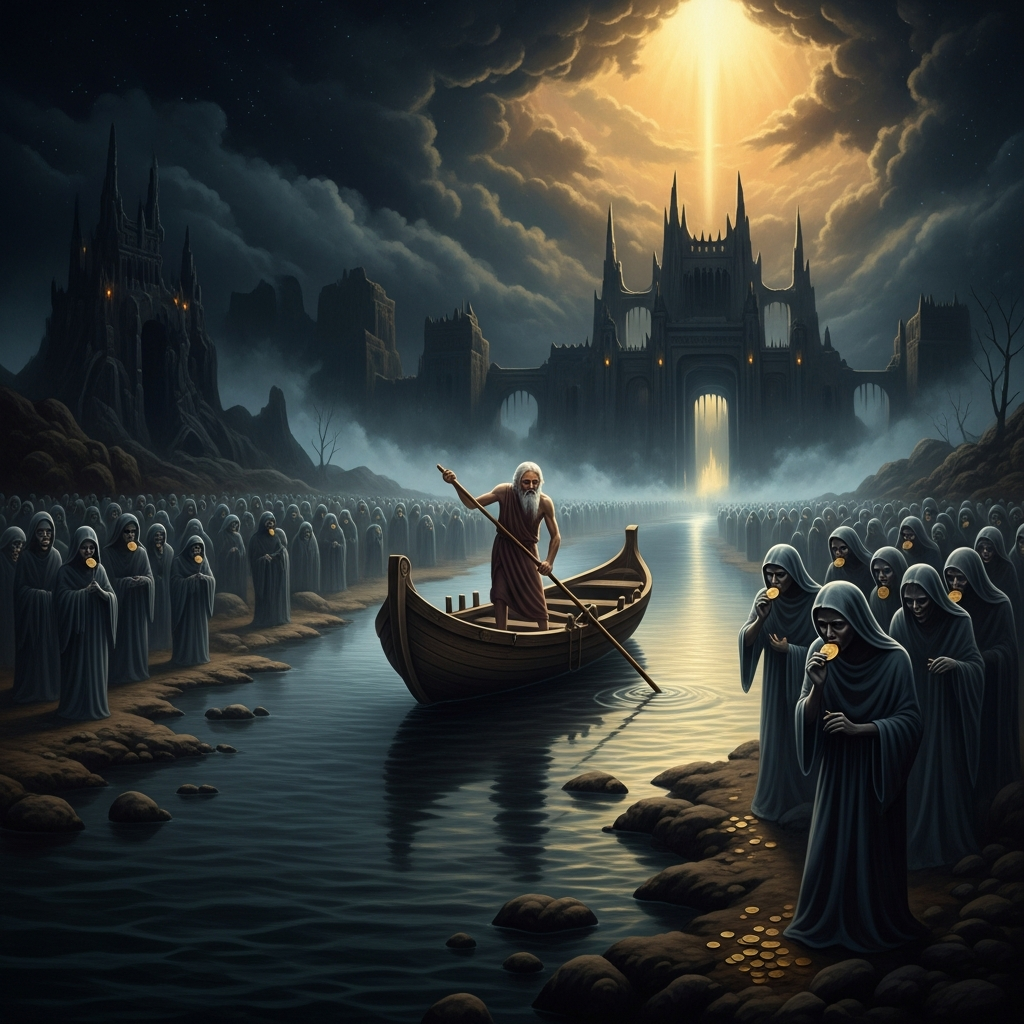
The Greek underworld is the most systematically designed in the ancient world. By the time Homer described it in the eleventh book of the Odyssey — Odysseus digging a pit at the edge of the world, pouring blood into it to attract the shades of the dead, and speaking to them one by one — Hades already had the feel of an established institution. Charon waiting at the riverbank. The coin under the tongue for the ferryman. The three judges (Minos, Rhadamanthus, and Aeacus) at the crossroads. Three roads leading in different directions depending on the verdict.
What is most striking about Hades, particularly in the Homeric version, is how little happens there for most of its inhabitants. The heroes and monsters get the dramatic geography — Sisyphus forever rolling his boulder up the hill, Tantalus standing in water that recedes when he reaches for it — but these are special cases, the inmates famous enough to be mentioned. The ordinary dead are shades in the Asphodel Meadows, drifting without purpose or pleasure or pain. Achilles, speaking to Odysseus from the underworld, makes the famous declaration: “I would rather be the slave of the poorest man on earth than king among the dead.”
The Greek underworld is not mainly a punishment and not mainly a reward. It is simply the fate of the dead — a continuation of existence without most of the qualities that made existence worth having. Its geography becomes more elaborate over the centuries (Virgil adds the Elysian Fields for the virtuous and the full architecture of Tartarus for the wicked), but the Homeric core is a cold, gloomy democracy of the departed.
Sheol: Where Everyone Goes Together
The Hebrew Bible’s underworld is even more egalitarian than Hades, and it is egalitarian in a way that reads, by later standards, as surprisingly dark. Sheol (from a root meaning either “hollow” or “to ask” — the dead are consulted in necromancy) is not divided into zones for the good and the wicked. It is simply down. Everyone goes.
Psalm 88 describes it from the inside: “the lowest pit, in the darkest depths,” where God’s “wonders” are not remembered and God’s “faithfulness” is not declared among the dead. The dead in Sheol do not praise God. They do not suffer, as far as the psalmist can tell — but they also do not experience anything that could be called life. The covenant people of God, the righteous who followed the Law — they die and go to the same place as everyone else.
This is a profoundly different theology from the one that Christianity would later inherit and transform. The early Hebrew reward system is worldly: long life, many descendants, the continuation of one’s name through children. Death is simply the end of the individual’s participation in the covenant story. Sheol is less an afterlife than an acknowledgment that death is real and final in every way that matters.
The belief in individual resurrection and differential afterlife that becomes central to Christianity only develops in late Second Temple Judaism, under the influence of Persian (Zoroastrian) contact and in response to the crisis of the Maccabean martyrs: if the righteous die for the Law and receive no reward, something is wrong with the theological accounting.
Naraka: Hell as Curriculum
The Hindu hells in the Garuda Purana and other Puranas are among the most detailed in world mythology — the text lists twenty-one major hells and dozens of minor ones, each calibrated to a specific category of sin with a matching punishment.
Those who killed cows are drowned in cow-dung. Those who burned houses are burned. Those who stole gold are beaten with clubs. The punishments have a bureaucratic specificity — they read less like divine wrath and more like a cosmic filing system, ensuring that every infraction receives its appropriate correction.
But the crucial feature is that Hindu hell is temporary. The soul that serves its sentence in Naraka is not there forever — it is there until the negative karma accumulated in its previous life is exhausted. Then it is reincarnated, with whatever positive karma it also accumulated, at an appropriate level of existence. The wheel of rebirth (samsara) continues. The fires of Naraka are correctional, not final.
Yama, the god of death and judge of Naraka, keeps records with the help of Chitragupta, who maintains a perfect account of every living being’s actions. At death, the soul appears before Yama and the record is read. There is no appeal, no advocacy, no mercy — only the precise balance of dharmic credit and debit. The Hindu afterlife is the most literally just system in world mythology, and it is just in the way a ledger is just: mathematically, without sentiment.
Xibalba: Death That Can Be Outsmarted
The Maya underworld in the Popol Vuh is the most structurally unusual in the comparative record: it can be defeated. It has, in fact, already been defeated once, by the Hero Twins.
Xibalba — the name means “Place of Fear” — is ruled by twelve lords with names that read like a taxonomy of what the Maya feared most: One Death and Seven Death (the chief lords), Pus Master, Jaundice Master, Bone Scepter, Skull Scepter, Blood Gatherer, Wing, Packstrap, Bloody Teeth, Bloody Claws. Each is a lord of a specific kind of suffering.
The underworld contains six houses of torment: the Dark House (complete darkness), the Cold House (killing cold), the House of Jaguar (flesh-eating jaguars), the House of Fire, the House of Bats (Camazotz, the bat-demon who will kill Hunahpu), and the House of Razors.
The Hero Twins — Hunahpu and Xbalanque — are summoned to Xibalba as their father and uncle were before them, and were killed. But the Twins use intelligence: they send a mosquito ahead to learn the names of the lords (who can be controlled once named), they substitute mannequins for themselves in the tests, they allow themselves to be sacrificed and then are reborn. Eventually they defeat the lords of death through deception, and death’s power over humanity is permanently curtailed.
The mythological implication is striking: death is not absolute. The underworld is a bureaucracy, and bureaucracies have loopholes. The sufficiently clever can escape.
Helheim: Fate as Postal Code
The Norse afterlife is unique in that the destination is determined not by moral conduct but by manner of death. Helheim — ruled by Hel, whose body is half living flesh and half rotting corpse — receives those who die of illness, old age, accidents, drowning. There is nothing wrong with these people morally. They simply did not die in battle.
Warriors who die in combat go to Valhalla (Odin’s hall) or Folkvangr (Freya’s field), where they spend their days in mock combat and their nights feasting, preparing for Ragnarok. This is the desirable destination. Helheim is the alternative — cold, dim, neither punitive nor pleasant, a realm for the majority who will not be needed at the final battle.
The theological message is explicit: the Norse gods value warriors because they need warriors. The afterlife is organized around the gods’ military requirements, not around human moral conduct. Helheim is not a punishment. It is simply not the honored destination.
This puts the Norse afterlife in a different category from all the others. It is not about justice. It is about utility.
What the Architecture Reveals
Lay the six underworlds side by side and the picture emerges: every culture builds its underworld from the same materials — fear, justice, continuity, geography — but the proportions differ.
Where punishment exists, it reflects a belief that cosmic justice is real. Where it is temporary (Naraka, Gehenna), there is a conviction that correction is the point. Where it is absent (Sheol, the Asphodel Meadows), there is an honest reckoning with the fact that death does not obviously reward virtue. Where it can be escaped (Xibalba), the culture is telling itself that intelligence and courage can overcome even the worst fate.
The underworld is the mirror held up beneath the earth. It reflects back what the living believe about themselves.
Echoes Across Traditions
Entities
- Hades
- Persephone
- Charon
- Osiris
- Anubis
- Yama
- Hun Came
- Vucub Came
- Hel


Sources
- Homer, *Odyssey* XI ('The Book of the Dead') (c. 750 BCE)
- Virgil, *Aeneid* VI (19 BCE)
- Psalms 6:5, 88:3-6; Ecclesiastes 9:10; Isaiah 38:18 (on Sheol)
- *Garuda Purana* (on Naraka, c. 800-1000 CE)
- *Popol Vuh*, Part 2 (Maya K'iche', oral tradition codified c. 1550 CE)
- Snorri Sturluson, *Prose Edda*, 'Gylfaginning' (c. 1220 CE)
- Mishnah, Tractate Avot 5:19; Talmud, Tractate Rosh Hashanah 16b-17a (on Gehenna)
- Alan Bernstein, *The Formation of Hell* (1993)
- Bart Ehrman, *Heaven and Hell: A History of the Afterlife* (2020)
- Jan Bremmer, *The Rise and Fall of the Afterlife* (2002)