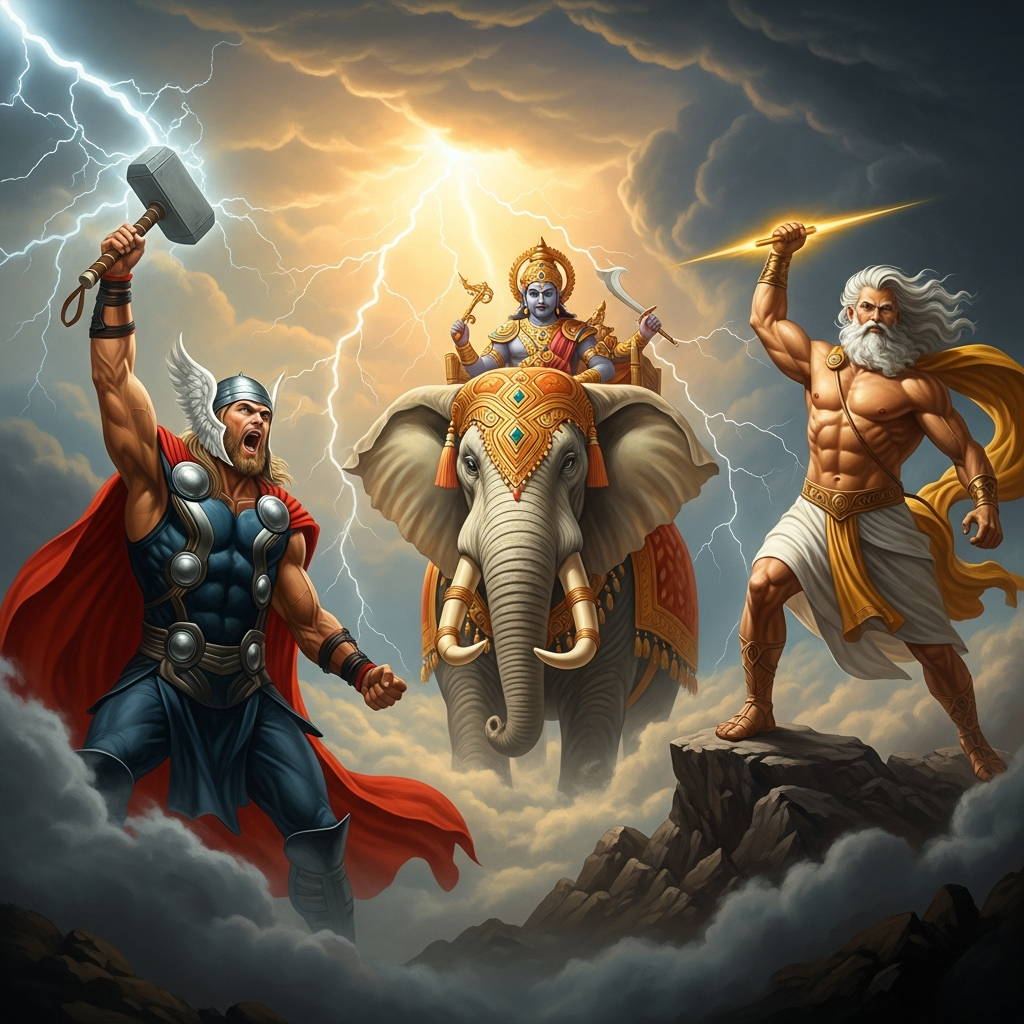
Thunder Kings: Zeus, Thor, Indra, Jupiter, Susanoo, and Tlaloc
Ancient, across all periods — Vedic Bronze Age through Aztec empire · Mount Olympus, Asgard, the Vedic heaven, the Capitol in Rome, Takamagahara, Tlalocan
Contents
Thunder gods are almost always the king of the pantheon. Six traditions reveal why: the storm is the only force that could plausibly hold all other gods accountable.
- When
- Ancient, across all periods — Vedic Bronze Age through Aztec empire
- Where
- Mount Olympus, Asgard, the Vedic heaven, the Capitol in Rome, Takamagahara, Tlalocan
The pattern is almost universal, and it is arresting once you see it: in tradition after tradition across cultures that had no contact with one another, the god of thunder is also the king of the gods.
Zeus rules Olympus with the thunderbolt. Jupiter governs Rome from the Capitoline. Indra is king of the Vedic heaven. Thor is the most worshipped deity in the Norse world. Tlaloc predates every Mesoamerican empire and outlasted most of them. The convergence is too consistent to be coincidence. It points to something structural — something about the storm’s qualities that every ancient civilization found, independently, to be the correct metaphor for supreme authority.
Zeus: Authority as Institutionalized Violence
Zeus is the king of the Olympians, but he is not an inherited king. He took the throne by force.
Kronos, his father, swallowed his children to prevent them from overthrowing him — as Kronos himself had overthrown his own father Ouranos. Zeus escaped only because his mother Rhea substituted a wrapped stone. When Zeus came of age, he forced Kronos to disgorge his siblings, led the Olympians in the Titanomachy, the ten-year war against the Titans, and emerged with the cosmos divided: sky for himself, sea for Poseidon, underworld for Hades.
The thunderbolt was not just his weapon. It was his credential. The Cyclopes forged it for him as payment for freeing them from Tartarus. It signified that the force which makes the sky violent — which kills without warning, which falls from above — was now under divine control, wielded by a will that (unlike the random lightning of nature) had intentions, preferences, and a capacity for justice.
Zeus’s authority is not wisdom-authority. He is not the smartest god — that is Athena. He is not the most moral — his sexual history is comprehensive and often coercive. He is the god who holds the force that can destroy everything else, and who has, over time, chosen to use it in service of a cosmic order rather than pure appetite. The storm that became a king is always a storm that made a choice. The question Zeus poses to every subsequent political theology is whether that choice can be trusted.
Thor: The Storm That Blesses
Thor is not Odin, but in the actual religion of the Norse and Germanic peoples — as opposed to the literary theology of the Eddas — he was almost certainly more worshipped.
Odin is the god of the aristocracy and the poets: wisdom, death, war strategy, the search for hidden knowledge. Thor is the god of everyone else. His cult was agricultural as much as martial. Farmers prayed to him for rain. His image was placed in wedding ceremonies. His hammer Mjolnir — whose etymology connects to the Vedic mjoln, “lightning” — was used to hallow births, deaths, and marriages alike.
This is the most important thing about Thor: his weapon is also a ritual implement. The same instrument that crushes giants and defends Asgard’s walls is the one you hold over a newborn to consecrate her to the community. The storm’s violence and the storm’s fertility — the thunder that terrifies and the rain that follows — are not separated in Thor’s theology. They are the same force used for different purposes.
The Poetic Edda presents Thor as the straightforward warrior, strong and not particularly subtle, the foil to Loki’s cleverness. But the archaeological record of Thor devotion is richer than the literary record. What ordinary Norse people wanted from their storm god was not a warrior but a blessing — someone whose terrible force had, somehow, been turned toward them.
Indra: The Rain That Ends the Drought
In the Vedic world, the single most important event imaginable is rain.
The Indian subcontinent’s civilization depends on monsoon agriculture. The difference between the monsoon arriving and not arriving is the difference between survival and catastrophe. Everything in Vedic theology about Indra flows from this physical reality: he is the god of thunder, and thunder in the Indian subcontinent precedes rain, and rain is life.
Indra’s defining myth is the slaying of Vritra. The demon Vritra — whose name means “obstacle” or “enveloper” — has swallowed all the cosmic waters. Drought grips the world. Indra, fortified with soma (the sacred ritual drink), takes up his vajra (thunderbolt) and kills Vritra, releasing the waters. The rains come. The world is saved.
This is the thunder god myth at its most literal: the storm’s noise and lightning directly precede the release of water. In a culture that watched this cycle repeat year after year, it was natural to encode it mythologically as divine combat. Indra does not just govern rain; he fights for it against a cosmic enemy. Every monsoon season is a reenactment of his victory.
Indra’s kingship over the Vedic gods is temporary and renewable — the texts are explicit that a being can attain Indra’s status through sufficient accumulated merit, and that the current Indra may be replaced. This is unusual among thunder-god kingships. It reflects the Vedic tradition’s discomfort with permanent power and its emphasis on karma as the ultimate authority.
Jupiter: The Storm as Constitutional Law
Rome’s relationship with Jupiter Optimus Maximus was almost bureaucratic.
Jupiter was not primarily a myth-generating deity in Roman religion. His character was less defined than Zeus’s, his personal adventures fewer, his personality less vivid. What he was, instead, was the constitutional center of Roman state religion. The great temple on the Capitoline Hill was where generals rendered thanks for victories. Oaths sworn in Jupiter’s name were binding in Roman law. The augurs, Rome’s official religious specialists, read Jupiter’s will primarily through lightning — where it struck, in what direction, at what time.
The thunder god became the rule of law made cosmic. Jupiter’s authority was not the authority of a personality but of a principle: that the visible force of the sky, which no human authority could override, stood behind Roman governance. When Rome swore Jupiter to a treaty, the implication was that breaking the treaty would draw down the response of the storm itself.
This is the furthest the thunder god theology gets from the myths: Jupiter in the Roman republic is not a character with a story. He is a guarantee. The storm was the most convincing pre-modern demonstration of force majeure, and Rome conscripted it into its legal system.
Tlaloc: The Storm That Owns Its Dead
Tlaloc is the oldest continuously worshipped deity in Mesoamerica. He appears at Teotihuacan more than a thousand years before the Aztec empire. He was still receiving sacrifice at the Great Temple in Tenochtitlan when the Spanish arrived.
His character is distinctive among thunder gods because he is explicitly a god of death by water as well as a god of rain and fertility. Tlalocan, his paradise, does not receive warriors or the virtuous or the initiated. It receives the drowned, the struck-by-lightning, the killed-by-flood, the dead-of-water-related-illness. The storm god owns the deaths he causes. His afterlife is populated by his own victims, who become, in death, his servants and his honored dead.
This theology does not soften the storm’s violence. It refuses to separate the storm’s gift from its destruction. Tlaloc gives rain and takes children — the Aztec festivals required child sacrifice to Tlaloc specifically because children’s tears were identified with rain. The theology is a cold-eyed acknowledgment that the force that sustains you will also, eventually, kill some of you, and that this is not an injustice but a feature of the divine economy.
Why Storms Rule
The convergence of storm god and king-of-the-gods across unconnected civilizations reveals a consistent logic. The storm is the one natural phenomenon that combines all the attributes that ancient peoples associated with supreme authority: it comes from above; it is undeniable; it sustains (rain) and destroys (flood, lightning) at will; it makes a sound loud enough to impose itself on every living thing simultaneously; and it cannot be reasoned with.
It is, in short, a perfect metaphor for sovereignty — not the warm, consensual, constitutional kind, but the older, pre-political kind: the kind that exists because nothing can stop it.
Every thunder god is, at some level, a domesticated storm. The raw violence of the sky has been given a personality, a will, a set of preferences and loyalties. And in that domestication lies the project of political theology: the question of whether the force that could destroy everything will, instead, protect you — and what you must offer it to keep that protection in place.
Echoes Across Traditions
Entities


Sources
- Walter Burkert, *Greek Religion* (1985)
- H.R. Ellis Davidson, *Gods and Myths of Northern Europe* (1964)
- Wendy Doniger, *The Rig Veda: An Anthology* (1981)
- Mary Miller and Karl Taube, *An Illustrated Dictionary of the Gods and Symbols of Ancient Mexico and the Maya* (1993)