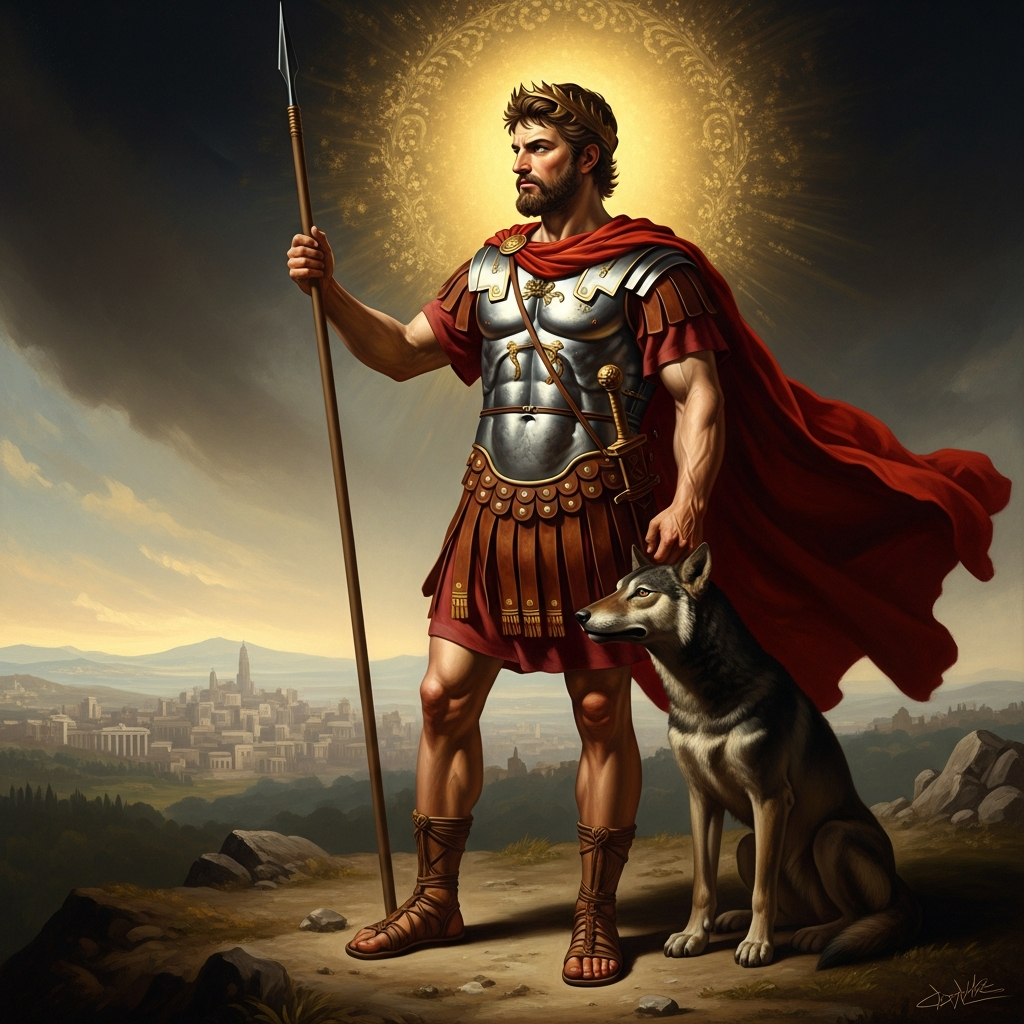
The divine twins are an unusually well-preserved Indo-European inheritance. The *Aśvinā* of the Vedas, the *Dióskouroi* of Greece, the Romulus and Remus of Rome, the Latvian *Dieva dēli* — all share a structural profile so consistent that 19th-century philologists used them as the textbook case for Indo-European common descent. Two young divine brothers, often associated with horses, often associated with healing or divine rescue at sea, often a pair where one is mortal and one is immortal — the formula recurs across the daughter languages of the Indo-European family with remarkable fidelity.
But the twins are not only Indo-European. The Maya *Popol Vuh* gives Hunahpu and Xbalanque, the Hero Twins who descend to Xibalba and become the sun and moon. Haitian Vodou has the Marassa — sacred twins who are senior to many of the *lwa*. West African traditions (Yoruba especially) honor the *Ibeji*, sacred twins associated with Shango. Many Native American traditions have twin culture-heroes; the Navajo Monster Slayer and Born for Water are paradigmatic. The pattern is wider than the Indo-European family alone, and may belong to a broader human cognitive structure: twins are anomalous (most births are single), they are striking, and their shared birth makes them obvious symbols of paired powers.
The twins' archetypal role is to rescue. They appear when ordinary divine machinery fails — when a hero is lost at sea, when monsters cannot be defeated by single combat, when the sun and moon must be made. They are paired because their power is paired: not one or the other, but both together, in conjunction. The pair is the unit.
Comparison Across Traditions 8
| Tradition | Entity | Key Trait | Story / Scene |
|---|---|---|---|
| Greek | Castor and Pollux | The *Dióskouroi*, "sons of Zeus"; horsemen, sailors' rescuers, the twin stars Gemini | When Castor (mortal) is killed, Pollux (immortal) shares his immortality; they alternate between Hades and Olympus |
| Roman | Romulus and Remus | Founders of Rome; suckled by the she-wolf; one kills the other at the founding wall | Romulus marks the boundary of the city; Remus jumps over it in mockery; Romulus kills him and the wall holds Read story → |
| Hindu | The Ashvins | Vedic horse-twins; physicians of the gods; rescuers at sea | The Ashvins restore the youth of the aged sage Chyavana, who has married a much younger wife Read story → |
| Maya (Popol Vuh) | Hunahpu and Xbalanque | The Hero Twins of the *Popol Vuh*; defeat the Lords of Death in Xibalba | Hunahpu and Xbalanque pass the trials of the Houses of Cold, Knives, Fire, Bats, and Jaguars; they become sun and moon Read story → |
| Haitian Vodou | Marassa | Sacred Vodou twins; senior to many *lwa*; demanding, jealous, powerful | The Marassa are saluted before all other *lwa* in any ceremony; they sulk if forgotten Read story → |
| Hindu | Nakula and Sahadeva | Twin Pandavas of the *Mahabharata*; sons of the Ashvins; the youngest of the five brothers | In the *Mahabharata*, Nakula and Sahadeva fight at Kurukshetra; their wisdom and beauty come from their divine fathers |
| Yoruba | Ibeji | Sacred twins of Shango; among the highest twin-birth rates in the world (Yorubaland) | A Yoruba family with twins is doubly blessed; if a twin dies, a carved *ere ibeji* figure is kept and fed alongside the surviving sibling Read story → |
| Native American (Navajo) | Monster Slayer and Born for Water | Sons of Changing Woman; cleanse the world of monsters | The Twins journey to the sun (their father), receive lightning weapons, and slay the monsters who oppress the people Read story → |
What the Pattern Means
The Indo-European twin pattern is one of the most carefully reconstructed shared inheritances in comparative philology. Donald Ward's *The Divine Twins* (1968) catalogued the Indo-European cases — Vedic Aśvins, Greek Dióskouroi, Latvian *Dieva dēli*, Lithuanian *Aśvieniai*, Old English *Hengist and Horsa* — and documented their shared profile: horse-association, youthfulness, healing power, rescue at sea, paired immortality (or one mortal and one immortal). Ward and his successors (notably Bruce Lincoln, *Death, War, and Sacrifice*, 1991) treated these cases as straightforward Indo-European retentions, descending from a Proto-Indo-European pair of brother-deities.
Romulus and Remus are an interesting partial case. Their story is uniquely Roman — the foundation of the city — and the fratricide is unique to that political theology (Rome is founded on a brother-killing, the violence at its origin). But the Roman material is heavily influenced by Greek narrative; T. P. Wiseman (*Remus: A Roman Myth*, 1995) argued that Remus is a relatively late literary invention, not an inherited tradition. The Roman material is partly Indo-European inheritance (the wolf-suckling has Iranian parallels), partly Greek borrowing, partly local invention. The twins are flexible.
Outside the Indo-European family, the twin pattern is structurally similar but historically independent. The Maya *Popol Vuh* twins, Hunahpu and Xbalanque, are not horsemen and not associated with rescue at sea — they are ballplayers and underworld-defeaters. The Haitian Marassa are children-spirits demanding food. The Yoruba Ibeji are the *most-born* twins on earth (Yorubaland has globally exceptional twinning rates) and the religious response to that biological fact. Each tradition has its own twins, with overlapping but not identical profiles.
What is theologically common across the cluster is the idea that *paired power* is more potent than singular power. The single hero is the protagonist of one kind of myth; the paired hero is the protagonist of another. In the Maya case, Hunahpu and Xbalanque succeed where their single-fathers (Hun-Hunahpu and Vucub-Hunahpu) failed — the single brothers were defeated in Xibalba; the paired sons defeat Xibalba. The pair has a redundancy the singleton lacks.
Wendy Doniger has cautioned, here as elsewhere, against flattening these distinct twin-figures into a single archetype. The Aśvins are healers and saviors of distressed mortals; the Dióskouroi are sailors' luck and the constellation Gemini; Hunahpu and Xbalanque are agonistic ball-game champions; the Marassa are demanding children. The "divine twins" is a useful comparative category, but the differences are theological. The Indo-European subset is more tightly unified than the global category.
Notable exceptions: Egyptian and Mesopotamian theology lacks a major twin-pair at the senior divine level. There are pairs (Shu and Tefnut; Geb and Nut) but they are male-female and architectural, not the brother-pair of the Indo-European pattern. Buddhist mythology rarely emphasizes twins. African traditions outside the Yoruba complex have varied attitudes — twins are sometimes blessed (Yoruba), sometimes cursed (parts of pre-modern central Africa where one or both were killed). The Yoruba reverence and the killing both reflect the same anomalous status; the cultural response varies.
- Donald Ward, *The Divine Twins: An Indo-European Myth in Germanic Tradition* (1968)
- Bruce Lincoln, *Death, War, and Sacrifice* (1991) — the IE comparative framework
- T. P. Wiseman, *Remus: A Roman Myth* (1995) — the Roman case
- Dennis Tedlock (trans.), *Popol Vuh* (1985) — the Maya twins
- David Doris, *Vigilant Things* (2011) — Yoruba Ibeji material in religious context