Contents
The army stands on the southern shore staring at a hundred miles of ocean and the island fortress of Ravana on the far side. Sita is there, alive, captive in a grove of ashoka trees. Someone must cross — alone, ahead of the army, to bring her word that Rama is coming. Hanuman climbs the mountain on the headland, swells until his shadow covers the troops, and jumps.
- When
- c. 500 BCE – 200 CE (Ramayana composed)
- Where
- Mahendra mountain on the southern coast of India; the open ocean; the city of Lanka and the ashoka grove where Sita is held
The army has reached the sea.
It has taken months. From the forest where Sita was taken, Rama and Lakshmana have walked south, gathering allies. They have killed the vulture-king Jatayu’s killer. They have befriended the monkey-king Sugriva, deposed his usurping brother, and taken on the alliance of his vanara army — a host of monkeys and bears as numerous as the trees they live in. They have followed every rumor of Sita southward. And now, at last, on the southernmost coast of the subcontinent, they have reached water they cannot cross.
A hundred yojanas of open sea. On the far side, dimly, on a clear morning, you can see the island. Lanka. Ravana’s city. Somewhere in there, alive — they hope she is alive — Sita is held.
The army stands on the beach and looks at the ocean.
Sugriva orders the elders to consider the problem. The eldest of the bears, the eldest of the monkeys, the strategists, the engineers — all of them confer. They consider building boats. They consider damming. They consider praying to the ocean to dry up. None of them can do what is required first: someone must go alone, ahead of the army, must reach the city, must find Sita, must give her a sign — Rama’s signet ring — must tell her he is coming, hold on, and must come back with proof she is alive.
The leap is one hundred yojanas. Roughly eight hundred miles, in some measures. No mortal can do it. No vanara can do it.
Then they remember Hanuman.
—
Hanuman is sitting at the edge of the council, listening. He has not spoken. He has been with the army for months without anyone fully understanding who he is. He is a vanara like the rest — a monkey-warrior, son of the wind-god Vayu, born of an apsara cursed into monkey form — but the Ramayana has been preparing us for this moment for a long time. As a child, Hanuman saw the rising sun, mistook it for a piece of fruit, and leapt for it. He nearly reached the sun before Indra knocked him out of the sky with a thunderbolt and broke his jaw. The wind-god, in fury at the injury to his son, withdrew the breath from the world; everything began to suffocate; the gods came to apologize and to give the boy gifts, including invulnerability and the power to grow to any size.
But the gifts came with a curse, too. Hanuman’s own teacher, knowing the boy’s pride was dangerous, had laid a forgetting on him: he would not remember his own powers until the right moment, until someone reminded him.
The right moment is now.
Jambavan, the bear elder, walks across the council to Hanuman and stands in front of him.
He says — and Valmiki gives this whole speech in lingering detail — Son of the wind. You have forgotten what you are. You have been sitting at the edge of this council as if you were one of these others. You are not. You are the only one of us who can do this. You leapt for the sun as a child. You can leap to Lanka. Stand up. Remember.
And Hanuman remembers.
—
He climbs Mahendra mountain at the southern tip of the headland. He stands on the summit. The army stretches behind him on the beach, looking up.
Then he begins to grow.
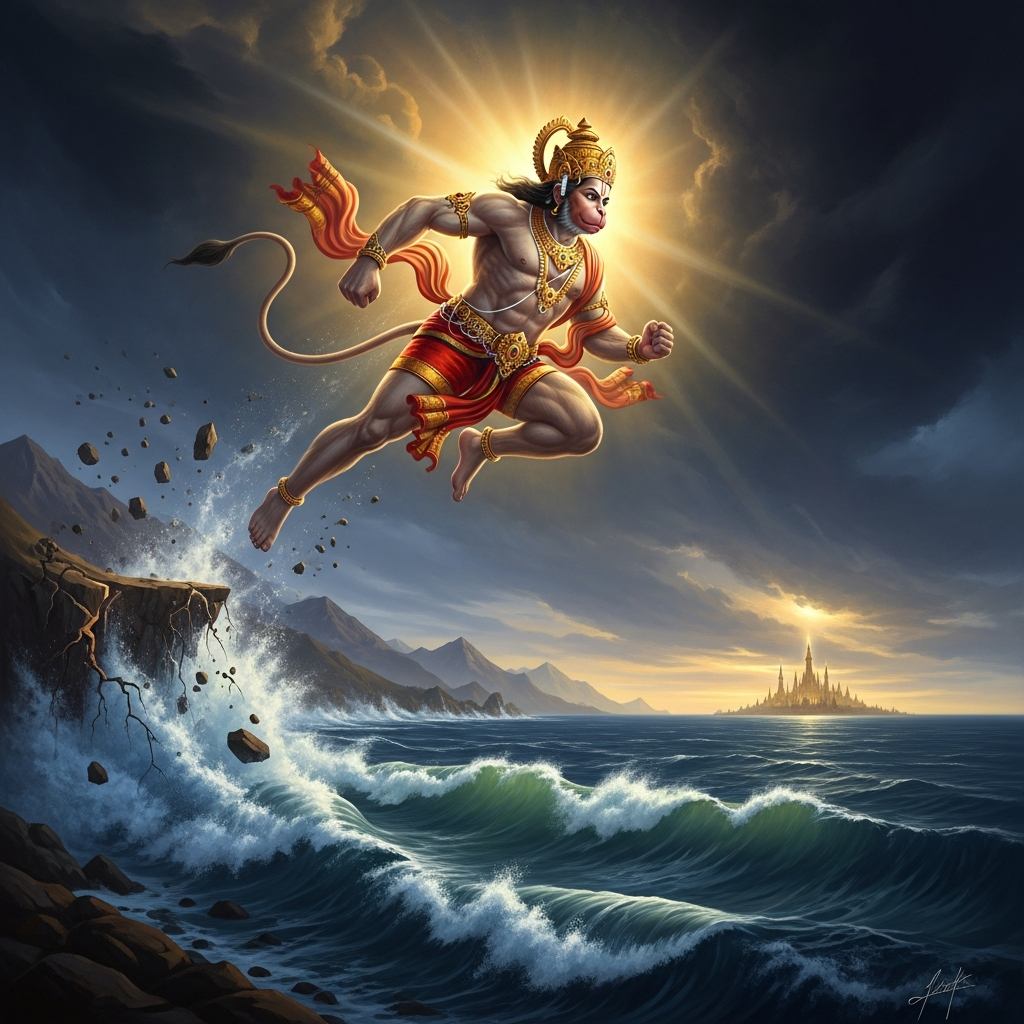
Vanara, monkey-shape, wider in the chest. Wider in the shoulders. His tail lengthens until it stretches the length of the mountain. His body climbs above the cloud-line. The sea-wind picks up around him; the trees on the mountain bend as he draws breath. The army on the beach, suddenly, has to crane back at an impossible angle to see his face. He is no longer the size of a monkey. He is the size of a mountain.
He bends his knees. The mountain itself trembles — the rock cracks at his heels under the weight of what is gathering. He breathes in. The sea level drops, just slightly, with the suction of his breath.
He jumps.
—
The leap, Valmiki tells us in the Sundara Kanda, looks from the ground like a comet. A streak of gold and red across the sky. The clouds part for him. The sea below recedes into a blue distance. His tail trails like a banner.
He is not unimpeded.
The gods, watching from above, decide to test him. They send three obstacles — partly to slow him, partly to verify that the right monkey is on the way.
The first is Mainaka, a mountain that the ocean had hidden underwater for centuries. Mainaka rises out of the waves in front of Hanuman as a place to rest. Stop here, son of the wind, the mountain says. You are tired. Sit on me. Eat my fruits. Rest. Hanuman touches the mountain with one hand to honor it — he will not insult a mountain — and continues without breaking stride.
The second is Surasa, the mother of serpents, sent by the gods themselves to test him. She rises from the sea with a mouth that grows larger and larger, demanding that Hanuman fly into her jaws. He cannot refuse a divine demand outright. So he grows larger to match. She grows larger. He grows still larger. She grows enormous. And then, suddenly, when her mouth is the size of a country, he shrinks — to the size of a thumb — flies into her mouth, flies out the side, and continues. You have passed, she says, laughing.
The third is Simhika, a sea-demon who eats by catching the shadows of flying creatures and pulling them down into her mouth. She is not a test. She is a predator. Her shadow rises out of the water beneath Hanuman; he feels himself slowing in mid-air; he looks down; he sees her enormous mouth opening below. He does not try to grow. He shrinks instead — small, smaller — flies down into her mouth, tears her heart out from inside, and emerges through her chest as she sinks. The sea closes over her.
He resumes flight.
—
He sees Lanka.
It rises out of the southern sea like a city carved from a single jewel. Walls of polished gold. Towers tipped with banners. Gardens cascading down terraced cliffs. A harbor full of ships. He has never imagined a city like this; few cities in the Ramayana’s known world rival it.
He lands on the headland outside the walls and shrinks himself. Small now — the size of a cat. He crosses the wall. He is met inside the gate by the goddess Lankini, the city’s guardian spirit, who takes the form of a woman and challenges him. He hits her once. She falls and tells him, surprisingly calmly, that her downfall has been prophesied: when a small monkey enters Lanka and strikes her, the city will end. She is glad to be defeated. She lets him pass.
He searches the city.
He looks in palaces. He looks in groves. He looks in stables and harems and treasure-rooms. He sees Ravana asleep on a bed surrounded by his concubines. He almost mistakes one of them for Sita and panics — but no, he reasons, Sita would not sleep beside Ravana, she would never. He keeps looking.
Finally he comes to the ashoka grove.
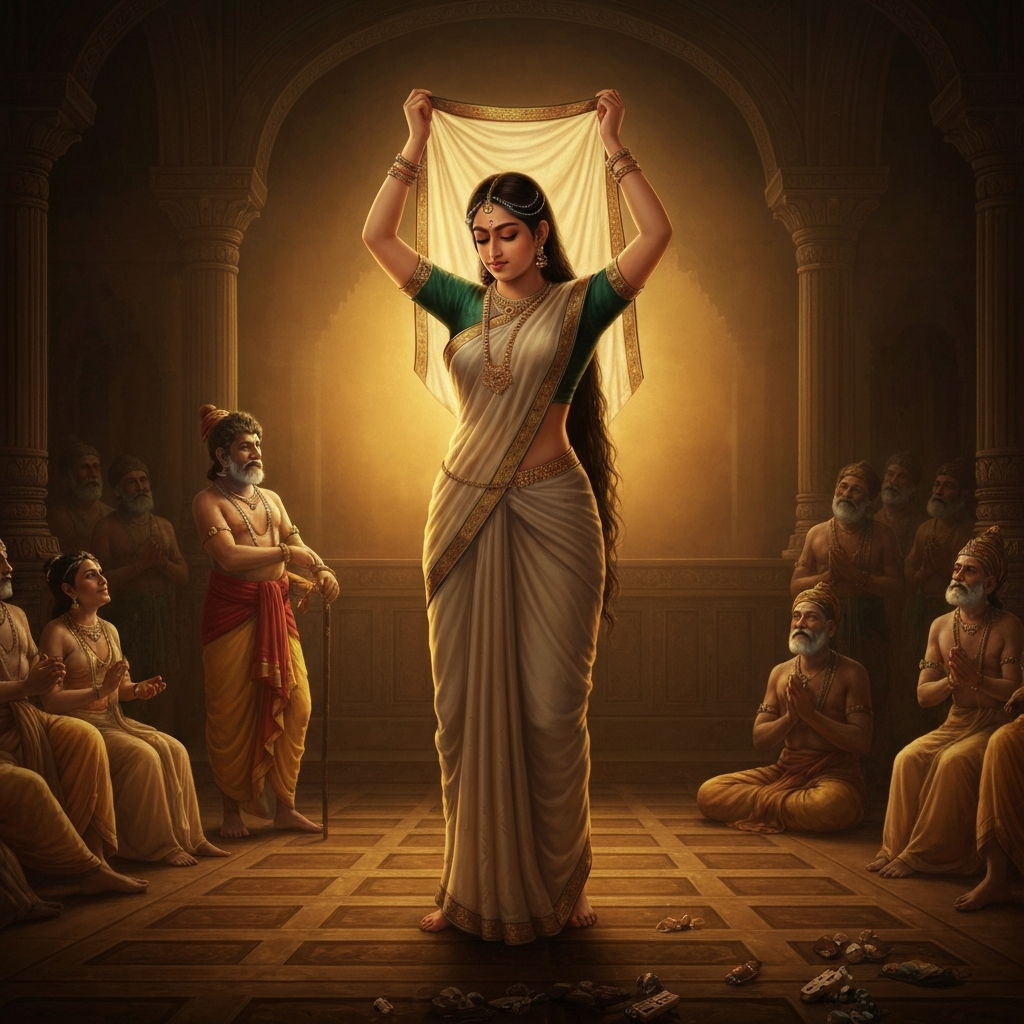
It is a private garden, walled, planted with flowering trees, kept for Ravana’s own use. In the middle of the grove, under a tree, sits a woman. She is thin. Her hair is matted. Her sari is a single piece of cloth, dirty. She is surrounded by rakshasi guards who have been instructed to alternately threaten her and tempt her into accepting Ravana. She has been refusing for ten months.
Hanuman climbs the tree above her. He hides in the leaves. He watches her, to be certain. He watches Ravana himself come into the grove, threaten her with deadlines, list the splendors he will give her. He watches Sita refuse — quietly, without theatrics, simply refuse — and Ravana storm out.
When the grove is empty, Hanuman speaks softly from the tree.
He tells her, in a voice she does not recognize, the story of Rama. He tells it as a stranger telling a story. She listens, weeping. Then he climbs down and presents himself.
She does not believe at first. She thinks he is another illusion sent by Ravana — Ravana has tried this trick before. Hanuman opens his hand. He drops Rama’s signet ring into her lap.
She picks it up. She knows the ring. She has worn it. She has touched it on his finger. The sob that breaks out of her is the sob of someone who has been carrying a weight alone for ten months and feels the first hand take its edge.
She gives him a jewel from her hair — Rama will know it — and a message: Tell him I am alive. Tell him the deadline Ravana has given me is two months. Tell him to come.
Hanuman accepts the jewel. He accepts the message. He bows.
Then, before leaving, because Hanuman is what he is, he tears down half the ashoka grove on his way out — burns parts of Lanka with his tail set on fire by demons who try to capture him — kills enough rakshasas to be remembered for it — and finally leaps from the tower of the city back across the ocean to the army.
He lands on Mahendra mountain with the news.
She is alive. Ravana is mortal. The city can be reached. The ocean can be crossed.
The army cheers. Rama embraces Hanuman and weeps. The bridge to Lanka — the Ramasetu — will be built next, monkey by monkey, stone by stone. The war will begin.
But the impossible leap has already been made. Everything that comes after is just engineering.
Scenes
On the headland, Hanuman swells from his ordinary monkey-size to a mountain of muscle and tail, the army of vanaras craning their heads back to see his face among the clouds
Mid-flight over the ocean: Hanuman streaks above the waves like a comet of fur and gold, the sea-monster Simhika rising open-mouthed below to swallow his shadow
In the moonlit ashoka grove of Lanka, Hanuman — small again, the size of a cat — drops Rama's signet ring into Sita's lap as she sits weeping under a tree
Echoes Across Traditions
Entities


Sources
- Valmiki, *Ramayana* (Sundara Kanda — 'The Beautiful Book', c. 500 BCE – 200 CE)
- Robert P. Goldman et al. (trans.), *The Ramayana of Valmiki* Vol. V Sundara (1996)
- Tulsidas, *Hanuman Chalisa* (16th c. CE)
- Philip Lutgendorf, *Hanuman's Tale: The Messages of a Divine Monkey* (2007)