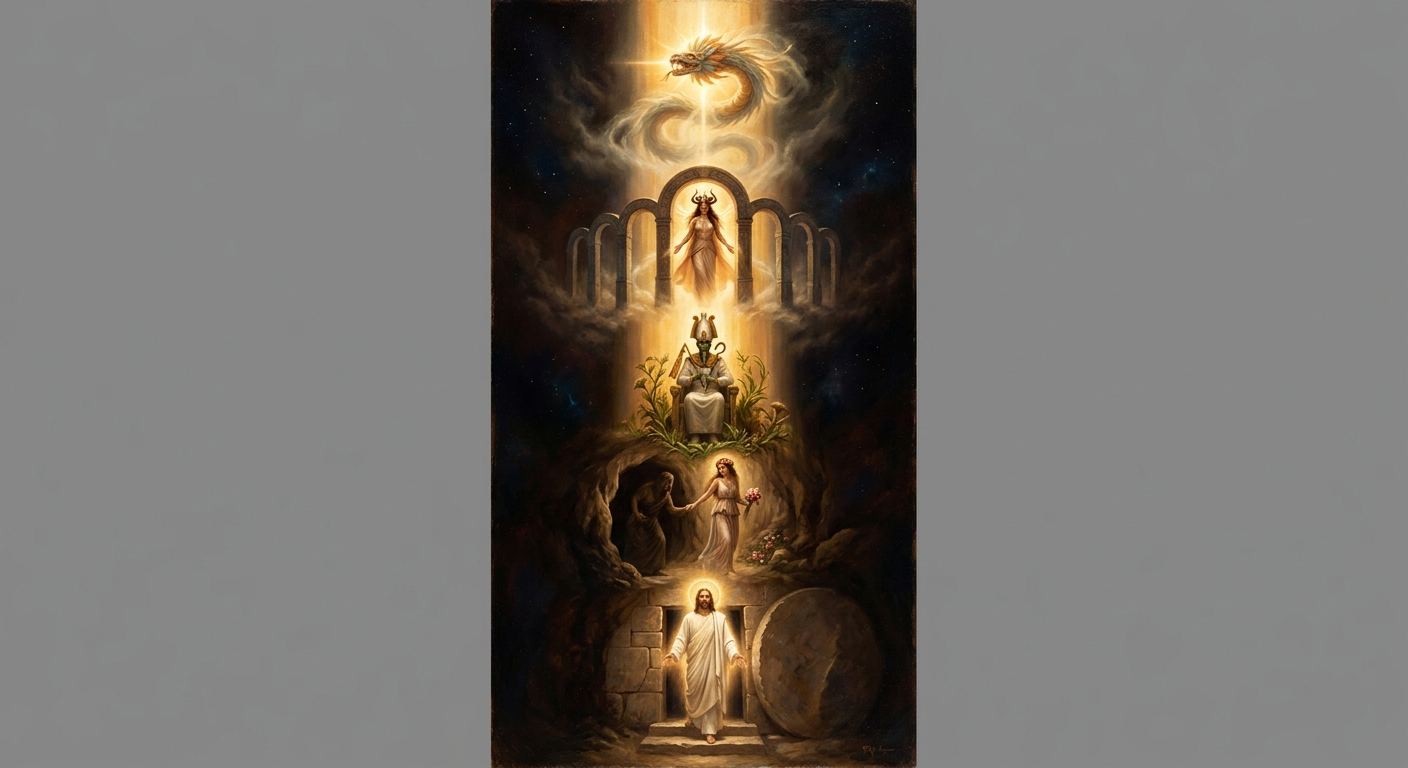
In 1890, James George Frazer published *The Golden Bough* and called a new archetype into the world: the dying-and-rising god. Frazer argued that across the ancient Near East and the Mediterranean, the same figure recurs — a young male deity, often associated with vegetation and the agricultural year, who is killed (often violently, often by a jealous rival) and then returns from death, restoring fertility and order. Osiris, Tammuz, Adonis, Attis, Dionysus — and, controversially, Christ — were all enrolled in this catalogue.
The Frazerian thesis has been heavily contested. Jonathan Z. Smith ("Dying and Rising Gods," in *Eliade Encyclopedia of Religion*, 1987) argued that Frazer overstated the parallels — most "dying-and-rising" gods either die and stay dead (Adonis, Tammuz in some sources) or rise but were never properly dead (Persephone). True resurrection of the body, Smith claimed, is rarer than Frazer made it seem. Tryggve Mettinger (*The Riddle of Resurrection*, 2001) defended a chastened version of the pattern: not universal, but real for a small set of Near Eastern cult deities.
The pattern, in its strict form, requires three things: a god who genuinely dies, a body that is mourned, and a return that is more than seasonal allegory. In its looser form — death and return in any cyclical sense — it covers most agricultural pantheons. This page presents the cast Frazer assembled, with Smith's and Mettinger's amendments noted in the analysis. Christ is included with academic care: Christian theology insists his resurrection is uniquely historical and not mythological; comparative religion treats the structural parallel as significant whatever its theological status.
Comparison Across Traditions 8
| Tradition | Entity | Key Trait | Story / Scene |
|---|---|---|---|
| Egyptian | Osiris | King of the dead, dismembered by Set, reassembled by Isis | Set tricks Osiris into a coffin, kills him, scatters him across Egypt; Isis gathers the pieces and conceives Horus Read story → |
| Greek | Dionysus | Twice-born god of wine, dismembered by Titans (Orphic) and reborn | The infant Dionysus is dismembered and eaten by the Titans; Zeus saves the heart and the god is reborn Read story → |
| Mesopotamian | Dumuzi | Shepherd-king consort of Inanna; descends to the underworld in her place | Inanna returns from the dead and finds Dumuzi unmourned on her throne — she names him as her substitute Read story → |
| Canaanite | Baal | Storm-king of Ugarit; swallowed by Mot (Death) and resurrected by Anat | Baal descends into the throat of Mot; Anat splits Mot like grain and Baal lives Read story → |
| Greek | Adonis | Beautiful young god killed by a boar; spends part of the year in the underworld | Aphrodite's lover is gored on the hunt; from his blood spring red anemones, and he divides his year between Aphrodite and Persephone |
| Greek | Persephone | Cyclical death-and-return — the seasons are her absence and presence | Hades abducts her, the pomegranate seeds bind her; six months below, six months above — that's the year Read story → |
| Aztec | Quetzalcoatl | Feathered-serpent god who burns himself on a pyre and returns as the morning star | Quetzalcoatl, shamed and exiled, sails east on a raft of serpents and immolates himself; his heart becomes Venus Read story → |
| Christian | Jesus | Crucified, buried, and (Christian doctrine) bodily raised on the third day | Killed under Pontius Pilate, laid in the tomb, the stone rolled away on the third day; the resurrection appearances follow Read story → |
What the Pattern Means
Frazer's *Golden Bough* (12 vols., 1890–1915) constructed the dying-and-rising-god archetype as the foundation for a sweeping evolutionary anthropology of religion. Magic gave way to religion gave way to science; the seasonal god who must be ritually killed and renewed was the centerpiece of the religious phase. The thesis was elegant and almost immediately controversial. By mid-century, anthropologists had abandoned Frazer's evolutionary framework, and religious historians had begun questioning his evidence.
The decisive critique came from Jonathan Z. Smith. In *Map Is Not Territory* (1978) and his *Encyclopedia of Religion* article (1987), Smith argued that most of Frazer's exemplars don't fit. Adonis dies — he doesn't rise. Tammuz, in the cuneiform sources, weeps and is mourned but is not unambiguously resurrected. Attis is castrated and mourned; only late post-Christian sources speak of his resurrection, and those may be cultural borrowings from Christianity rather than parallels to it. Smith's conclusion: the dying-and-rising-god is, in large part, a category constructed by Frazer rather than discovered by him.
Tryggve Mettinger's *The Riddle of Resurrection* (2001) revisited the question with newer sources (especially from Ugarit) and concluded that Smith had over-corrected. Baal genuinely dies and is genuinely raised in the Ugaritic cycle. Melqart (Tyrian) appears to. Dumuzi has a more complicated case — he descends, returns, but for half the year only. Mettinger's chastened pattern: real but rare, and concentrated in the Levantine Bronze Age.
The Christian case is theologically distinct. Christianity insists on the historicity of the Resurrection — a single bodily event, witnessed, public, not seasonal. Bart Ehrman, Larry Hurtado, and N. T. Wright (from very different stances) all agree that Christian resurrection language was forged within Second Temple Jewish apocalyptic, not borrowed from Mediterranean mystery cults. The structural parallel exists, and matters historically; whether it is genealogical or convergent is a question theology and history answer differently.
Joseph Campbell, in *The Hero with a Thousand Faces* (1949), folded these gods into the wider monomyth — the hero's journey is itself a death and rebirth. Mircea Eliade saw the pattern as the eternal return of cosmic time, ritually re-actualized. Wendy Doniger has emphasized the variants — that "death and return" is a fuzzy category, and the Hindu material (Krishna's death, the cycles of Vishnu's avatars) is structurally different again. The exception that breaks every theory is always the next tradition you read.
- James George Frazer, *The Golden Bough* (1890–1915) — the original thesis
- Jonathan Z. Smith, "Dying and Rising Gods" in *Encyclopedia of Religion* (1987) — the major critique
- Tryggve Mettinger, *The Riddle of Resurrection* (2001) — the chastened defense
- N. T. Wright, *The Resurrection of the Son of God* (2003) — the theological distinction
- Joseph Campbell, *The Hero with a Thousand Faces* (1949) — the monomyth synthesis
- Mircea Eliade, *The Myth of the Eternal Return* (1949) — cyclical religious time